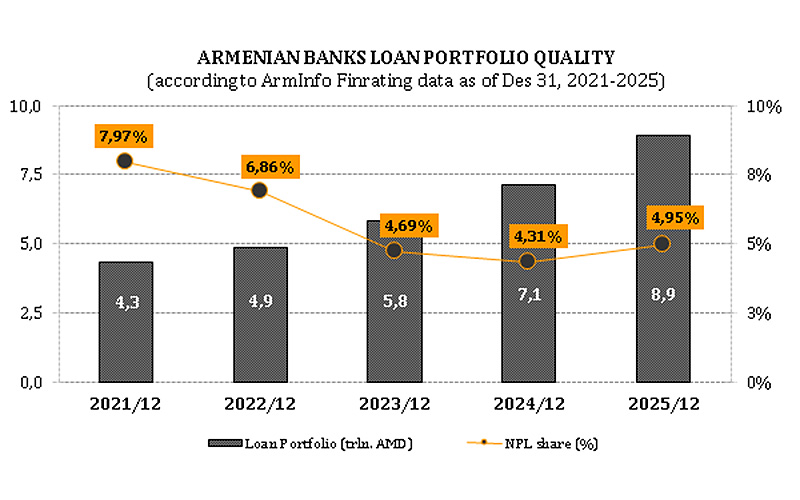



ArmInfo. Situation with loan defaults or, as professionals say, with their classification in the banking system of Armenia is not so favorable. The portfolio of non-performing loans (NPL) has increased by 52% over the year accounting for almost 10% of the total volume of bank loans. Most banks providing retail loans are aware that the general economic situation in the country is worsening, the real incomes of the population are falling making the population less solvent, and the foreign transfers - key factor of our economy – are shrinking. Eventually, they have fundamentally changed their credit policy, seriously curtailed their “risks appetites” and increased risk-management activities. ArmInfo’s correspondent had an opportunity to look into the risk-management activities of VTB Bank (Armenia), one of the biggest banks in the country. In an interview with ArmInfo, Aliona Stratan, Deputy CEO- member of the Management Board of VTB Bank (Armenia) speaks about the situation in the loan market, the crisis-induced behavior of customers, and how the Bank organizes its business process not to lose customers and minimize the risks at the same time.
The heavy economic situation in the country has affected the customers-borrowers, who are not always able to assess their future solvency objectively, which creates risks for creditors. Eventually, the portfolios of banks deteriorate. How do you organize your work to avoid risks?
Our customer base, including the one of personal borrowers, is rather wide. Speaking of the retail sector, we serve about 500-700 customers daily. How to serve them? How to chose the reliable ones? Despite the big number of branches, it is at the head office that the decisions to provide loans to the population are adopted. It is a critical decision connected with the Bank’s group-wide approach to the human factor. About 7-8 people are engaged in application processing and decision-making in the segment of retail lending and they are unable to ensure the application processing within limited time, which sometimes does not exceed 15-20 minutes depending on the product. Therefore, depending on the “risk appetite” for every product and target segment of borrowers, we automatically manage the customer flow. In different periods of time, the flow of customers that could claim loans was different.
Does it mean that you began displaying much stricter approach to the selection of customers eligible for loans?
Sure, much stricter, but these decisions are not made by credit officers, but by a multi-stage scoring system that selects potential borrowers automatically basing on the customer’s social profile - Who is the customer? Where from? Has he education, profession, job etc? It is an absolutely automated selection based on our statistics. It is a well-adjusted scoring system operating at all the banks of VTB Group. Our scoring card is fully adjusted to the Armenian market.
How many factors is that scoring system based on? Is it able to protect the bank against defaults?
The number of these factors depends on the product the system is intended for i.e. there is a special scoring card for every product. The system is able to select such volume and quality of portfolios that will lead to the planed indicators of yield and others. The scoring factors correlate to the portfolio quality and their correlation shows which of the applicants are more prone to default. The level of the factor’s correlation determines its influence and power when processing the customer’s application in the system. Now, in view of crisis developments, the system has been reorganized so that it is able to filter at least 68% of default on the basis of comprehensive statistical data. After all, it is impossible to rule out default. Unfortunately, the more you filter out default prone customers, the fewer loans you issue. That is exactly why retail lending has been shrinking recently in both the banking system of Armenia and at our bank, particularly. In other words, it is impossible to hedge against losses.
Well, is it credit officers that select the customers eligible for loans from the short-listed ones, whose incomes have been confirmed?
No, human factor is removed from this stage too. Credit officers do not influence the decision-making. If a customer complies with the minimal requirements of the product, his credit history is checked automatically so that to avoid this at further stages of the application processing. Afterwards, if the incomes of the customer are confirmed, the system transfers his application to the next stage where it is processed via the scoring card and the limit of the loan products is fixed basing on his incomes and expenses. The size of incomes as such is not that important. The ratio of these incomes to the expected payments is what matters. This is what allowed the system to decide the limit per customer.
It is interesting how that indicator affects the crisis phenomena?
You are quite right. We have a very interesting statistics here. The system rejects more and more applications for loans. The solvency for some products has nearly halved, which means that customers undertake too big burdens. Apparently, the incomes of the population have shrunk and customers more frequently search refinancing at other banks. The loan rejections for a range of products have increased threefold due to bad credit histories of the borrowers.
These toughened measures have aroused discontent of many customers who complain about unfair analysis of their solvency. What do you think about it?
Well, you are quite right. Some customers feel indignant at unfair attitude to them. We have never paid scant attention to it. Customers should understand that we need them, otherwise the bank will not be able to have profits. Therefore, we tried to look at ourselves from outside and reconsidered all the loan rejections for 6 months and tracked the history of rejected customers. Guess what. We found out that 30% of them were classified within 6 months after borrowing funds from other banks i.e. they failed to make the payments. Another 45% of the applicants that were rejected by our system received loan rejection at other banks too. So, basically, our system is efficient and more and less fair to both customers and the bank. After all, it is a high social responsibility to provide loans to the people and know beforehand that they will not be able to redeem it.
The task of a lending factory is not just to find reliable borrowers, but also collect the payments for the issued loans. Is this part of the work automated too? After all, human factor should be removed from this part of the system too.
Our system is designed both to segment customers eligible for loans and collect loan payments. The system adjusts the strategy to every customer in an automated regime of decision-making. The only difference is that the issue of loans unlike collection of loan payments requires no actions from the bank employees. Depending on the strategy, the system requires either contacting a borrower or meeting with him. There is a range of other payment collection instruments.
What do you mean by saying “strategy per customer”? Do you analyze the behavior?
Well, there are three categories of borrowers: legal entities, SME, and privates that are, in turn, segmented into categories depending on abilities. The payment collection strategies are adjusted to these categories. Roughly speaking, these are the people who “want to and can” repay a loan, who “want, but cannot,” who “can, but do not want,” and who “neither can nor want.” There is a category of people who want to pay for the loan, but cannot do it for various reasons: shrinking incomes, loss of job, and personal reasons. His life circumstances have changed, and it is important for us to establish contact with him. We need to know what is the reason of delaying with payments, as we try to find out what has happened to the customer. Along with the strategies of payment collections, we work on a scoring card of payment collection, which will help us separate the customers, who “want to” pay and “can” pay into a category of “self-supporting” customers. If he wants and can, he is happy, he pays, and we have no problems with him and do not have to spend resources to collect payments.
We contact customers and here we deal with a very interesting factor for our market - promise. A customer’s promise is included in the system along with the date of the first payment for the loan. The employee of the relevant unit receives a notification “the customer promised” on that date. We wait for another 3-5 days after that date. If the customer contacts the bank, it means he remembers about his promise and tries to fulfill it, offers certain options. We try to help such customers restructure their debt, if they want us to do it, of course. We try to find out how much and how he can pay. We display a customized approach. We make a new amicable settlement in line with the bank’s procedures basing on the customer’s new incomes, previous promises and his credit history.
What if the customer refuses to come in touch with the bank?
It is a black mark. If efforts to contact him fail, we lost confidence in him and resort to tougher measures. I am speaking about the customers that can pay but do not want to. It means that a customer is solvent and refuses to pay. We confirm this by visiting his place of residence and workplace. Sometimes, such customers sue the bank making absurd allegations against it. There are customers that threaten the bank or warn to complain to Mass Media. Here, I’d like to speak of the features of an insecure person. Such people fail to make even the first payment. They avoid contacts, their phones are always disconnected and their neighbors do not know them. Unfortunately, we have to apply to toughest strategy of fine and penalties to such customers using our toughest measures of money recovery. The most efficient measure for such situations is application to the court. As to the category of the customers who neither can nor want to pay, everything is clear here. It is necessary to quit the process. Inside all this, there is certain segmentation depending on the debt size. The higher is the amount, the more promptly our money recovery measures - contacts, meeting, visits and others - are applied.
What about the human factor?
Here everything is managed by the system. The system decides whether to sue a customer or not. After the terms approved by the bank leadership expire, the system automatically transfers the customer to the next stage. The bank’s lawyer is to initiate proceedings, as the customer is in the “red zone.” No one can make a deal with the customer, various employees work with him at different stages and include data into the system to ensure the right strategy on the customer.
Have you made any corrections to the system amid current solvency crisis?
I have the Financial Ratings of Armenian Banks prepared by your analysis service unit. I have studied the period from the end of 2012. In that period our loan portfolio has increased by some 25%, while earlier it grew 42% within 2 years and we were leaders in the banking system by the average growth of this indicator. We have toughened our system, as the profile of our borrower has changed dramatically. Our credit risk has increased too. This indicator of the banking system keeps growing, but we launched our corrections yet in April 2014. We have changed our approaches to the consumer lending fundamentally. We have become much stricter and much more conservative to our borrowers. The banking system has grown by 33% in average, amid 25%-26% growth of our bank’s portfolio. Improving the quality of the bank charges we have maintained the balance of the reserve costs, recovering twice as much NPL. Eventually, over the last 4 quarters the average quarterly growth of the bank’s NPL totaled 5.8%, amid 9.2% quarterly growth of this indicator in the banking system. We have managed to recover more bad loans. We started giving people more instruments and this really works.
I remember you even announced a campaign for troubled borrowers…
Sure, we announced that the customers who borrowed Lombard loans, particularly gold secured loans, and whose gold was sold, were given an opportunity to repay only 90% for the primary loan, as the bank would write off the penalties and fines. We drafted a repayment scheduled for a year. I was disappointed, as we managed to contact only 58% of that category of borrowers, and only 23% participated in it, while 13% refused from the offer. Another 64% promised to come but did not come. I want them to understand that the bank cannot do impossible things. It does everything it can.
There was splash over some deals and gold-secured loans at the end of the last year. Customers blamed the bank for deceiving them, as they did not know that they borrowed more than their gold cost. The customers refused to pay and suggested the bank to sold their gold. Such customers immediately present themselves as victims and try to press the bank by all means possible, via press and court. Some even addressed the president of Armenia. One even wrote a letter to the Russian president. Meantime, we operate strictly in line with the bank’s regulations and within the laws.
Judging by your reports, the bank has written off many debts…
We wrote off as many debts as it was possible under the financial model of operating in this segment. To introduce new products and accumulate statistics, banks sometimes afford more defaults, which they partly write off later.
Before the crisis, big banks did not avoid working on the basis of the so-called “law of large numbers.” Considering that gold prices were growing and interest rates on consumer loans were high, as a rule, big banks easily covered their losses at the expense of incomes. Now, much has changed…
The market deteriorated then. Banks began issuing gold-secured loans the size of which was much higher than the cost of the collateral. The banks were pirating customers. As a risk-manager I think that this process holds high risks, unless all the factors of the customer’s solvency are checked. Gold is an adequate product, but we provide loans exceeding the value of collateral only to solvent customers.
Do you mean that some banks issue Lombard loans exceeding the value of collateral, with hope that the gold price will start rising again?
Some banks issue loans accounting for 110% of the value of collateral/gold. I think it is because the value of gold is reflected in US dollars. If dollar appreciated against dram, the dram cost of gold will increase consequently.
Please, brief about the loan market per segments.
Well, lending rates shrank in October 2014. In June-July, banks started issuing more loans. This was because the requirements to the mandatory reserve fund were changed drastically. Second, I have already mentioned, the profile of borrowers have changed dramatically.
I have the statistics of overdrafts at hand. In 2013, we rejected only 15% of customers not eligible for overdrafts. Now, we reject 37% of total. Previously, we rejected 5% of customers for bad credit history, not this indicator has increased to 19%, mainly due to low salaries and other incomes. Instead, we now provide consumer loans to 38% of customers without collateral security. Previously, this indicator was 34%. The crisis has not affected this category of customers, as loans without collateral security have always been provided on very tough terms and to reliable customers only. In 2013, 43% of applications for POS-loans were rejected. Now, this indicator has increased to 63%. Two years ago, an army of fraudsters was applying for POS-loans.
What about the situation in the mortgage-lending segment?
Mortgage lending segment is relatively stable, as we have inherently provided mortgage loans at the expense of the resources in the national currency provided by the National Mortgage Company and the Fund Housing for Young Families. We anticipated more from the mortgage sector this year due to the government-launched program. I am speaking of the program under which the income tax is returned if the real estate is bought on the primary market. I think people do not want to sell real estate waiting for restoration of demand. Indicators very much depend on the “risk appetite,” as the consumer behavior has changed tangibly. Doesn’t it mean that the people do not pin hopes with their future in Armenia?
It does, I think. There is overall depression in the country, including in economy. How do you manage the problems in the market of corporate lending? The general statistics of the banking system points at high percentage of NPL.
Let’s look back. The level of NPL in the corporate sector began to grow five years ago, amid stiff competition in the market and customer piracy. Customers were changing their banks in search of better terms of refinancing. It is normal for business, when a company refinances to reduce the debt burden, to get more time to use the borrowed funds or to have the interest rate reduced. However, sometimes it is connected with borrowers’ risks. Banks not always manage to unveil all risks. Actually, the last creditor of such companies falls into a trap, as it agreed to provide loan on preferential terms to gain the customer and, in fact, came off a loser. I think it was a common thing in Armenia and when the competition decreased, many have realized their mistakes. Perhaps, this is why the corporate lending rates shrank and certain number of NPL occurred in the portfolios of banks.
Is it easy for the bank to recover corporate debts?
It is a different story. Sometimes debtor companies resort to amazing tricks. Sometimes, it turns out that a debtor did not visit the bank, did not make any contract and did not receive any loan. Fortunately, we have become more experienced in dealing with such customers. They try to press banks through Mass Media that report about alleged one-sided changes in the lending terms and interests by banks. We often avoid responding to such reports, as all this is not serious. Still, we have a strategy adjusted to every customer and we adhere to it.
The Bank is not interested in leading its customers to the debt pit. Customers are not always guilty in their financial problems. Much depends on the level of demand and consumer preferences, external factors of trade, economic relations and regimes. It is impossible to foresee everything. If a customer perceives the bank as a partner not as an enemy, we do everything possible to find a mutually acceptable solution.