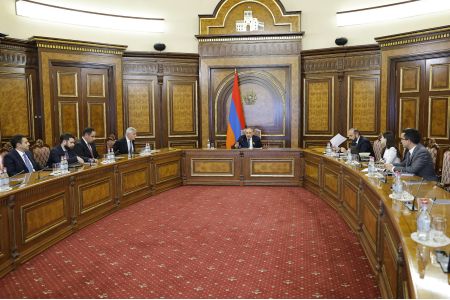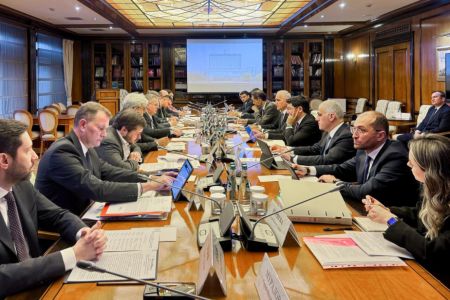


ArmInfo. The second phase of UNIDO Project "Improving Competitiveness of Export-Oriented Industries in Armenia through Modernization and Market Access" has been launched in Armenia. Head of UNIDO Operations in Armenia Anahit Simonyan and Armenian Minister of Economic Development and Investments Suren Karayan signed an agreement on extension of the project on February 14.
Anahit Simonyan said that like the first phase, the second phase is funded by the Russian Government's contribution to UNIDO's budget. She noted that the project envisages improvement of technical capacities and introduction of innovative solutions in design and modeling. "Given the success of the first phase, a decision was taken to double the funding to USD 2 million versus USD 1 million a year before," she stressed.
Minister Karayan, in turn, noted that the second phase of the project involves Armenian enterprises engaged in production of leather goods and footwear with due regard for the high export potential, which is not unlocked to the full extent.
Andrey Ivanov, Advisor at the Russian Embassy in Armenia, said for his part: "Within the framework of the Russia-funded program, tangible results have been achieved over the past short period. The companies involved in the project had an opportunity to cooperate with the best specialists from Italy, Germany, etc. The project allowed considerably improving the competitiveness and attractiveness of the Armenian companies' products. I think the Government of Armenia should take this practice into account," he said.
Ivanov told ArmInfo's correspondent that the successful start of the UNIDO project allowed launching the second phase involving enterprises manufacturing leather goods and footwear, whereas the first phase focused on textile industry. "2.5 years ago we did not know what would come out of it. But today the funding has been doubled and the project will be implemented within 3 years," he said. The Russian Embassy representative expressed confidence about the project efficiency. "It is a great success that now Armenian designers are cooperating with Russian colleagues. I am personally familiar with Mr.Yudashkin. In addition, he is a creative thinker and a high-class professional. And if he is interested in the collection of young Armenian designers, this means that the ideas are really very good and promising. The project has a big future,> Ivanov said. He does not rule out possible implementation of a third, fourth and fifth phases of the project.
He added that such projects will make it possible to promote the Armenian product on the EEU market not only in the industrial sector, but also in all other sectors. "This will be useful not only for Russia and Armenia but also for other EEU member states," he said.
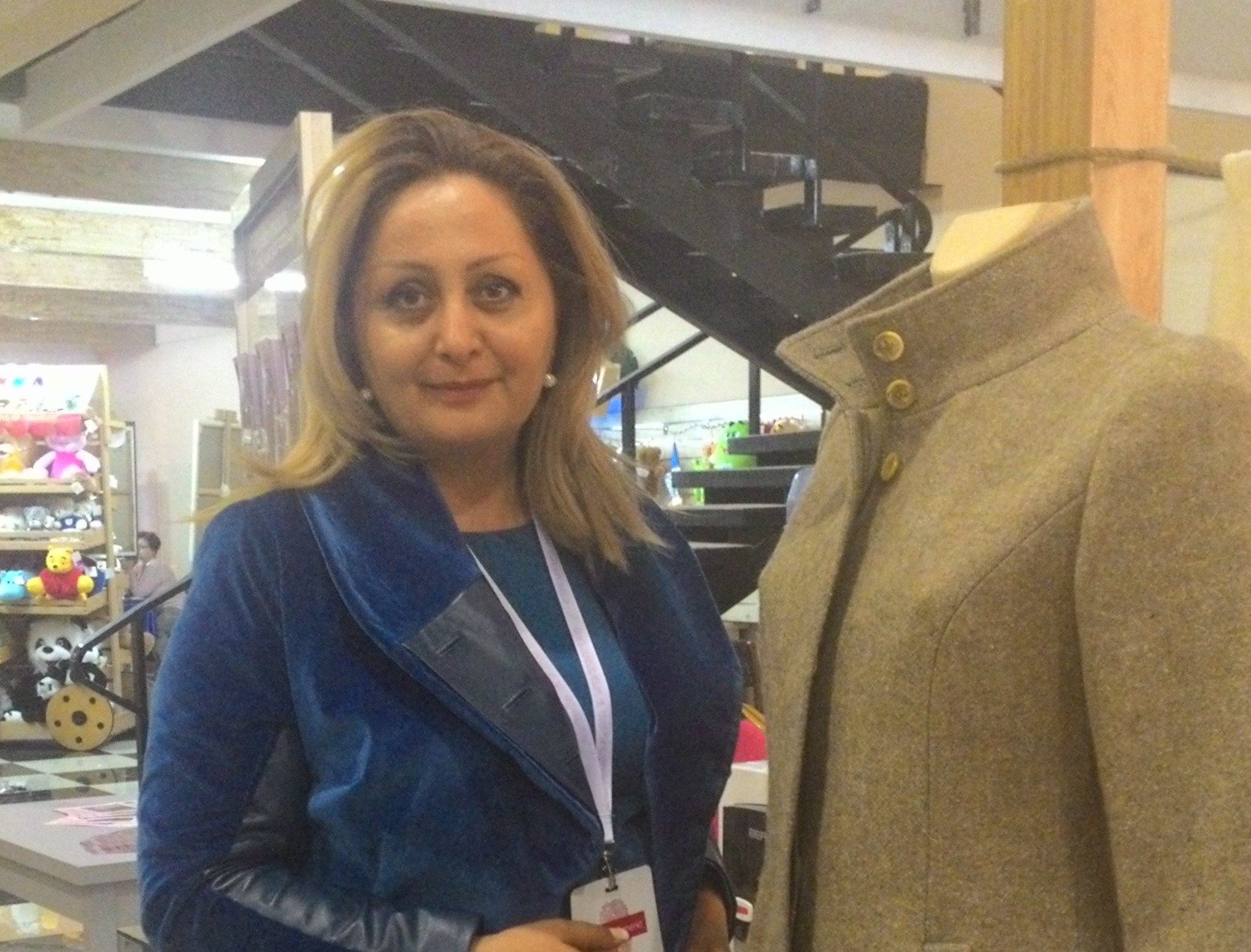
To note, the first phase of the UNIDO Project "Improving Competitiveness of Export-Oriented Industries in Armenia through Modernization and Market Access" was launched in 2014. Eight companies united under a single brand "5900BC" participated in the project to design and produce joint collections of fashionable clothes. In addition, Atex-Burgo fashion school was set up in Yerevan on the margins of cooperation with the Milan-based Burgo fashion institute. In the course of the first phase, contacts were established with over 40 large chains. The Armenian companies are cooperating with 10 of them.
According to the National Statistical Service of Armenia, in Jan-Dec 2016 the clothes output in Armenia grew by 16.4% to 11.5 bln AMD versus 16.8% growth a year before. The textile output dropped by 4.8% to 466 mln AMD versus 13.3% drop a year before. In 2016 the foreign trade turnover between Armenia and Russia amounted to $1.3 bln (up 15.1% versus 2015), with exports rising by 51.5% to $371 million and imports growing by 5.7% to $996 million.