


ArmInfo. The volume of imports of oil products to Armenia increased by 6.8% in 2016 to 318.2 thousand tons, with a 7% decline in value up to $ 198.5 million. This trend is caused by a prolonged sharp decline in prices in the world market of petroleum products. This is evidenced by the data of the Customs Service of Armenia.
According to the source, in the reporting year, 243 kg of oil products were exported for $ 3 million. In quantitative terms, exports of oil products in 2016 were halved, and in value terms, by 98.1%.
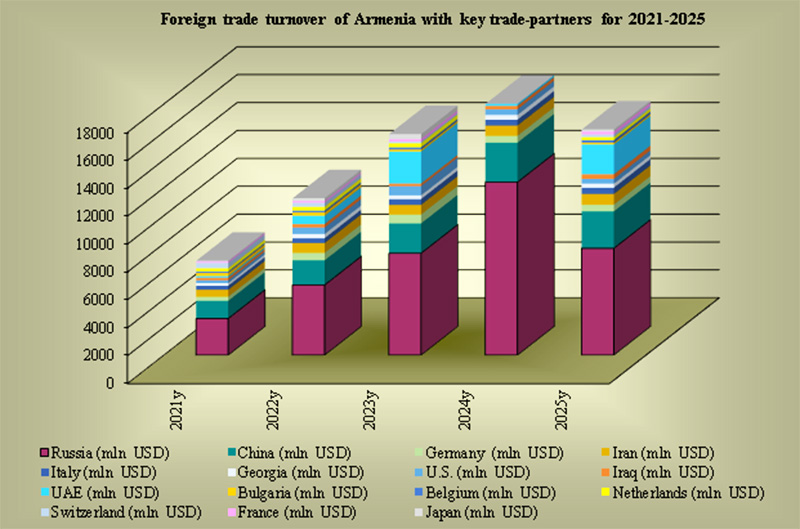
Basically, oil products are imported from Russia (72.4%), Iran (4.2%), Romania (3.5%), Greece (2.7%), Saudi Arabia (2.2%). The export of oil products from Armenia mainly falls to Georgia - 97%, and to a small extent to Poland - 2% and Russia - 1%.
The situation with the export of oil products from Armenia cannot but cause interest, since the country does not have its own raw materials base, but there is an intergovernmental agreement with the Russian Federation on duty-free supplies of petroleum products.
In 2017, within the new indicative balance sheet, the republic will receive 148,000 tons of motor gasoline, of which 123,000 tons are produced in Russia. In addition, it is planned to receive 153 thousand tons of diesel fuel (123 thousand tons of Russian production), 44.6 thousand tons of jet fuel (12.6 thousand tons of Russian production), and 2 thousand tons of paraffin (completely Russian production).
To note, the indicative balance for each year is approved in accordance with the Armenian-Russian intergovernmental agreement of December 2, 2013, which does not provide re-export of products. The growth of world oil supplies is still ahead of the increase in demand, which, according to the famous Italian analyst, Harvard University professor Leonardo Moderi, can cause a new drop in fuel prices. "It's too early to talk about any improvements", the Financial Times quotes him as saying: "If in 2017 we do not see growth in demand, oil prices may experience a significant decline". Oil fell in price by 9% last week, although before that it was trading in a rather narrow corridor. Previously, investors generally ignored the news about the growth of reserves and production in the US and focused on reducing production in the OPEC countries. According to L. Mogeri, the US received the greatest benefit from the OPEC agreement on the limitation of production. The agreement led to a rise in prices, and companies producing oil in the shale deposits in the States were able to restore their business. However, in addition to the United States, there are other major projects in the world that have been put into operation recently or will be working soon, the expert says.