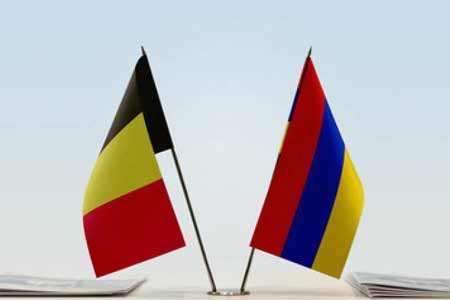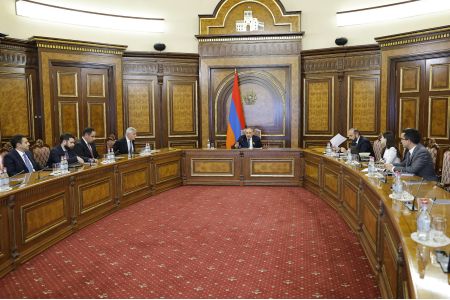
ArmInfo. In Yerevan on April 27, negotiations started between Armenia and the European Union on a comprehensive agreement on the common aviation space. According to the head of the General Department of Civil Aviation of Armenia Sergey Avetisyan, the agreement is part of the policy of the Open Sky approved by the government of the republic in 2013. With the signing of the document, Armenia will have the opportunity to further liberalize the air transportation market, improve the quality of passenger service, and regulate the legal framework. "I think that we will not have to wait long for the agreement," stressed Sergey Avetisyan, adding that the first contacts on the beginning of the negotiation process began as early as 2014.
In his turn, the head of the European Union delegation in Armenia, Ambassador Piotr Switalski stressed the importance of starting negotiations. According to him, the relations between Armenia and the EU are entering a new stage, the results of which will be felt by ordinary citizens of Armenia. Conclusion of the agreement will lead to significant growth of flights, appearance of new European airlines in the Armenian market, reduction of prices for air tickets. In addition, the document could lead to a sharp increase in the number of tourists. "In Armenia, is beautiful nature, which I myself admire, and I am sure that it will be awarded the same rating by tourists from the countries of the European Union," said Piotr Switalski.
A similar point of view has the deputy head of the European Commission's department for the conclusion of aviation agreements Klaus Gale. According to him, both the EU and Armenia are interested in the successful conclusion of the negotiations, as evidenced by the December 1, 2016 EU Council on Transport, Telecommunications and Energy mandate to start negotiations on a comprehensive agreement on air transport with Armenia. The conclusion of the document will allow increasing competitiveness in the Armenian market of air transportation, bringing the legal base closer to international standards. Klaus Gale noted that similar EU negotiations are also taking place with a number of other countries, including with the Eastern Partnership countries. He stressed that Armenia will also have all chances to become an aviation hub that will connect the West with the East and become a transit stopover point. In this context, the parties will provide each other with the 5th aviation freedom, that is, European carriers will be able to carry cargo and passengers not only from their country to Armenia, but also from Armenia to third countries. The same freedom will be granted to airlines from Armenia.
To recall, on December 1, 2016, the EU Council for Transport, Telecommunications and Energy approved the mandate to begin negotiations on the conclusion of a comprehensive agreement on air transport with Armenia. The comprehensive agreement on the common aviation space is aimed at improving the quality of international communications in Europe, providing high-quality services and providing a wider choice for passengers, the EU's report to ArmInfo reads. The agreement is also aimed at increasing competitiveness in the EU aviation industry. The agreement with Armenia will take the form of the Common Aviation Area Agreement, as Armenia is one of the countries with which the EU is building closer ties within its neighborhood policy.
It is reported that the chairman of the council Arpad Er?ek welcomed the decision to start negotiations with Armenia. In his opinion, the agreement will facilitate the dynamic exchange of tourists, the establishment of lower tariffs in the aviation market and will open new opportunities for business. "The agreement will be an excellent example of cooperation between Armenia and the EU in the context of the Eastern Partnership," he said. The Commission will conduct negotiations on behalf of the EU and its member states.
To note, Europe's safe and stable airspace for a long time remained closed to Armenia. The timing of Armenia's accession to the "Single European Sky" was postponed several times. In December 2015, in Brussels, during a meeting between Armenian Foreign Minister and EU High Representative for Foreign Affairs Federica Mogherini, Edward Nalbandian announced Armenia's readiness to sign the Common Aviation Area Agreement with the EU. In recent months, Yerevan has repeatedly stressed its interest in the early start of negotiations. At the same time, the Armenian side noted that it sees no reason for postponing the execution of the mandate.
According to the established procedure, immediately after receiving the mandate, the EC will be authorized to start negotiations with Yerevan. Armenia will be provided with a draft agreement, which, according to the EU, will be the basis for negotiations on accession to a unified airspace. As those responsible for the sphere in Armenia assured, the negotiations will not be long, since there is a basic model format of cooperation with all countries.
The single aviation space of Europe is considered a horizontal agreement, that is, it will automatically come into force for both the EU as a whole and for each of its countries separately. As a result of the accession to this agreement, a more liberal aviation regime will operate between Armenia and 28 EU countries, which will be used by airlines from Armenia and EU countries. In addition to ensuring flight safety and certification regulations, the document provides for the removal of restrictions on the performance of flights of foreign carriers of Armenia, Armenian - to European countries. This will allow, on better terms, to attract European airlines to Armenia, in particular, budgetary ones. Liberalization will also ensure fair competition at the international level through a combination of state aid and regulation of standards. This means integration into the European aviation market, assistance to the entry of Armenian businessmen into foreign markets, becoming an important transit country in the air transport field. From the member countries of the Eastern Partnership, Moldova, Georgia and Ukraine joined the common aviation space.