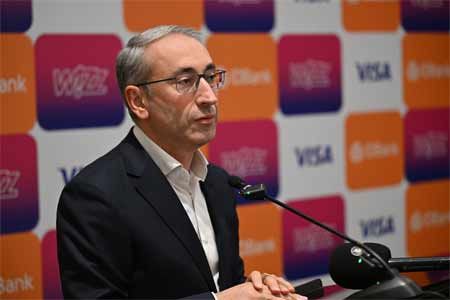
ArmInfo. An International Monetary Fund (IMF) team led by Nathan Porter conducted discussions on the second review of Armenia's reform program supported by the IMF Stand-By Arrangement (SBA) during March 12-April 8, 2020, the press release of the IMF informs. At the conclusion of the mission, Mr. Porter issued the following statement:
''IMF team reaches a staff level agreement with the Armenian authorities for the completion of the second review of Armenia's reform program, which is supported by the IMF. The authorities have requested an increase in financial support provided by the IMF for Armenia and, pending Executive Board approval, around $280 million will be available immediately after the Board meeting.
IMF considers that the COVID-19 pandemic, together with the recent oil price shock and the tightening of global financial conditions, will significantly change Armenia's near-term economic outlook and prompt a deterioration of its external and fiscal accounts. Higher access to IMF financing will help the authorities contain short-term risks and will provide resources to meet urgent medical and socio-economic needs during the peak of the virus outbreak, the IMF report notes.
"We are happy to announce that the IMF team reached a staff-level agreement with the Armenian authorities on the conclusion of the second review under their economic reform program supported by a three-year SBA. The agreement is subject to approval by the IMF's Executive Board, which is scheduled to consider the review in mid-May. The staff will also recommend an increase in IMF financial support for Armenia by SDR128.80 million (about US$175 million), which together with the authorities' intention to draw purchase rights accumulated under the SBA would make SDR 206 million (about US$280 million) available to be disbursed immediately after the Board meeting, Nathan Porter noted.
Such an increase is justified in the context of the urgent balance of payments financing needs resulting from the consequences of the spread of the COVID-19 virus. This financing will be allocated to the budget to help the authorities' efforts in meeting urgent medical and socio-economic needs during the peak of the virus outbreak, thereby preserving the gains in economic potential and inclusion that Armenia has achieved over recent years.
It should be noted that in the same press release, the IMF presented an updated forecast for Armenia for 2020, expecting GDP growth at the level of -1.5%, for the state debt - over 60% of GDP, for the state budget deficit - an increase of up to 5% of GDP. The IMF made such a forecast for the Armenian economy, given the restrictions on internal mobility and activity associated with COVID, significantly lower external demand, more stringent financial conditions and disruptions in global trade and supply chains. And the forecasted 2020 increase in the ratio of the state budget deficit to GDP is caused by a decrease in income and an increase in spending on health care and economic support.
To recall, a year earlier, on May 17, 2019, the International Monetary Fund (IMF) approved providing Armenia with a stand-by credit line for the three-year "transit period" in the amount of SDR 180 million (equivalent to almost $ 248.2 million) or about 139.75% of Armenia's quota in IMF. Out of this amount, it was planned to immediately receive 25.714 million SDR (equivalent to almost $ 35.5 million), and the provision of the rest was provided on the basis of six semi-annual estimates.
These loan funds are aimed at strengthening the economic foundations and policies of Armenia, as well as conducting structural reforms, in particular, improving management efficiency and improving the business environment. This loan was provided to neutralize macro-risks, namely, internal "transit" risks and possible external shocks caused by the possible increase in sanctions against Armenia's main trading partner, Russia, creating uncertainty, both in terms of a possible "subsidence" of production and export volumes, as well as the plan of risks of reducing the transfer component of the economy. The ability of these factors to influence the level of aggregate demand and create certain imbalances in the country's balance of payments was taken into account.