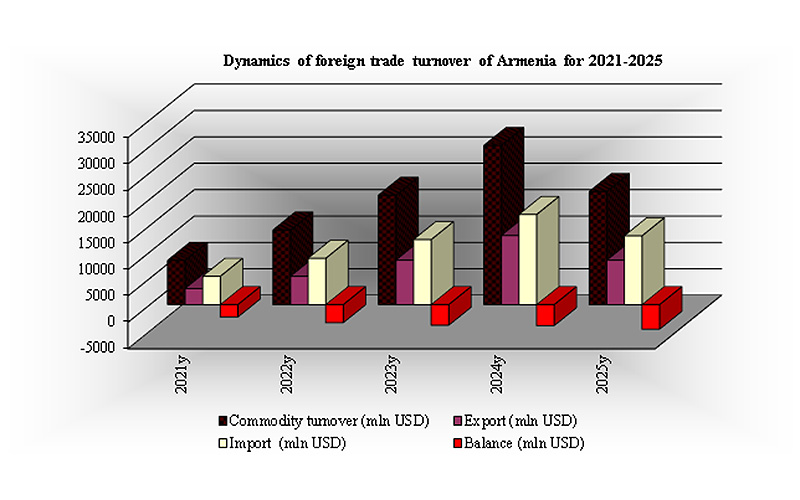


ArmInfo. A more impressive decline in imports than exports reduced the foreign trade deficit of Armenia in January-May 2020 by 18% per annum. At the same time, in May alone decline of this indicator amounted to 23.1%, against the background of high export growth with a modest increase in imports. And in May 2020, compared with May 2019, the foreign trade deficit decreased by 35.4% as a result of a significant decline in imports with a modest drop in exports.
According to preliminary data of the Statistical Committee of Armenia, in January-May 2020, the foreign trade turnover of Armenia accelerated the decline to 11.2% from 2.6% a year earlier, due to the acceleration of the y-o-y decline in imports from 3.4% to 12.8% and exports from 0 , 9% to 8.1%. As a result, the foreign trade turnover of Armenia amounted to 1227.6 billion drams ($ 2539.2 million), in particular export - 428.5 billion drams ($ 886.2 million), import - 799.1 billion drams ($ 1653.0 million), which created a foreign trade deficit at the level of 370.6 billion drams ($ 766.8 million).
In May 2020 alone, foreign trade turnover increased by 13% due to a significant increase in exports by 30.7% and a modest increase in imports by 4.3%. As a result, the deficit of foreign trade of Armenia in May 2020 amounted to 58 billion drams ($ 120.4 million), this time falling more significantly (23.1%) than in the same month of 2019 (7.3%). A year earlier, in May 2019, foreign trade turnover was in decline by 2.2% due to the downward trend in both imports (3.3%) and exports (0.1%).
In y-o-y terms (May 2020 to May 2019), the decline in foreign trade turnover by 17.3% was largely triggered by a decline in imports by 21.8% rather than exports - by 8.7%. A year earlier, in May 2019, by May 2018, imports were in a more modest decline (10.5%), and exports showed an increase of 11.7%, which restrained foreign trade from a larger drop, recording only a 3.9% decline.
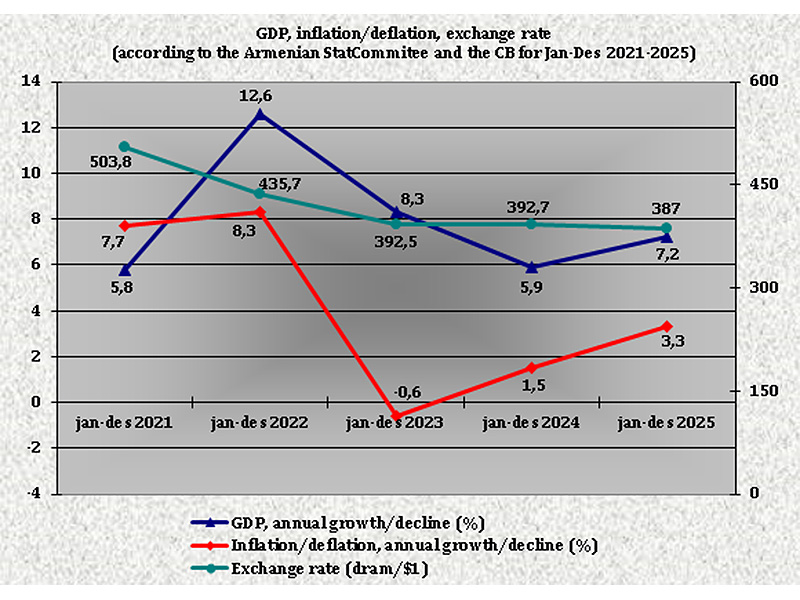
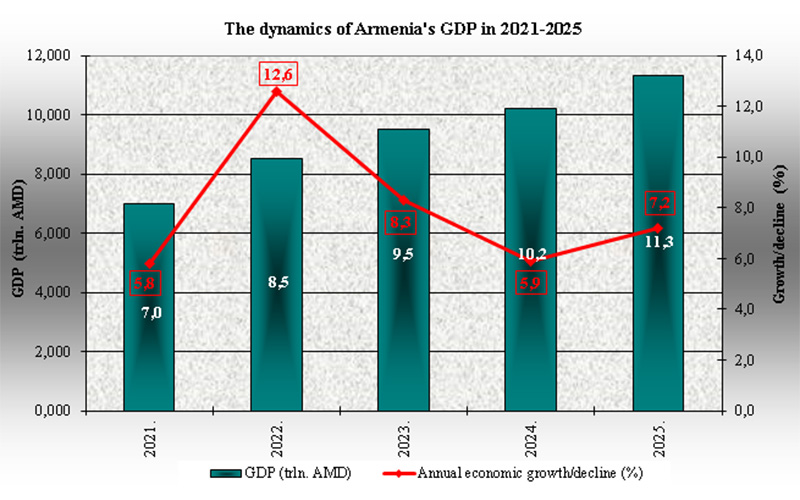
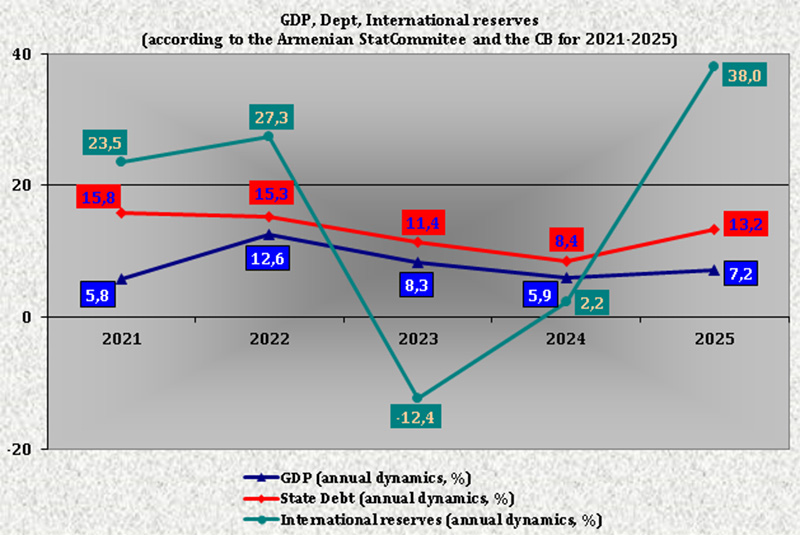
According to statistical data, the economic activity of Armenia in January-May 2020 decreased by 3.9% per annum, compared with an increase of 7.3% in the same period of 2019. In May 2020 alone, economic activity increased by 13.3%, after a decline of 13.5% in April and against an increase of 8.4% in May 2019. In y-o-y terms (May 2020 to May 2019), economic activity decreased by 12.8% (against an increase of 7.3% in May 2019 compared to May 2018).
It should be noted that according to new (June) forecasts of the World Bank, the decline in Armenia's GDP in 2020 will be 2.8%. As for Armenia's foreign trade, the WB in the previous forecast (May) expected a 2020 drop in exports and imports by 1.5% and 2.6%, respectively. The IMF in its April forecast expected a 1.5% drop in GDP for Armenia for 2020. According to forecasts of the RA Government for 2020, the decline in GDP will be 2%. The forecast of the Central Bank of the Republic of Armenia (March) portends a slowdown in GDP growth in 2020 to a stagnant 0.7% (from the actual 7.6% growth in 2019).
To recall, in Armenia, on March 16, in connection with the coronavirus pandemic, a state of emergency was introduced, which will last until July 13 inclusive. As part of the measures to prevent the spread of the pandemic, many activities in the first month of the emergency were temporarily banned (including restaurants, cafes, bars, casinos, hotels, canteens, retail outlets and industries not related to food and medical products). As part of the ban, public transport (including the metro) was suspended in the republic and the movement of other vehicles (except for taxis) was restricted, and international aviation, rail and bus services were limited. The ban was partially lifted in the second half of April, then from May 4 the list of permitted types of economic activity was further expanded to ensure the vital functions of the economy, and from May 18 the ban was lifted almost completely. From the same day, public transport (including the metro) and many public catering facilities and services began to operate, but so far the activities of international air, rail, and bus services have been limited.