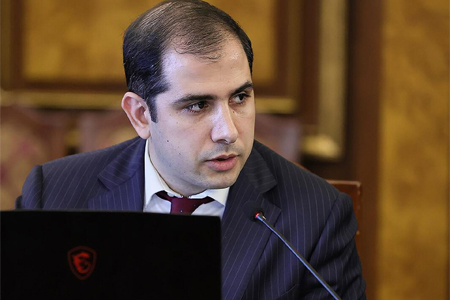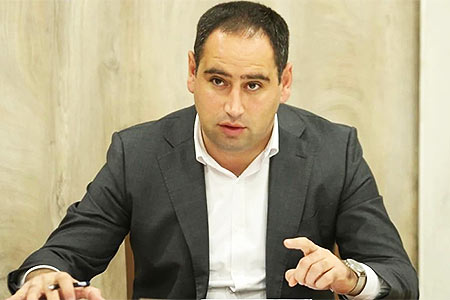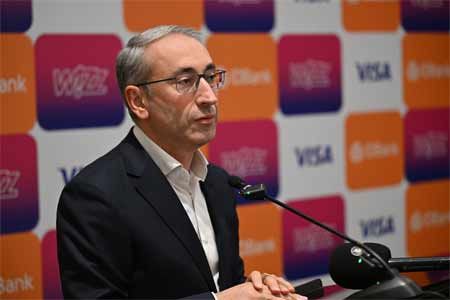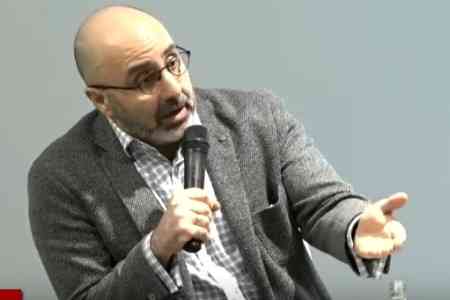
ArmInfo. For several years now, global economic trends have been distinguished by the shift of international investment flows from developing countries towards developed ones, and Armenia should take this circumstance into account, improving the macro conditions to improve the investment environment and attract foreign investment. A well-known economic analyst, Head of Management Advisory Services at Ameria Group of Companies Tigran Jrbashyan expressed this opinion today at a press conference.
According to him, the government and the Central Bank should have corrected their monetary policy long ago and abandoned stereotypes of unjustifiably low inflationary environment, critically low interest rates and a stable exchange rate. In such conditions, the analyst noted, for such a small economy as Armenia, the incentives for export-oriented production are suppressed and the already low level of productivity declines even more. According to Jrbashyan, the monetary policy should provide an opportunity for economic agents to remain in competitive positions with the producers of trading partner countries, especially in foreign markets. With low labor productivity, and by this indicator Armenia does not yield only to Kyrgyzstan in the region, a soft monetary policy will help not only increase the potential of producers, but also provide an opportunity for the modernization of fixed assets.
According to the expert, the issue of productivity concerns not only exporters, but also the construction sector, which technologically and resourcefully lags far behind international work standards. For this reason, the construction sector is suppressed in its development, although it has a fairly strong investment potential.
As a result, in today's coronavirus crisis, when the state is the main customer in a variety of infrastructure projects aimed at mitigating the consequences of this crisis, contractors were not ready to efficiently absorb major government infrastructure orders. As a result, the budget capital expenditure plan is fulfilled by 60%. "The economy of Armenia must be seriously technologically modernized in order to increase the level of productivity. So, the key to the growth of domestic and foreign investment is in our hands>, the economist emphasized, noting that the crisis, together with all the troubles, disadvantages and risks, gives the country the opportunity to resolve a number of important tasks, which will improve the economy.
The economist, however, positively assessed the government's 24 anti-crisis programs, adopted to mitigate the consequences of the coronavirus pandemic. This led to the fact that the decline of the country's GDP was not as strong as predicted. "Another question is that we do not have institutional solutions for anti-crisis management. We made decisions along the way, as problems appeared, so many government measures were delayed, "Jrbashyan said. In his opinion, the government needs to resolve the issue with the development and implementation of the so-called anti-crisis management model, especially since this is not an Armenian problem, since the world economy has already entered the turbulence zone and this state will accompany it for a long time. This will allow tracking internal and global trends and, in the event of risks, smoothly transfer the country from a normal management regime to an anti-crisis management regime.