

ArmInfo.The industry of Armenia summed up the past 2020 in a negative trend. According to official statistics, industrial production in the country fell by 0.9% over the year, amounting to 2.070 trillion drams in absolute figures ($ 4.2 billion), against a 9% growth registered in 2019.
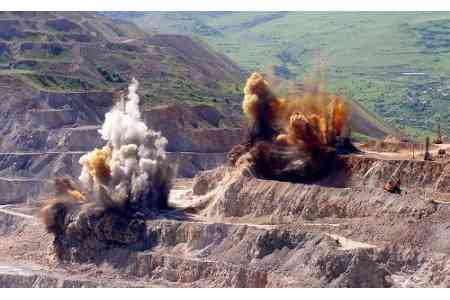
The change from the upward dynamics to the downward one was triggered mainly by the slowdown in the growth rate of the mining sector and the recession in the manufacturing industry that has been continuing since March.
Nevertheless, according to statisticians, in December 2020 alone, industrial production increased by 14.4% (against a 5.8% decline in December 2019) with a volume of 238.2 billion drams ($ 459 million). In the mining industry and open pit development in 2020 compared to 2019 an increase of 11.6% was recorded - to 403.1 billion drams, but the growth rates dropped significantly. A year earlier, the growth was 23.9%. In December alone, the mining sector provided a volume of 39.9 billion drams with a monthly growth of 2.1%, with an annual growth of 0.4%.
The volume of the manufacturing industry fell by 3.9% over the year (against growth by 7.6% a year earlier) - to 1.4 trillion drams, of which 170.3 billion drams fell in December, having increased by 17.7% over the month (with an annual decline of 7.3%).
Moreover, in the manufacturing industry the growth in volumes in 2020 was recorded in the production of pharmaceuticals (by 23.6%), electrical equipment (by 22.2%), finished metal products (by 20.6%), chemical production (by 14.5%), furniture (by 13.7%), basic metals (by 9.4%), other non-metallic mineral products (by 9.3%), clothing (by 4.3%), machinery and equipment (by 2.8%).
At the same time, decline was recorded in the textile industry (by 31.6%), printing activities (by 23.7%), the production of cigarettes (by 19.7%), jewelry (by 13.3%), beverages (by 12, 9%), computers, electronic and optical equipment (by 9.2%), rubber products (by 7.2%) and food (by 0.4%). In the manufacturing industry, the leaders in terms of production are food (536.3 billion drams), basic metals (190.9 billion), drinks (163.1 billion drams), cigarettes (152.3 billion).
According to statistics, the dynamics of the supply of electricity, gas, steam and air conditioning in 2019 from stagnant 0% turned into 0.1% growth, amounting to 257.8 billion drams. In December alone, an increase of 14.4% was recorded - up to 26.3 billion drams. Moreover, the generation, transmission and distribution of electricity decreased by 0.4% over the year (with an increase of 8.4% in December), while the production of gas, the distribution of gaseous fuel through the gas supply systems increased by 2.8% (with an increase of 35.6% in December).
Revenues from water supply, waste treatment and processing, and production of secondary raw materials decreased by 13.9% in 2020 (against 3.1% decline a year earlier) - to 21.4 billion drams, with a decline of 8.1% in December - up to 1.6 billion drams. Moreover, the deterioration of the dynamics is largely due to the decline in the segment of collection, processing and disposal of waste by 60.5%. It should be recalled that the volume of industrial production in Armenia in 2019, compared to 2018, accelerated growth to 9% (against growth in 2018 by 4.3%), amounting to 2.104 trillion drams ($ 4.4 billion). The acceleration of upward dynamics was provoked by the recovery of the mining sector from the recession, while the manufacturing industry continued to grow.
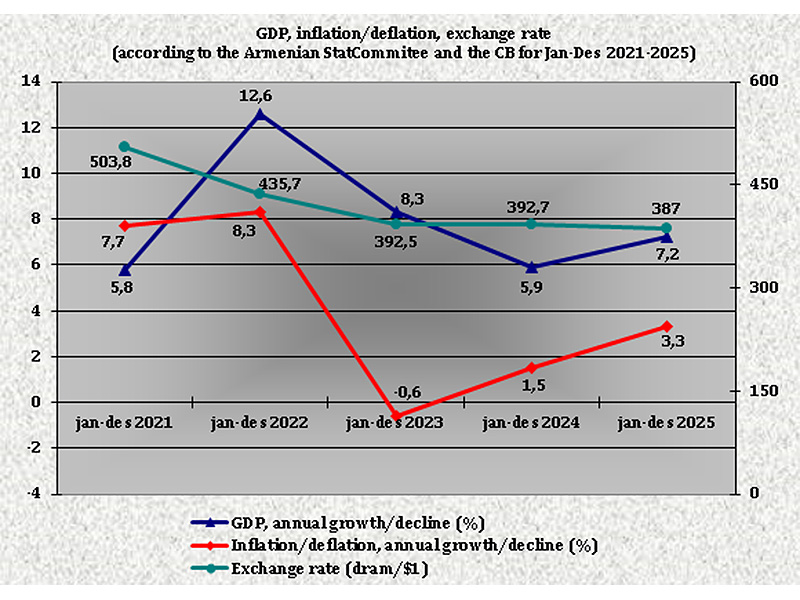
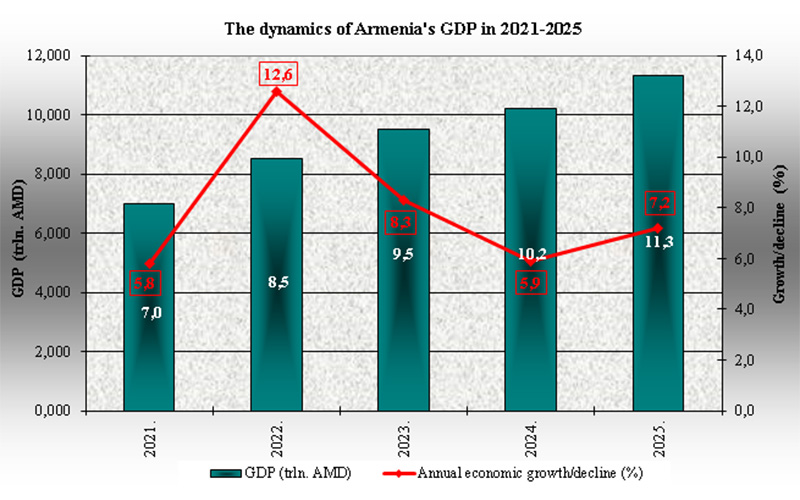
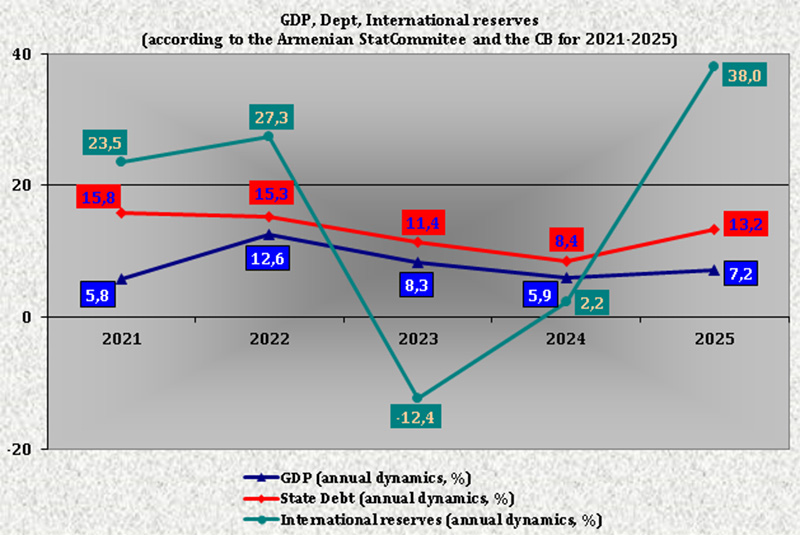
To recall, the economic activity of Armenia in 2020 decreased by 7.5%. Growth is laid in the state budget of Armenia for 2021 GDP by 3.2%. According to the forecast of the Central Bank, Armenia should have end 2020 with an economic decline of 7.8%, with the following 2% growth in 2021. The aggravation of the epidemiological situation, which entailed a number of restrictions in economic activity and the 44-day war in Artsakh, had a strong impact on the final indicators.