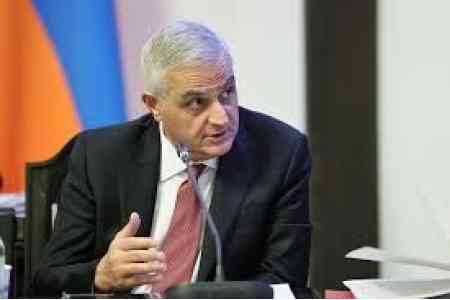
ArmInfo.The World Bank offered the Ministry of Economy of Armenia to identify the fields in need of assistance. As the press service of the department told ArmInfo on March 4, this recommendation was made by Sebastian Molineus, the World Bank Regional Director for the South Caucasus, during his visit to Armenia and a meeting on March 3 with RA Minister of Economy Vahan Kerobyan.
In particular, S. Molineus suggested identifying those fields, legal regulations, directions or programs in which the World Bank can render assistance to Armenia.
During the meeting, the parties discussed the progress of the programs implemented with the assistance of the WB in the areas of public investment management, partnership between the state and the private sector, infrastructure development, agriculture and tourism.
V. Kerobyan briefly presented to the WB regional director the current development of the Armenian economy and the priorities outlined by the government, which are taken into account in the new economic policy being developed by the Ministry of Economy, which is at the final stage of preparation.
The meeting ended with a mutual agreement of the parties to continue discussions in order to determine new programs in the field of water infrastructure development, and other areas of cooperation.
To note, according to the new forecast of the World Bank for 2021, GDP growth in Armenia will be 3.1% with an acceleration in 2022 to 4.5%. According to the Statistical Committee of the Republic of Armenia, in 2020, Armenia's GDP decreased by 7.6% (against 7.6% growth in 2019), against the background of a decline in exports and imports by 3.9% and 17.7%, respectively. Of the sectors of the economy, only the energy complex and the agricultural sector showed growth - a scanty 1.2-1.4%, and the rest fell into recession, and - the service sector and the trade sector (14.7-14%) demonstrated the deepest decline. Consumer inflation reached 3.7% in 2020 (versus 0.7% in 2019).