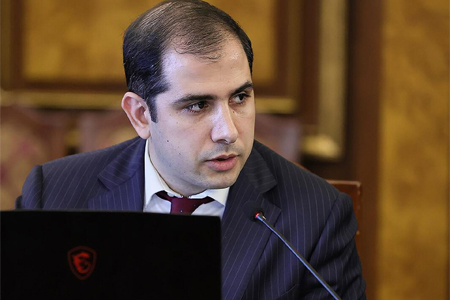
ArmInfo.The RA Central Bank continues to expect inflationary influence on the Armenian economy from the external sector. The Chairman of the RA Central Bank Martin Galstyan announced this on March 16 at a press conference.
He explained this by the fact that, under the influence of positive expectations of a recovery in global demand and a number of supply factors, price growth trends were recorded on the international markets for raw materials and food products. "It also contributes to the formation of a higher than expected inflationary background in partner countries," he remarked.
The head of the Central Bank of Armenia informed that in the 4th quarter of 2020, the economic recession in Armenia to some extent exceeded the level predicted in the previous monetary policy program, mainly due to the reduction in activity in the service sector and the agricultural sector. To this, he added that in the first quarter of 2021, low economic activity is still preserved, under the influence of the continuing decline in the volume of services due to weak demand and low private consumption.
"Despite a weakly expanded fiscal policy, amid continuing uncertainties and a slowdown in lending growth, it is predicted that domestic demand will remain moderate in the near future. In such conditions, the Central Bank Council does not expect inflationary impact from the domestic economy," he said. Back in December, the Central Bank Council, predicting a certain acceleration of inflation and inflationary expectations due to supply factors, significantly tightened monetary conditions (raising the refinancing rate by 1 percentage point - from 4.25% to 5.25%, and later starting from February 2021 raising by another 0.25 p.p. to 5.5% -ed. note). The Council of the Central Bank, taking into account the above and the continuing weak demand, considered it expedient to keep the refinancing rate at the same level (at 5.5% - this decision was made on March 16 this year - ed. note).
The Board of the Central Bank is unanimous in the opinion that monetary policy will be aimed at neutralizing any risk of accelerating inflation expectations, if possible without prejudice to the recovery of domestic demand. In such conditions, the Central Bank predicts that 12-month inflation, after a certain acceleration, will decrease towards the end of the forecast horizon and stabilize near the target level of 4%. The Council of the Central Bank believes that, in conditions of high uncertainty of economic prospects, the risks of inflation deviating from the projected medium-term rate are balanced, and if they occur, the Central Bank is ready to react accordingly to ensure price stability.
At the same time, it was mentioned that in February 2021 inflation was recorded at 0.6%, against deflation of 0.2% in February 2020. As a result, 12-month official inflation and real inflation increased and by the end of the reporting month amounted to 5.3% and 5.5%, respectively, which was mainly due to the influence emanating from international commodity markets and from the depreciation of the AMD.
To note, according to the new forecast of the Central Bank of Armenia, GDP growth in Armenia for 2021 is underestimated to 1.4% from the previously expected 2%. And according to the January forecast of the World Bank, GDP growth in Armenia in 2021 will be 3.1%. The state budget of Armenia for 2021 provides for a GDP growth of 3.2%. According to the RA Statistical Committee, the decline in Armenia's GDP in 2021 amounted to 7.6%, in particular, the services and trade sectors reduced volumes by 14.7-14%, the industrial sector - by 0.9%, the construction sector - by 9.5%, while the agricultural sector and the energy complex were in weak growth by 1.4-1.2%.