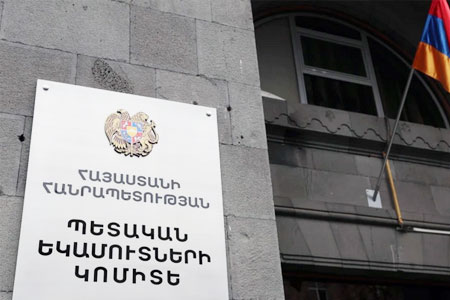
ArmInfo. For the second time this year, the Central Bank of Armenia announces its intention to intervene in the foreign exchange market to ensure the normal operation of the financial sector. This is stated in the statement of the Central Bank of the Republic of Armenia issued on April 8.
The report also notes that the Central Bank of Armenia continues to monitor the financial markets and, if necessary, will use all the tools available in its arsenal, ensuring price stability and financial stability. Note that the Central Bank's previous announcements of its intention to enter the foreign exchange market with interventions were made in 2020 on November 24 and December 15, and in 2021 on January 13. Prior to this, a noticeable devaluation of the dram in the retail foreign exchange market of Armenia began to be observed from the second decade of October 2020, with the approach of November 18 close to the mark of 500 DR/$1 on average, and the next day the dram exchange rate against the dollar already exceeded 501 DR/$1, and by November 23 reached 507 DR / $1 on average, continuing to weaken more pronounced. So, on November 24, the dram rate against the US dollar jumped to 516 DR/$1 on average, against the euro-to 612 DR/1 euro, and against the ruble rose moderately to 6.9 DR/1 ruble.
However, after the Central Bank announced its intention to intervene in the foreign exchange market on November 24, a slow strengthening of the dram has already been observed since November 26, and by December 1, the dram strengthened against the dollar to 507 DR/$1 on average, against the euro-to 607 DR/1 euro, and against the ruble - to 6.7 DR/1 ruble, continuing this attitude on December 2 - to 506.5 DR/$1 and 605 DR/1 euro, respectively, and "frozen" against the ruble at 6.7 DR / 1 ruble. But since December 3, the dram has again devalued to 511.5 DR/$1, 619 DR/1 euro and 6.9 DR/1 ruble, with the continuation of this trend in the following days, and by December 11, the dram weakened against the dollar to 521.5 DR/$1, against the euro - to 634 DR/1 euro, against the ruble - to 7.2 DR / 1 ruble. And on December 15, the dram devalued against the dollar and the euro to 528 DR/$1 and 640 DR/1 euro, while maintaining its position against the ruble. After the repeated announcement of interventions and high activity on the foreign exchange interbank market during the last decade of December 2020, the dram was set to strengthen, revaluing by December 29 against the US dollar to 522.5 DR/$1 on average, against the euro-to 639 DR/1 euro, against the ruble - to 7.1 DR / 1 ruble. As a comparison, we note that at the end of 2019, the dram exchange rate against the US dollar was 479.3 DR/$1 on average, against the euro-531 DR/1 euro, against the ruble-7.7 DR/1 ruble.
After the Central Bank announced its intention to intervene on January 13, 2021, by January 29, the dram against the US dollar strengthened to 518.5 DR/$1 on average, against the euro-to 627 DR/1evro, against the ruble - up to 6.9 dr/1 ruble. But the dram's renewed devaluation in February weakened it to 531.8 DR/$1 on average against the US dollar by the end of March. The devaluation mood of the dram in the retail foreign exchange market continued in the following month, which weakened it by April 8 against the US dollar to 540.5 DR/$1 on average, against the euro-to 640.5 DR/1 euro, against the ruble - to 7.1 DR/1 ruble.
According to the Central Bank of the Republic of Armenia, in January 2021, the Central Bank of the Republic of Armenia intervened in the foreign exchange market for a total of $46.8 million-completely on sale. For the whole of 2020, the Central Bank intervened for a total of $328.750 million, of which $90.9 million was bought (January-February and April) and $237.850 million was sold (March-April, November-December). And if in January-February interventions in the foreign exchange market were exclusively for rbuying, and in March-only for selling, then in April the Central Bank made operations for both buying and selling (sales volume almost 2 times exceeded the volume of buying - $57 million against $33.1 million), and in November-December the Central Bank made operations only for selling in the amount of $110.850 million. In May-October, the Central Bank did not intervene.