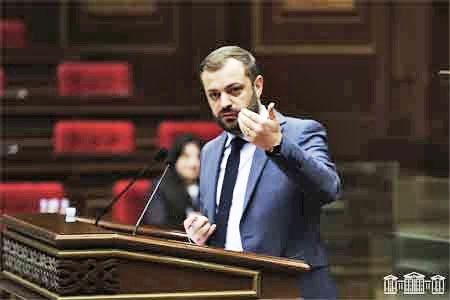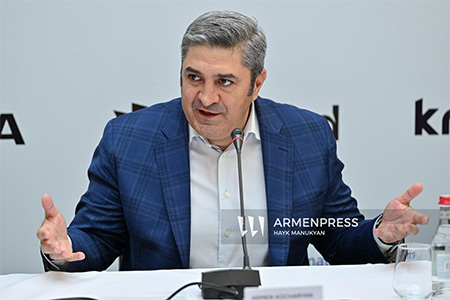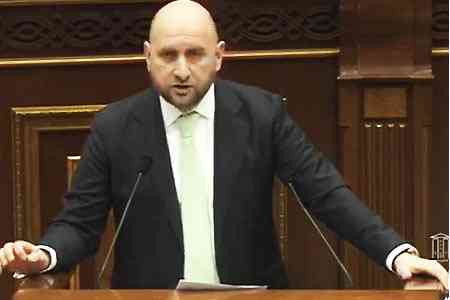
ArmInfo. The Central Bank of Armenia attaches importance to pursuing a countercyclical (stabilization) policy in the current economic situation to mitigate negative consequences and maintain macroeconomic balance. On June 1, Governor of the Central Bank of the Republic of Armenia Martin Galstyan stated this in the parliament during the preliminary discussions of the annual report on the implementation of the 2020 state budget.
M. Galstyan noted that in this context, the Central Bank considers it a priority in the coming years, through continuous implementation of fiscal adjustments, to stabilize the state debt at the level envisaged in the medium-term program and to consolidate the solid foundations of sustainable economic development.
He noted that government debt increased by 13% in 2020 - to 63.5% of GDP, exceeding the threshold of 60% set by the state budget. "Moreover, in the structure of the state debt, the share of domestic debt continued to increase, and it is noteworthy that this was accompanied by a decrease in interest rates, which was facilitated by an expansive monetary policy," he noted.
M. Galstyan stressed that the effective correlation of expansionary fiscal and monetary policies in 2020 made it possible to ensure macroeconomic stability. This is a very important achievement given the challenges of 2020 and the magnitude of their implications. At the same time, fiscal policy, as in the rest of the world, in order to quickly respond to the socio-economic problems caused by the pandemic, was implemented in Armenia by a significant increase in public debt, with a deviation from the level outlined in the medium and long-term programs.
He also added that the Central Bank attaches importance to the introduction and further improvement of the public investment regulation system in order to increase the long-term economic efficiency of capital expenditures.
It should be noted that according to the March forecast of the World Bank, the national debt of Armenia will grow in 2021 to 70.8% of GDP, with a slight decrease in 2022 to 70.6% of GDP, with the GDP growth projected by the World Bank for these years by 3.4% in 2021 with an acceleration to 4.3% in 2022.
According to the May forecast of the IMF, the gross external debt of Armenia, which already in 2020 exceeded the volume of GDP to 103.5%, will continue to prevail over GDP both in 2021 (107%) and in 2021 (105.1%). In particular, according to the IMF forecast, the gross debt of the Armenian government will reach 69.9% of GDP in 2021, and then in 2022 it will modestly decrease to 68.8% of GDP. And this is despite the 1% GDP growth projected by the IMF in 2021, with an acceleration in 2022 to 3.5%. According to the Statistical Committee of the Republic of Armenia, the decline in Armenia's GDP amounted to 7.4% in 2020 - to 6.182 trillion drams, against 7.6% growth in 2019. The state debt of Armenia grew in 2020 by 8.8% to $ 7.97 billion, as a result of an increase in both external debt by 4.6% to $ 6.05 billion and domestic debt by 24.6% to $ 1.92 billion