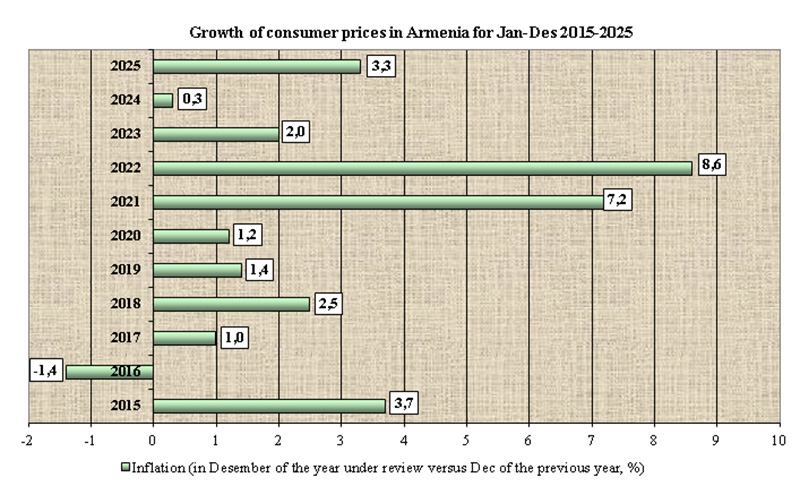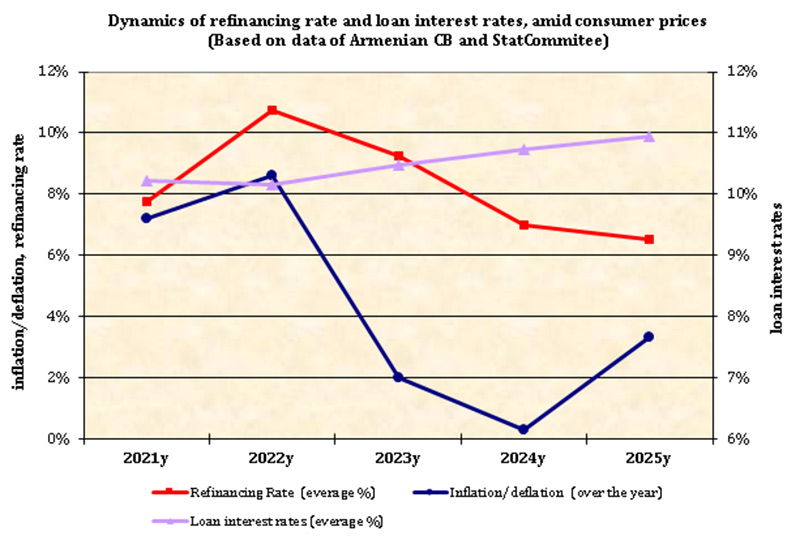



ArmInfo. In Armenia, in August 2021, the official y-o-y inflation calculated by the Statistical Committee exceeded the y-o-y real inflation calculated by the Central Bank - 8.8% versus 8%, respectively. In July 2021, the y-o-y official inflation also exceeded real inflation, but less noticeably - 8.2% versus 8.1%. And in the previous months of this year, on the contrary, the real y- o-y inflation exceeded the official one.
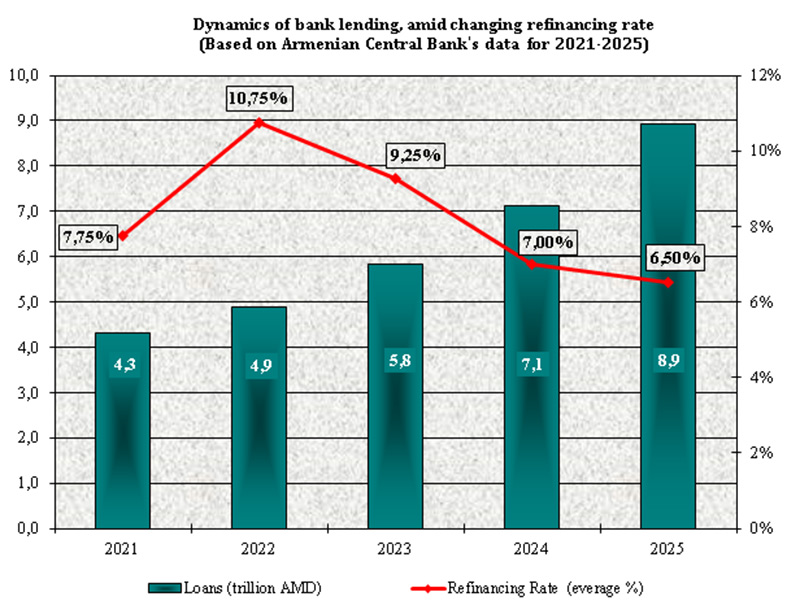
With inflation continuing to accelerate in 2021, it is not surprising that the Central Bank, committed to ensuring price stability, is raising the refinancing rate for the fifth time this year - to 7.25% in September from 5.25% in December. In other words, the Central Bank, being consistent in neutralizing the risks of accelerating inflationary expectations in parallel with an increase in domestic demand, considered it appropriate to tighten monetary conditions. According to the Central Bank's forecast, 12-month inflation will remain at a high level until the end of 2021, then it will gradually decrease and in the forecast horizon will stabilize near the target of 4%.
According to the Statistical Committee of the Republic of Armenia, prices for food products (including alcohol and cigarettes) increased in August 2021 compared to the same month of 2020 by 14.5%, for non- food products - by 9.4%, and tariffs for services - by 1. 8%. Moreover, in the group of food products, the most noticeable rise in price in y-o-y terms was observed: vegetables - by 66.4%, sugar and granulated sugar - by 36.2%, vegetable and animal oils - by 29.1% (with an increase in prices for sunflower oil by 61.9%), fish and seafood - by 25.5% (with an increase in prices for trout by 29.3%), dairy products, cheese and eggs - by 12.2% (with an increase in prices for eggs by 46, 5%), cigarettes - by 10.4%, meat products - by 9.9% (with an increase in pork prices by 40.3%), and alcohol - by 8.7%. Among non-food products, gasoline and diesel fuel rose most significantly in August - by 47.5% and 44.3% per annum, respectively, and in 8 months of this year alone - by 35.1% and 41.7%. The growth of tariffs for services in August especially distinguished the transport sector - by 10% per annum, and healthcare - by 5.3% per annum, against which the restaurant / hotel business and the education sector looked more modest with a rise in the price of services by 2.6-2.1 %.
To note, the difference in the calculation methodology is that the Central Bank of Armenia calculates real inflation (monthly), adjusted for seasonal fluctuations of a separate list of goods and administratively regulated services. As a rule, in the list of food products these are fruits and vegetables, price fluctuations for which have a pronounced seasonal character. In non-food products, it is the fuel (except for gasoline), the dynamics of prices for certain types of which, in addition to the seasonal factor, is subject to administrative influence. And from the group of paid services to the population, these are those types, the formation of prices for which is carried out, as a rule, under the influence of administrative decisions of the authorities (certain passenger transport services, communication services, practically all types of housing and communal services, certain types of legal services, banks, funeral services, etc.). It should be noted that the list of the most volatile and seasonal goods and services always includes fruits and vegetables and, with rare exceptions, fuel and electricity.
And the Statistical Committee of the Republic of Armenia calculates monthly inflation on 425 items of goods and services, and information is collected from about 8000 trade and service objects. Basic objects of price monitoring are divided into 3 conditional groups, and in each of them price monitoring is carried out once a reporting month (on the 1st, 10th, or 20th, or on the days closest to these dates), with the exception of fresh fruits, vegetables and fuel (gasoline and diesel fuel), for which prices are monitored 3 times a month (on the 1st, 10th, 20th, or on the days next to these dates). In the surveyed cities of 10 regions of the republic and in the capital, monitoring of prices and tariffs for each product and service is carried out in pre-selected 6-12 basic objects of trade and services. Moreover, these objects are selected taking into account the degree of their saturation and consumption in the consumer market, relevance, respectability, etc., paying attention to their technical characteristics (unit of measurement and other necessary features). Based on the price information base, the final consumer price index is calculated, according to the Classification of Individual Consumption According to Purpose (COICOP), calculated for 12 sections (2 levels of classification), 44 groups (3 levels of classification), 94 classes (4 levels of classification), and 188 subclasses (5 levels of classification). The CPI is calculated using a modified Laspeyres formula.