


ArmInfo. In Armenia, the specific debt burden per capita continues to grow, reaching $ 3.1 thousand on October 1, 2021, against $ 2.7 thousand a year earlier. Moreover, per capita debt burden from external debt increased from $ 2 thousand to $ 2.3 thousand. This is due to the continuing annual growth of both the public debt in general and external debt, in particular, with the annual decrease in the population of Armenia by 1.1 thousand people. - down to 2.967 million people by October 1, 2021.
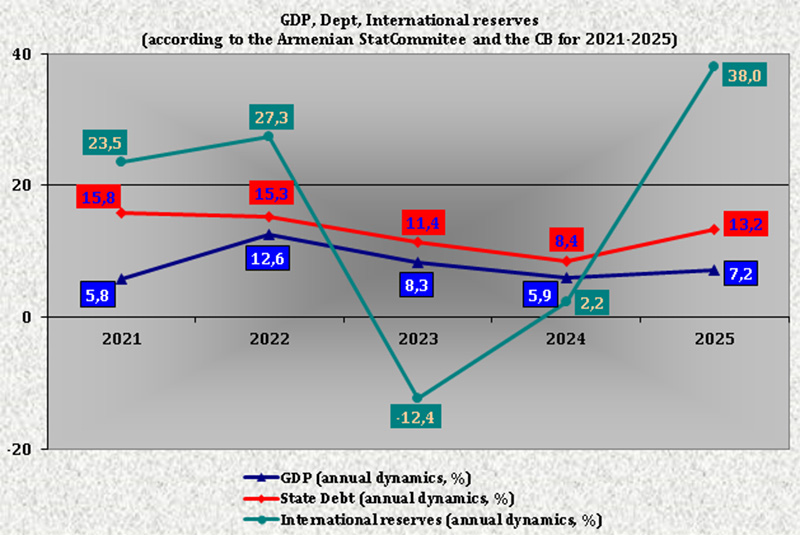
The coverage of external debt by gold and foreign exchange reserves by October 1, 2021 reached 48% against 41% a year earlier, against the background of a more moderate annual growth of external debt than reserves - by 12% and 30.3% respectively, due to the receipt of additional reserve financing from the IMF. The picture was an opposite one a year earlier - the growth of external debt exceeded the upward rate of reserves - 8% versus 1.7%.
According to the preliminary data of the RA Ministry of Finance, published by the Statistical Committee, by October 1, 2021, the state debt of Armenia crossed the 9 billion mark, amounting to $ 9.038 billion (4,370bln), accelerating the annual growth to 15.1% against11.3% a year earlier. This is due to the accelerating growth of both external and internal debt. In particular, external debt accelerated annual growth from 7.8% to 12%, amounting to $ 6.666 billion (AMD 3,223bln), while domestic debt growth accelerated from 24.8% to 26.4% - to $ 2.373 billion (AMD 1,147bln).
Over nine months of 2021, the national debt of Armenia grew by 13.4% due to the growth of external debt by 10% and internal debt by 24.3%, while a year earlier the nine- month dynamics of these indicators was more modest positive - the national debt by 7.3%, external debt by 3.3% and domestic by 22.2%.
In the third quarter of 2021, the growth of the state debt of Armenia slowed down to 1.9% against 2.5% in the second quarter, against the background of a slowdown in the decline in external debt from 0.6% to 0.2%, while the growth of domestic debt slowed down from 13.1% to 8.3%. A year earlier, in the third quarter of 2020, an almost similar dynamics was observed: a slowdown in the growth of public debt to 1.8% from 5.9% in the second quarter was accompanied by a reversal of the dynamics of external debt from 4.6% to a 0.04% decline and a slowdown in the growth of domestic debt from 10.9% to 8%.
In the structure of external debt, following the results of 9 months of 2021, the share of the Government increased to 93% against 92% a year earlier, while the share of the Central Bank fell to 7% against last year's 8%, amounting in absolute terms to $ 6.192 billion and $ 473.6 million, respectively. The varied annual dynamics of the debts of the Government and the Central Bank remained unchanged. In particular, the government's external debt accelerated its growth from 9.2% to 12.6%, and the Central Bank's debt slowed down the decline from 6.3% to 1.4%.
In the structure of domestic national debt, government bonds dominate with a negligible change in their share by October 2021 - 95.2% against 95.3% a year earlier ($ 2.3 billion or 1.1 trillion drams), with a slowdown in annual growth in absolute value from 30.1% to 26.2 %. And the remaining 4.8% (against 4.7% a year earlier) falls on the share of Armenian Eurobonds - $ 114.2 million, or 55.2 billion drams, with the annual dynamics in absolute value tending from the 32.5% decline to 28% growth.
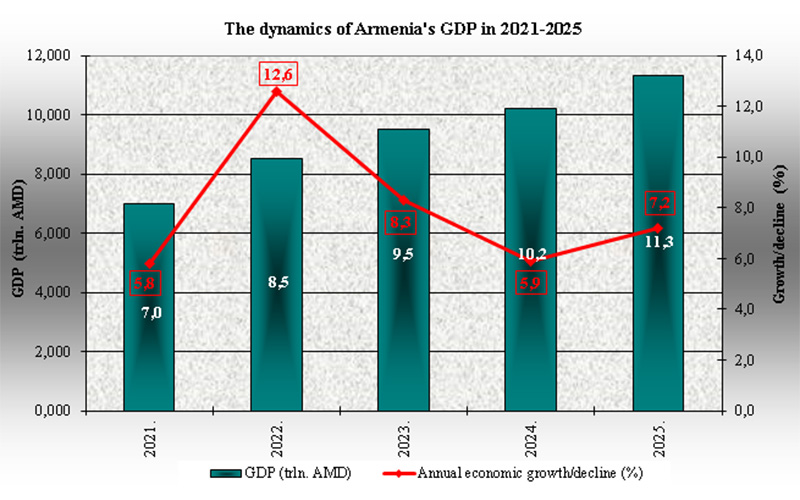
Note that the ratio of public debt to GDP at the end of 2020 was 67.4%, against 53.7% in 2019. And the ratio of external debt to GDP increased from 42.4% in 2019 to 51.2% in 2020. According to the World Bank's October forecast, the national debt of Armenia will decrease in 2021 down to 66.9% of GDP, with a further decline to 65.8% of GDP in 2022 and to 63.4% of GDP in 2023. The WB also significantly improved the forecast for GDP growth in Armenia for 2021 - from the previous 3.4% to the updated 6.1%, planning, as the economy enters a phase of economic recovery, to gradually abandon government support measures and focus on creating a competitive business environment, which is a key aspect for a stable recovery, resilience to future crises and long-term economic growth. In the same report, the WB note that in the absence of new blockages or serious internal or regional instability, the Armenian economy by mid-2022 will return to the pre-COVID-19 level of production.