

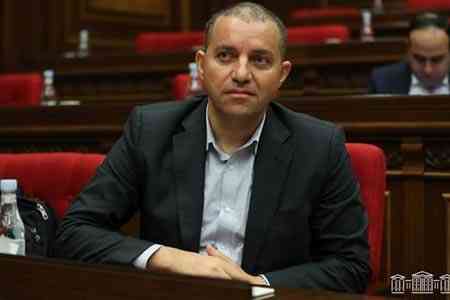
ArmInfo.The opinion that Armenia has no water deficit is a myth, Minister of Economy Vahan Kerobyan said in an interview with the Public TV of Armenia.
In this context, he referred to the renewable water volume rating, with Armenia listed 133rd. the minister pointed out a serious irrigation problem. "At present, we can irrigate only 22% of our lands, which is an extremely low figure. And we have to resolve grave problems in the field. First of all we have to enhance the efficiency of water resource utilization," the minister said. Relevant reforms are on the Armenian government agenda. Just 10% of the annually generated water resources can be recollected now. "We lose huge water resources before water reaches farms," Kerobyan said.
In this context, the minister mentioned the climate change, which has caused a 2.5C average rise in air temperature in Armenia over the last year. This, in turn, brings about serious changes in the demand for water. As a result, water saving becomes an important task. Minister Kerobyan also referred to the Armenian premier's initiative which implies the government subsidies of irrigation systems in areas of up to 3 hectares. "However, it is only a partial solution to the problem. We need to create an environment for attracting investments in reservoir construction, supplying as much water to the farmers as they need and control their saving water. It is a long process, but the sooner we start the sooner we implement it," the minister said.
In an interview with ArmInfo, water expert Knarik Hovhannesyan said that aqueous runoff equal to nearly 7bln cubic meters is yearly formed in Armenia, with surface runoff totaling 3.8bln cubic meters and subsurface runoff 3.2bln cubic meters. The latter is high- quality water used by households and in production.
"But, by rough estimates, we are using just 2.5bln cubic meters of this huge amount. The rest flows out to our neighbors. So we should not look at what is going on in the Turkish territory. It is their land and they can do what they want there. In our turn, we must be able to construct reservoirs and retain the runoff formed in out territory. If we are able to efficiently use our own resources, we'll not face the threat of any warming or 'water deficit,'" the expert said.
In this context she stressed a need for a reasonable and scientifically grounded water policy. "Learn to use what you have got, and you won't need what you have not. Yes, these are expensive and long-term projects, but they are of paramount importance now," Hovhannesyan said.