

ArmInfo.According to a revised forecast by the Central Bank of Armenia (CBA) 5.3% GDP growth is expected next year against 4.2% growth this year, with a downward trend to 4.4% and 3.6% respectively in 2023 and 2024 (against the 7.4% decline recorded in 2020 and 7.6% growth in 2019).
In absolute terms, the CBA expects the GDP to grow from AMD 6,900 billion up to AMD 8,800 billion, according to the CBA Monetary Policy Programme for the 4th quarter of 2021 released late in December 2021.
According to the revised CBA forecast, among the drivers of economic growth will be the industrial sector (0.3%), services sector (7.8%), construction sector (3.2%) and agricultural sector (2.2%). Next year, the construction sector`s growth will go up to 16%, with that of the services sector to go down to 5.9%. The construction sector is expected to record 16.8% growth, with the agricultural sector`s growth expected to reach 3.3%. During the next two years, all the mentioned sectors are expected to retrain growth, with the industrial sector alone to record higher growth up to 3.9% in 2023, retain it in 2024, with its growth expected to go down to 3.5%. A decline in growth down to 4.9% is expected in the construction sector in 2023, and further down to 3.4% in 2024. The services sector`s growth is expected to go down to 4.8% in 2023 and to 3.7% in 2024. The agricultural sector is expected to retain 3% growth.
15-16 percent unemployment
Despite a downward revision of the GDP forecast in 2021 (4.2% against the previously forecast 5.4%), the CBA has not revised its unemployment forecast - 15.7%. The reason is a reduced demand for labor force due to the migration observed since early 2021. In the medium-term, 15%-16% unemployment is expected in Armenia. In 2019-2020, unemployment rose from 17.9% to 18.1%. Inflation to go down to target
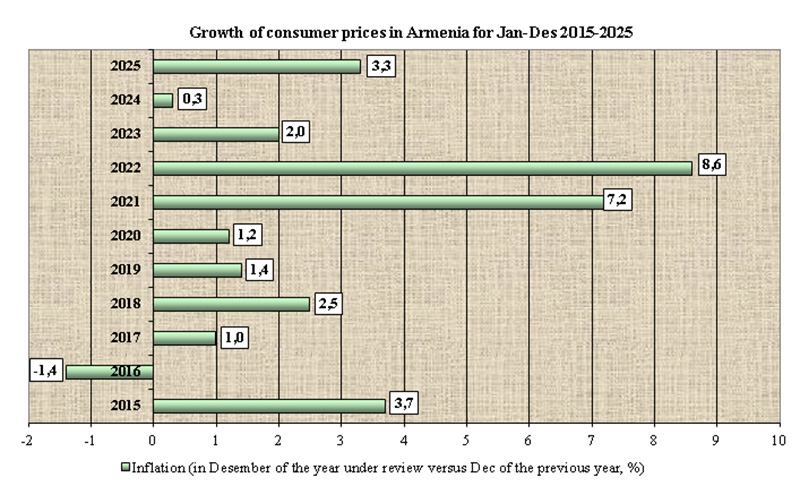
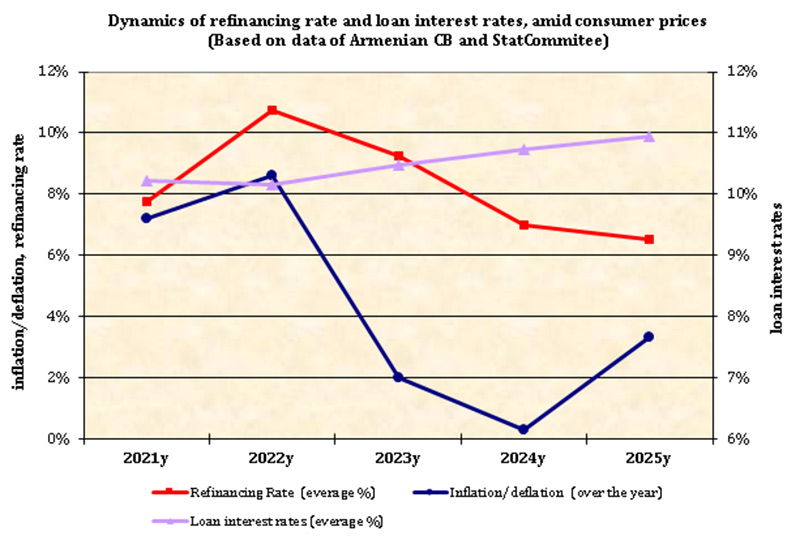
The CBA expects inflation to go from 8.4% in 2021 down to 5.5% in 2022, to 4.7% in 2023 and to the targeted 4% in 2024. This concerns officially registered inflation (by the Statistical Committee). But the CBA forecasts the basic inflation to go down as well: from 7.2% in 2021 to 6.1% in 2022, 5.3% in 2023 and further to the targeted 4.3% in 2024. In 2020, the official and basic inflation levels were almost the same - 3.7% and 3.6% respectively, against the 0.7% in 2019, before the COVID-19 pandemic. In its forecast, the CBA refers to the FAO index, which has over the years under review been rising from 125.7% in 2021 to reach 141.4% in 2024.
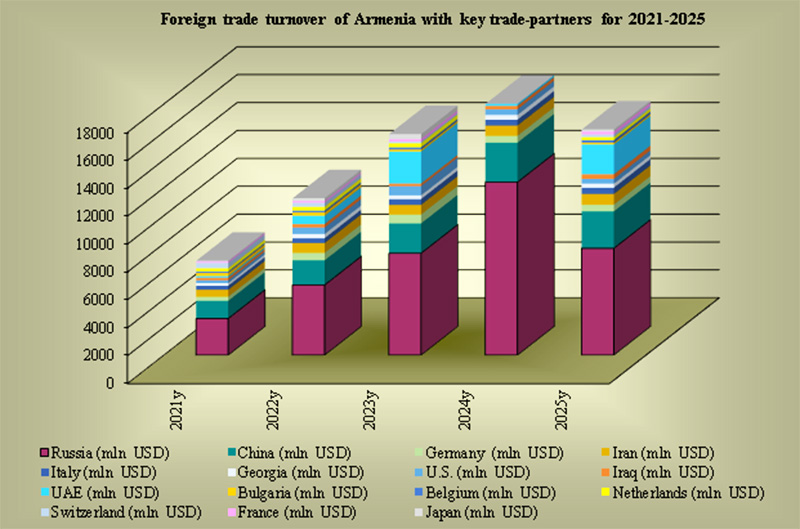
Upward export and import trend
According to the revised CBA forecast, 5.6% growth in exports is expected in 2022 against 12.4% growth in 2021, with 12% growth expected in 2023 and 5.5% in 2024. As regards imports, 10.3% growth in expected against 9% in 2021, with 10.7% growth in 2023 and 5.1% in 2024. In 2020, both exports and imports wend down by 3.9% and 17.7%5 respectively against the respective growth of 9.4% and 10.8% in 2019.
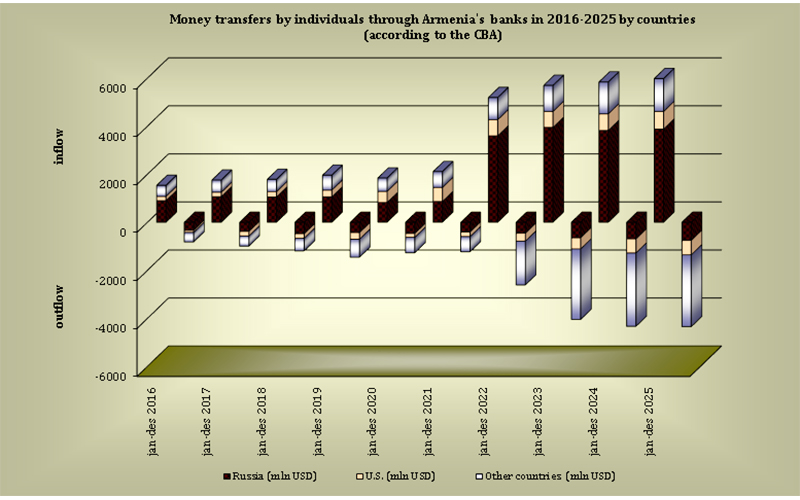
Decline in transfers from USA
According to the revised CBA forecast, net inflow of money transfers is expected to go from 23 up to 26 percent. But, as compared with their 9.9% share in the GDP in 2021 (against 8.2% in 2020), it is expected to go down during the next three years - 8.2% in 2022 to 6.5% in 2024. The CBA expects money transfers from the USA to go down throughout next year due to gradual removal of COVID-19 pandemic restrictions. Simultaneously, the economic recovery in Russia will enable seasonal guest workers to recover their own incomes. As a result, the current account deficit/GDP ratio will show an upward trend: to 3.4% in 2022 (after it went from 3.8% in 2020 down to 1.8% in 2021), to be followed by an annual rise to 4.7% in 2023 and to 5.2% in 2024. The CBA links the gradually growing current account deficit in the medium- term with the forecast global economic growth rate, upward tendencies in domestic demand, relatively stable international prices and gradual recovery of tourism. Delaying effect on gross demand, national debt over 60% of GDP
The CBA expects the budget revenues/GDP ratio to reach 23% this year (a year-on-year growth of 6 percent points), with the budget expenditures/GDP ratio to be 28% (a 2.2% year-on-year decline). In 2022, the respective ratios are to reach 24.4% and 28.9%. In 2023, the ratios are expected to go down to 23% and 26% respectively. As a result, the deficit/GDP ratio will go down to 3.1% in 2022 and to 2.1% in 2023. According to the CBA, the 2021 budget expenditures will be performed 97.3% of the government-adjusted amount, which is accounted for by sluggish capital expenses, which caused the planned refinancing to be saved. As a result, the state budget deficit/GDP ratio is expected to reach 4.1% this year (a 1.3 percent point year-on-year decline), and remain at the historically high average annual level. The monetary policy is expected to have a 1.6% delaying effect on the gross demand this year against the boosting effect last year. The CBA expects a 60% national debt/GDP ratio this year.
Private consumption up, state consumption down
The CBA expects 4.6% growth in consumption this year against 10.1% decline last year, with a downward trend to 4% in 2022-2023. Improved private consumption will account for that - 5.5% growth in 2021 against 13.9% decline in 2020, with an upward trend to 5.7% in 2022 and a downward trend to 4.4% in 2023. The state consumption is expected to rapidly go down to 0.4% (against 15.2% in 2020). It will further go down to 4.8% in 2022 and grow to 2.4% in 2023, with a further moderate growth.
The CBA expects a 21.9% decline in government investments in 2021 (against 15.6% growth in 2020), with a 58% growth in 2022 and too moderate growth during the next two years. On the other hand, private investments are expected to be up by 4.4% this year (against 14.5% decline in 2020), with further growth to 5.3% in 2022 and an upward trend ranging between 4.9% and 3.8% in 2023 and 2024. IMF and WB forecasts:
According to an IMF forecast revised this November, 5.5% GDP growth is expected in Armenia in 2021, with a downward trend to 5.3%. In its October forecast the World Bank expected 6.1% GDP growth, with a downward trend to 4.8%. 3.2% GDP growth is budgeted for 2021, and 7% GDP growth, for 2022, after the 7.4% decline in 2020 and 7.6% growth in 2019.
According to the RA Statistical Committee, this January-November saw 5.2% growth in economic activity against the 7.2% decline in January-November 2020 and 7.5% growth in January-November 2019. It was accompanied by a double-digit growth in exports and imports against much moderate figures in the corresponding pre-pandemic period. In January-November 2021, Armenia`s foreign trade turnover recorded a 16.6% year-on-year growth due to 19.4% growth in exports and 15.1% growth in imports. The decline in Armenia`s foreign trade turnover in January-November 2020 was caused by a 15.9% decline in imports and 5.1% decline in exports. In January-November 2019, the 7.9% growth in the country`s foreign trade turnover was due to 9% growth in exports and 6.6% growth in imports.