


ArmInfo. Over the past 3 years, 39% of Armenian families have received transfers from abroad. This is evidenced by the results of a "Armenian society at the Crossroads: Orientation, Priorities and Foreign Policy Expectations" sociological survey by the SOCIES Expert Center.
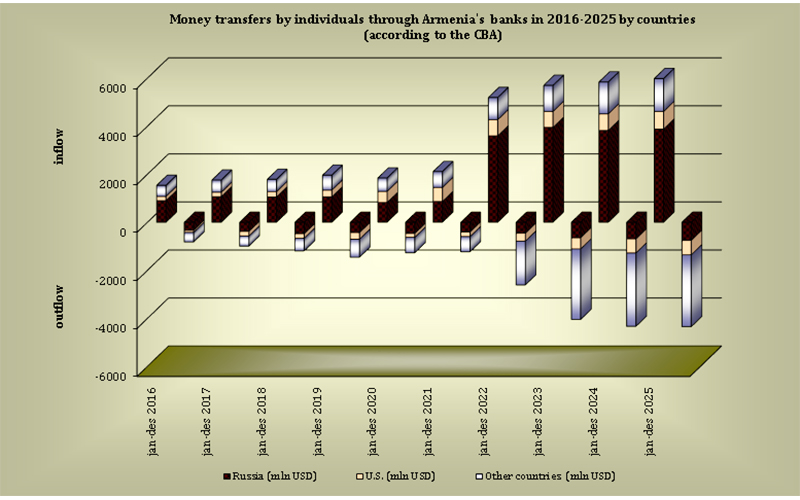
At the same time, the vast majority receives funds from the Russian Federation (59.2%), followed by the United States by a wide margin (19.5%), then France (6.8%), Ukraine (1%), Canada (0.7%)), Poland (0.3%) and 12.5% are from other countries.
The source says that since the 90s, Armenia registered a negative migration balance. Referring to the work of the doctor of economic sciences, academician Vladimir Khojabekian, the study notes that since 1990- 2000, natural population growth decreased by 6.5 times. In particular, from 1991 to 2000, the outflow of the population of Armenia amounted to 1.3 million people.
"The Armenian authorities have always tried to take advantage of this reality, considering the transfers sent by migrants to Armenia as an important financial and economic factor," the study notes.
It should be noted, that the Central Bank of Armenia in its Monetary Policy Program (MPP) for Q1 2022 published on March 29, forecasts a decline in the net inflow of remittances in dollar terms by 20% for 2022 (against 54% growth in 2021), due to the foreseeable economic downturn in Russia (by 6%) and a tangible decrease in the dollar income of seasonal workers. According to the Central Bank of the Republic of Armenia, in 2021, the growth of the net inflow of private transfers to Armenia accelerated to 54% from 14% in 2020, due to the recovery of the dynamics of transfers from the Russian Federation from the 42.1% decline to 27.1% growth, with a significant slowdown in their growth from the US from 50-fold to 32%. As a result, the total net inflow of private transfers in 2021 amounted to $883.3 million, in particular, from the Russian Federation - $463.8 million, and from the USA - $391.3 million. It should be noted that the "Armenian society at the Crossroads: Orientation, Priorities and Foreign Policy Expectations" survey of the SOCIES Expert Center was conducted with the assistance of YSU and financial support from the Konrad Adenauer Foundation. The study involved 1,530 people, of whom 570 were residents of Yerevan, 430 were residents of regional cities, and 530 were villagers. The age category of respondents is as follows: from 18 to 34 years old - 531 people, from 35 to 49 years old - 387 people, from 50 to 64 years old - 374 people, and over 65 years old - 238 people. Sampling error +/-3.3%, probability 0.99%.