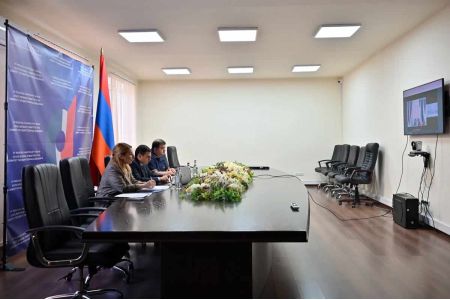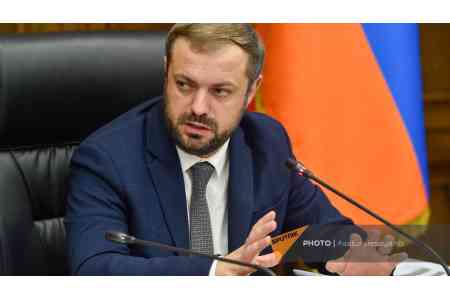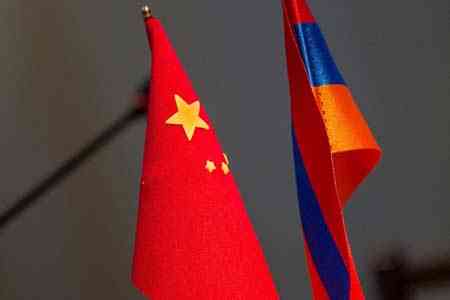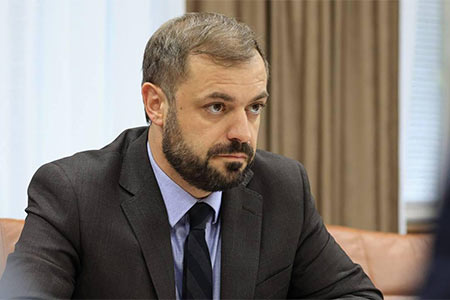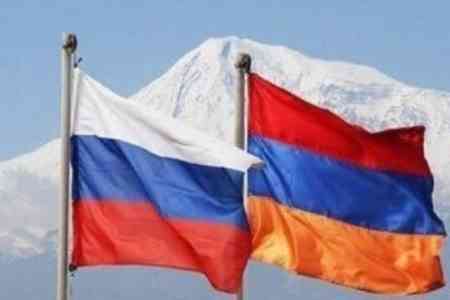
ArmInfo. The common border and land routes are necessary for the development of Armenian-Russian economic relations. Sergey Mikheev, a Russian political scientist, radio and TV presenter, stated this on April 14 during the Yerevan-Moscow video bridge to clarify what the RA and the Russian Federation lack for strengthening and development bilateral relations.
According to him, in fact, this is a serious problem regarding the deepening of economic ties in the first place. "There is apparently no way to solve this. Maybe someday it will be possible to solve it, because at some point there were other relations with Georgia, not like now," the Russian expert said, adding that the current Georgian authorities were offered different ways to resolve (the Abkhazian conflict - ed. note) within the framework of a federation, confederation, and then, perhaps, the situation would be somewhat different.
At the same time, he expressed his conviction that in the event of a successful solution of this issue, the situation in the South Caucasus would seriously change.
"Now there should be more economics in our relations, and more confidence and support for each other on security issues," the political scientist summed up. Since the beginning of the 90s of the last century, the former Georgian road through the "Upper Lars" checkpoint has become the only land route that provides communication between Armenia and Russia. The checkpoint is periodically closed - in winter due to avalanches, and in spring due to mudflows.
Then Armenian Prime Minister Karen Karapetyan at a government meeting on January 26spoke about the need to create an alternative road to Upper Lars. As an alternative, requiring a political decision by the countries of the region, roads connecting Georgia and Russia through the conflict zones - South Ossetia and Abkhazia - can serve. It should be noted that in January 2013, then Prime Minister of Georgia, Bidzini Ivanishvili, considered it possible to resume the operation of the Black Sea section of the railway, which passes through Abkhazia. Then Bidzina Ivanishvili said that if all parties agreed, it would be possible to open the railway.
Earlier, Deputy Foreign Minister of the Russian Federation Grigory Karasin said that the agreement on the mechanisms of customs administration and monitoring of goods between Russia and Georgia brought the necessary clarity to the question of where the customs borders of the Georgian side pass.
"This is the Kazbegi region on the border with Russia, an area south of the Inguri River (beyond which the territory of the Republic of Abkhazia begins) and the vicinity of Gori (near the border with the Republic of South Ossetia)," Karasin said in an interview with Kommersant.
Agreements on the mechanisms of customs administration and monitoring of goods were reached after the third president of Georgia, Mikheil Saakashvili, lifted a veto on Russia's entry into the WTO in 2011, but only on the condition that trade corridors from Russia pass through the territories not controlled by the Georgian authorities - Abkhazia and the Tskhinvali region, and that the parties invite international mediators to control the flow of goods and label them. The choice fell on the Swiss company SGS, with which Georgia signed a contract six years after the signing of the agreement. Russia welcomed this decision, but is in no hurry to sign the contract.
As Prime Minister of Georgia Giorgi Kvirikashvili explained, the agreement with SGS allows the transportation of goods to Russia through the Tskhinvali region, which is not controlled by official Tbilisi, if an emergency occurs on the way to the Kazbegi-Upper Lars checkpoint. According to research by the British International Alert non-governmental organization, the reconstruction of the Abkhaz railway, which has been inactive since 1991 along the Sochi-Sukhumi-Tbilisi-Yerevan route, will cost $ 277.5 million, which will be paid back no earlier than in 100 years. $251 million is required to restore the 190-kilometer Abkhaz section of Psou-Enguri, while from Enguri to Zugdidi, the cost will be only $26.5 dollars. From Zugdidi to Tbilisi and further to Yerevan, the road works and does not need repairs. It is noteworthy that according to the official conclusions of Abkhaz experts, this amount is $350- 400 million, while their Georgian colleagues believe that this will require no more than $73 million.
As of today, the Armenian authorities are working on the issue of renting a ferry to transport goods to Russia.