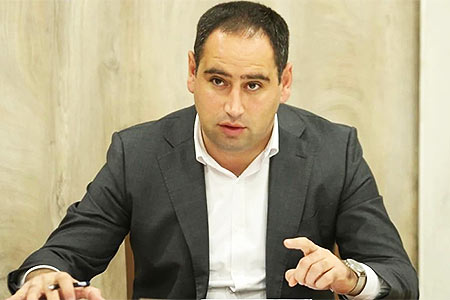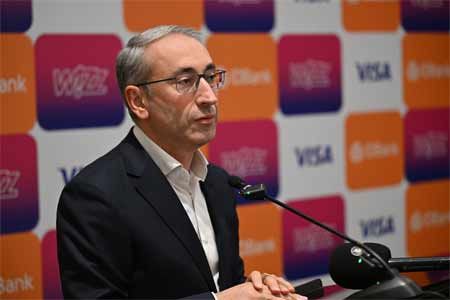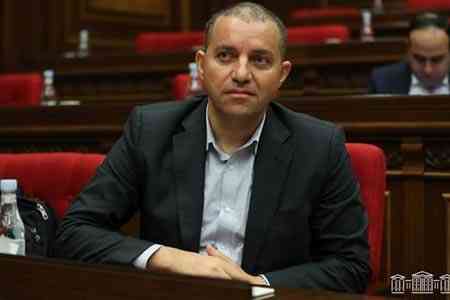
ArmInfo.At the end of March, inflation in Armenia rose significantly to 7.4%, next month we are likely to see higher inflation again as food and energy prices rise. Armenian Economy Minister Vahan Kerobyan stated this in an interview with "Kommersant".
In particular, he stressed that tariffs for gas and electricity have already increased, which will lead to higher prices for other goods. Kerobyan recalled that in order to curb inflation, the Central Bank raised the base rate by 1.25% points in March, in general, bringing it from 8% to 9.25%. However, as the minister mentioned, this measure at the same time slows down the economic growth. Therefore, the Armenian government took the step of almost completely subsidizing loans for the purchase of new equipment, conveyor lines for production. "In general, we are solving a very important problem of changing the structure of the Armenian economy, since for a long time it grew primarily through consumption, but now we want to make industry the main base for economic growth," he said.
At this stage, the emphasis in this sense is on metallurgy, chemistry, pharmaceuticals, food production, light industry, which is now called in a new way - the creative industry. "Here we are able to move from selling labor to creating our own brands and increasing productivity," the minister said.
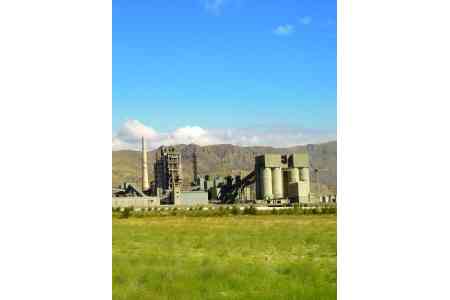
Speaking about metallurgy, Kerobyan stressed that the country has large deposits of copper and molybdenum, gold, silver and zinc. And in this sense, the state intends to deepen the production of these metals. "This, as well as the processing of scrap metal, both ferrous and aluminum, is a very large market For Armenia. There are already great successes, but there is still a lot to be done>, the official said.
According to him, the chemical industry was developed in Armenia during the Soviet era, where they were actively engaged in the production of rubber, and there are very few such places in the world. , he added. It should be noted that according to the RA Statistical Committee, in March 2022 by March 2021, inflation of 7.4% was recorded (against inflation of 5.8% in March 2021 by March 2020), provoked by a rise in prices for food products by 12.3%, non-food 4.8% and an increase in tariffs for services by 3.3%. In Q1 2022, compared to the same period in 2021, inflation was fixed at 7%, against inflationary 5.2% a year earlier. Moreover, in y-o-y terms, food products rose in price by 11.7%, non-food products by 5.5%, while tariffs for services increased by 2.5%.