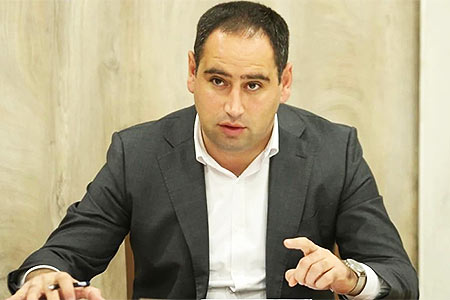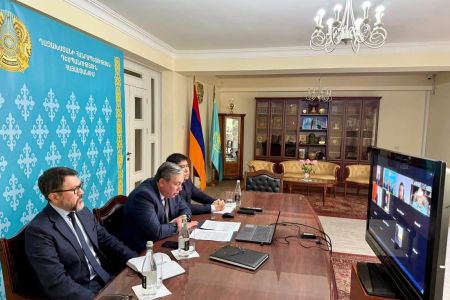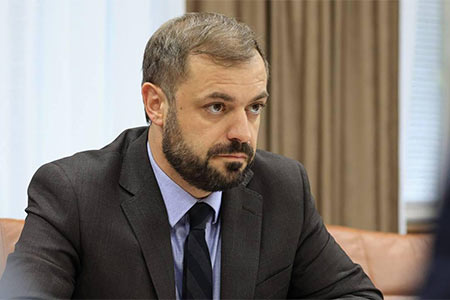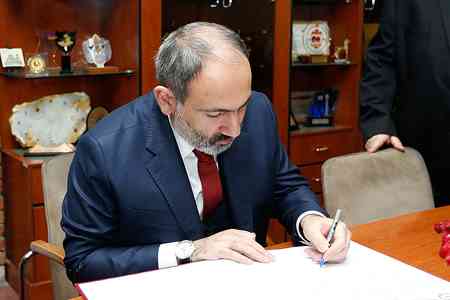
ArmInfo.RA Prime Minister Nikol Pashinyan took part in the extended-format session of the Eurasian Intergovernmental Council in Almaty. The event was attended by the Heads of Government of EAEU countries, as well as the prime minister of Uzbekistan and the diplomatic representative of Cuba in the Union.
As the press service of the RA PM reports, at the session, Prime Minister Pashinyan made a speech, in which he specifically noted: "Dear Heads of Government, Dear members of delegations, I am pleased to welcome the participants and guests of this year's first session of the Eurasian Intergovernmental Council. Let me start my speech with words of gratitude to Alikhan Smailov for the invitation and for organizing today's meeting at a high level. Taking this opportunity, I want to wish the presiding party and personally to Mikhail Mishustin fruitful work and success in the implementation of the priority directions outlined by the Russian presidency. I sincerely welcome the Prime Minister of the Republic of Uzbekistan Abdulla Aripov and the honorable representative of Cuba, confirm my readiness to develop effective cooperation with the observer states.
Before moving on to the issues of today's agenda, I would like to note that despite the geopolitical tension, mutual trade in the Union continues to demonstrate positive dynamics. The trade turnover between Armenia and the EAEU states in January-November 2022 increased by more than 90% compared to the same period of 2021 and amounted to 4.6 billion US dollars. At the same time, import by country of origin of goods increased by more than 50%. Dear colleagues, For the further development of the Union, we need to continue systematic and consistent work based on a solid foundation of internal capacities and resources aimed at ensuring economic development, increasing the competitiveness of national economies and the well-being of our citizens. To achieve these goals, it is important to create favorable conditions for business, to work on eliminating barriers, to increase cooperation in the field of entrepreneurship. Of course, measures aimed at supporting producers at all stages of production still have a decisive role. In this context, I would like to note the importance of speedy development and adoption of legal acts aimed at introducing mechanisms for financial support of industrial cooperative projects with integration potential. The development of this direction, according to our estimates, will allow industrialists to concentrate their efforts on their own production in such branches of economy as mechanical engineering, radio electronics, aircraft constructi
on, software production, pharmaceutical and medical industry. The formation of the competitive industry of the Union is completely determined by the level of technological independence and the dynamics of the introduction of new technologies. These are the undisputed priorities of the EAEU in the near and medium term. Strengthening the technological independence of EAEU member states is directly dependent on the transition to a new technological system and cannot be implemented all at once. It requires defining strategy, stages, expenditures that depend on the level of technological development of EAEU industries and, as a result, the transition will require the modernization of existing productions, as well as the creation of new innovative sectors of industry. It is quite obvious that for these purposes, a technological forecasting system should be established in the Union for the timely identification of the most promising trends in the field of technological development. At the same time, an important element of interaction can be the creation of a data bank of the best available technologies. Dear colleagues, I want to note that we also attach great importance to the development of local and pan-EAEU systems of food safety.
We believe that the activation of cooperation on the creation of a system of collective food security of the EAEU member states will in the future allow to increase the efficiency of the use of available resources, restrain inflation, ensure the availability of food and activate mutual trade. I consider the formation of common markets of energy resources to be another important component of the integration cooperation of the EAEU. In this context, I would like to underline our interest in reaching consensus as soon as possible on the unregulated issues of the draft international treaty on the formation of a common gas market and once again confirm our readiness for a constructive approach for their solution? Within the framework of the issues of the EAEU common electric power market, I consider the flexible and multi-vector approaches laid down in the basis of the "Rules for Access to Interstate Electricity Transmission Services" to be relevant for Armenia.
In particular, the Rules will make it possible to ensure connection to the energy systems of the EAEU member states through a country that is not a member state of the Union (in our case, through Georgia), thereby creating technical and legal prerequisites for concluding mutually beneficial market contracts. Dear meeting participants, In order to fully launch the integrated information system of the Union, we need to synchronize our actions in this direction, which will allow us to form a reliable "digital framework" to ensure the freedom of movement of goods, services, capital and labor.
The development of the digital economy and the introduction of digital technologies is an objective necessity for the formation of a single digital space. In this context, I would like to note the relevance and high demand for the tools of the interstate information exchange system, the creation and development of digital projects with an integration effect. And irrespective of the achievements, we need to constantly review and expand the priorities of the digital agenda. In this context, I would like to note that the Almaty Digital Forum has become one of the effective platforms for a comprehensive dialogue with interested participants to discuss issues of digital transformation and prospects for digital development. Dear colleagues, In conclusion, I would like to wish us all success and fruitful work and once again confirm the readiness of the Armenian side to make efforts in implementing the priority directions of Eurasian integration. Thank you for attention".
The Prime Ministers of the Eurasian Economic Union countries discussed a number of topical issues related to Eurasian integration. In particular, reference was made to the operation of the EAEU internal market, the financing of industrial cooperative, the development of the agro-industrial complex, and cooperation in the energy sector.
The implementation of the digital agenda, in particular, the improvement of the integration information system of the Union, was highlighted. Minutes of decisions taken at the session were also signed. The next session of the Eurasian Intergovernmental Council will take place in June in Sochi. Prime Minister Nikol Pashinyan's wife, Anna Hakobyan, visited the Museum of Folk Instruments of Kazakhstan and the State Art Museum in Almaty, toured the exhibition halls and got acquainted with the presented samples. PM Pashinyan's working visit to Almaty is over.