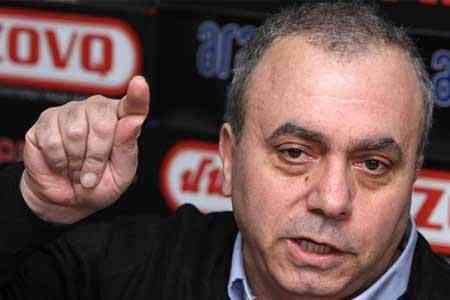
ArmInfo.Former Prime Minister of Armenia, economist Hrant Bagratyan believes that the efficiency of economic growth in 2018-2022 was several times lower than in 2003-2007 and 2013-2017.
<So, economic growth for 2018-2022, in quantitative terms, does not exceed the growth of the previous five-year plans (2003-2007; 2008-2012; 2013-2017) (significantly lower than in first five-year plan, significantly exceeds the second five-year plan and is almost equal to the third five-year plan). Qualitatively, in terms of the structure of GDP production, growth is inferior to all three five-year plans - in the current structure of GDP, the share of mining and gambling has significantly increased. Now let's see what this economic growth will cost us >, he wrote on his Facebook page.
Noting that the official GDP growth in 2018-2022 amounted to only 26.5%, Bagratyan draws attention to the "cost" of ensuring such growth. Having considered the ratio of GDP growth for all 4 five-year periods and the financial resources that ensured this growth, the expert notes that, for example, GDP growth in 2018-2022 is 2298 billion drams (we subtract 5569 billion drams in 2017 from the GDP of 8497 billion drams in 2022). <To achieve these 2298 billion drams of GDP growth in 2018-2022, an additional 3980 billion drams were spent from the budget (the difference between the total budget expenditures of 2013- 2017 and 2018-2022 is 5236 and 9216 billion drams, respectively), 3702 billion drams of money transfers (the volume of transfers in 2013-2017 amounted to 2252 billion drams, and 5.954 billion drams in 2018- 2022 ), credit resources 4.026 billion drams (difference between the total monetary assets of commercial banks as of December 31, 2022 and 2017, respectively) and borrowed funds of 1526 billion drams (difference between the levels of public debt of 4186 billion drams in 2022 and 2660 billion drams in 2017). Thus, it turns out that for 2018-2022, financial resources in the amount of 13234 billion drams were spent on GDP growth of 2298 billion drams. This means that 5.8 drams of financial resources were spent on the growth of 1 dram of GDP>, the economist noted.
Having made similar calculations for the next 5 years (2003-2007 - 1.2 drams of financial resources were spent for the growth of 1 dram of GDP), ( 6.4 drams of financial resources were spent for the growth of 1 dram of GDP in 2008-2012) and (2.6 drams of financial resources were spent to increase 1dram of GDP in 2013-2017), the ex-premier noted that the efficiency of economic growth in 2018-2022 was several times lower than in 2003-2007 and 2013-2017. The growth of the last 5-year period, as the expert pointed out, exceeded the figures of 2008-2012 by only 10% - one of the worst periods in the economic history of the Republic of Armenia since its independence. -