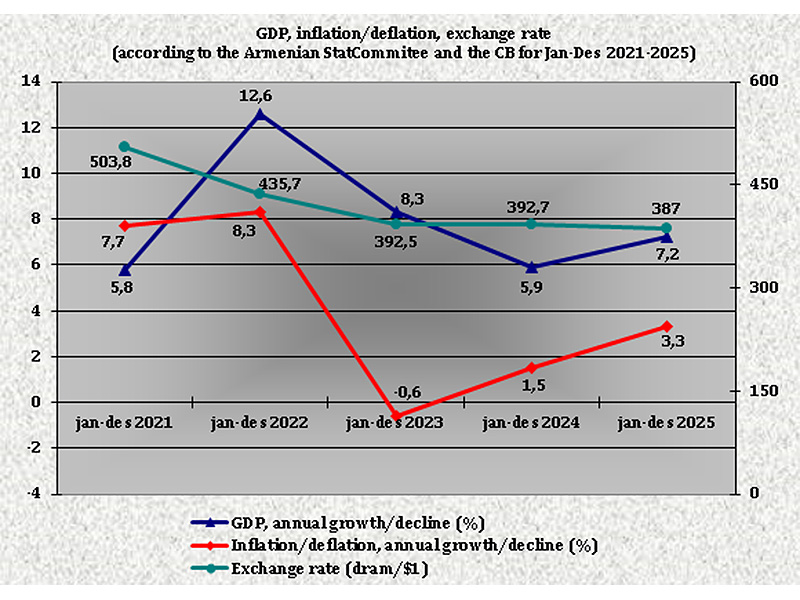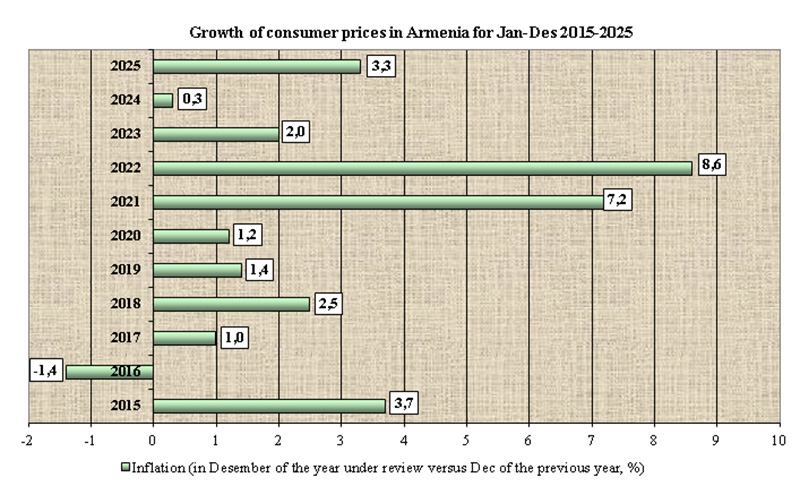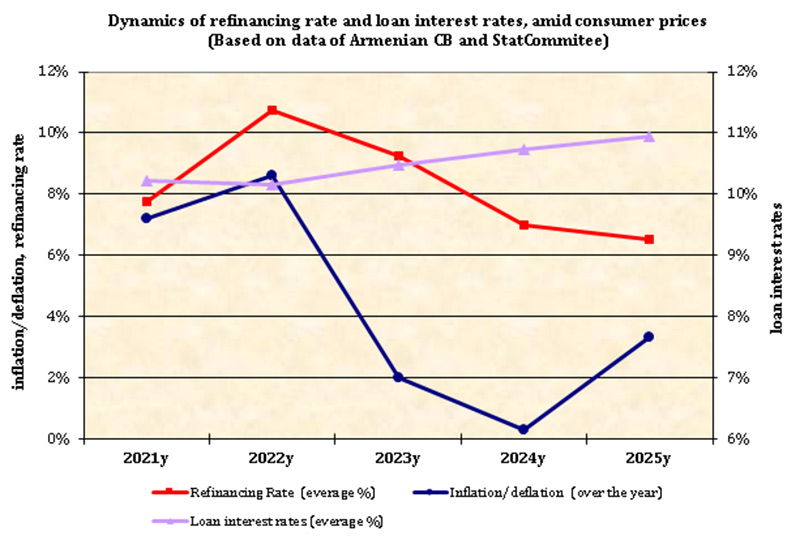


ArmInfo. As a result of the stabilization of food prices, in the consumer market of Armenia in March 2023, compared to March 2022, inflation decreased to 5.4% (from 7.4% a year earlier). In Q1 2023 also, inflation was lower than last year's quarterly level of 0.8% against 3.5%, which was also the result of the stabilization of food prices and the reduction in the cost of non-food products.
According to the RA Statistical Committee, in March alone of this year, deflation of 0.7% was recorded (against inflationary 1.8% a year earlier in the same month), provoked by a reduction in the price of food products by 1.9%, with an increase in tariffs for services by 0.4% and an increase in the price of non-food products by 0.2%. Consumer prices In Yerevan, decreased by 0.7% in March, against a 1.9% increase in March 2022.
For Q1 of this year, the decrease in inflation was mainly provoked by a 1.1% reduction in the price of non- food products, a weaker increase in the price of food products - by 1.4% and an increase in tariffs for services by 1.2%, while a year earlier in Q1 2022 these three categories recorded a noticeable rise in price by 1.3%, 5.8% and 2.3%, respectively. In Q1 2023, compared to the same period in 2022, inflation was recorded at 7.2%, against inflation of 7% a year earlier. Moreover, food products rose in price by 8.1% year-on-year (against 11.7% growth a year earlier), non-food products by 5.4% (against 5.5% growth a year earlier), with an increase in tariffs for services by 6.9% (against 2.5% growth a year earlier).
In March 2023 compared to March 2022, the decrease in inflation was due to a less noticeable increase in the price of food products by 5.4%, and non-food products by 4.6%, with a more significant increase in tariffs for services by 6%, while a year earlier in March 2022 by March 2021, there was an increase in prices for food products by 12.3%, non-food products by 4.8% and an increase in tariffs for services by 3.3%.
In the food market, vegetables fell in price both in y-o-y terms by 0.7% (after an increase in prices by 40.8% a year earlier) and in March by 5.3% (against a price increase of 2.4% in March 2022) . And fruits, on the contrary, increased in price by 8.7% year-on-year (after a decline in prices by 3.8% a year earlier), while in March alone they fell in price by 1.8% (against a price increase of 3% in March 2022). In particular, potatoes and cucumbers have continued to increase in price among vegetables year by year- by 4.5% and 12% respectively, while beets and carrots fell in price - by 20.9% and 14% respectively, and in March alone this group of products fell in price by 3.7% -18%.
The weighted average deflation in the group of fruits and vegetables amounted to 3.79% in March, and this group of products, having a share of 9.38% in the consumer basket, had a downward effect on inflation by 0.32 percentage points. Fish and seafood fell in price by 0.6% on a y-o-y terms, while not changing in price in March, while in March 2022 there was an increase in prices by 30.2% per annum and by 0.6% per month.
Cereals also fell in price both in y-o-y terms and for the reporting month. In particular, prices for buckwheat, lentils, rice, beans and peas decreased by 9.2%, 5.3%, 3.1%, 2.7% and 0.2%, respectively, and by 4.9%, 1.9%, 1.3%, 0.5% and 3.3% in March, while in March 2022 both y-o-y and monthly price increases were recorded, by 37.2-16.8% and 8, 4-4.6%, respectively. At the same time, the y-o-yprice growth for spelt (achar), bulgur and dzavar (crushed and whole wheat) slowed down significantly - up to 2.1%, 3.6% and 4.8%, and in March alone their price decreased by 1%, 0.8% and 2.2% respectively (compared to the price increase in March 2022).
Sugar and granulated sugar fell in price in y-o-y terms by 10.9%, and in March aloneby 1.9%, after an increase in prices 24.7% per annum and by 7.9% per month in March 2022 by. Eggs fell in price in y-o-y terms by 1.1%, and in March alone by 5.8%, after a rise in price a year earlier in comparable periods.
Pasta and bread rose in price by 7.6% and 7.3%, respectively, while in March alone they fell in price by 1.2% and 1.9% respectively. And flour, on the contrary, fell in price both in y-o-yl terms and in a month - by 2.6% and 2.8%, respectively. As a comparison, we note that a year earlier in March 2022, an increase in prices for pasta, bread and flour was recorded by 18.2-10.8% per annum and 8.1-3% per month.
Margarine and cheese rose in price by 10.8% and 15.4% in y-o-y terms, while in March they fell in price by 3% and 5% respectively. And sunflower and butter fell in price both in y-o-y terms - by 20% and 0.1% respectively, and in March - by 6.8% and 0.3% respectively. Sour cream and milk rose in price by 6.2% and 8.4% in y-o-y terms respectively, and in March alone by 0.2% and 1.1% respectively.
In y-o-yterms, beef prices rose by 18.9%, poultry meat - by 1.6%, lamb - by 3.4%, and in March alone, beef prices fell by 0.6%, while prices for poultry meat and lamb, rose by 0.6% and 0.1%, respectively. Pork fell in price both in y-o-y terms by 13.8% and in month term by 10.6%.
Coffee, tea and cocoa rose in price by 4.7% year-on-year, with a price reduction of 0.2% in March alone, against an increase in price in March 2022 by 11.2% and 2.4% in y-o-y and monthly terms.
Cigarettes rose in price in y-o-y terms by 8.8%, and - by 0.2% in March alone, repeating last year's upward trend - by 8.8% per year and by 1.6% per month. Vodka, beer and wine have risen in price by 10.5%, 4.7% and 1.9% respectively, and vodka and wine in March alone rose in price by the same 0.8% each, while beer has fallen in price by 0 .1, while in March 2022, prices increased by 8.7-1.1% year-on-year and by 0.3-2.7% monthly. Bottled mineral water rose in price by 8.2% year-on-year, and in March alone- by 0.7%, against price increases of 6.6% and 1.5% y-o-y, a year earlier.
In the market of non-food products, the y-o-y growth in prices for clothing and footwear continues - by 6.7- 8.8%, furniture - by 7.2%, household equipment and electrical appliances - by 6.2-5.5%, dishes and kitchen utensils - by 8.2%, disposable household goods - by 15.4%, hand tools and accessories - by 4.8%. At the same time, a decrease in prices in the y-o-y terms was observed for jewelry - by 14.5%, fuel and lubricants - by 2.6% and gardening equipment - by 1.6%. Gasoline has risen in price for March by 7%, and diesel fuel - by 1.5%. At the same time, over the year (March 2023 to March 2022), both diesel fuel and gasoline fell in price by 2.8% and 26.9% (against an increase in diesel and gasoline prices by 39.9% and 25.4% a year earlier). And in January-March 2023, gasoline and diesel fuel fell in price by 14.4% and 6.1%, respectively, while a year earlier in the same period, gasoline fell in price by 0.2%, while the price of diesel fuel rose by 9.8%.
As for tariffs for services, in the y-o-y terms a significant increase was recorded in the areas of organizing sports and entertainment events - by 20.5%, complex services for organizing recreation - by 17.4%, transport - by 17.2%, in the housing repair segment - by 10.2%, in the service sector - by 9.2%, in the field of postal services - by 5.8%, in the field of preschool and primary education - by 5.7%, and in higher educational institutions - by 4.6%. Services in the hotel business also rose in price - by 7.7%, hairdressing and spa salons - by 2.9%, and medical services increased in price by 6.7%. Dry-cleaning and clothing repair services, as well as clothing rental salons have risen in price by 9% over the year, shoe repair - by 12%. And financial services rose in price by 21.4% year-on-year.
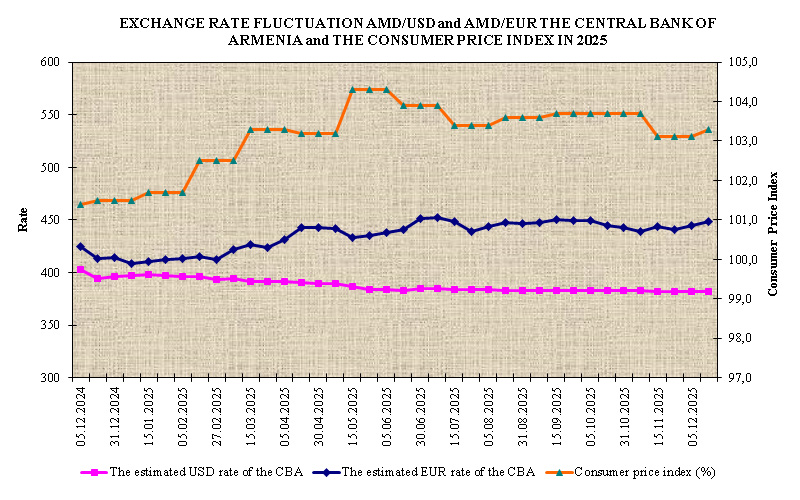
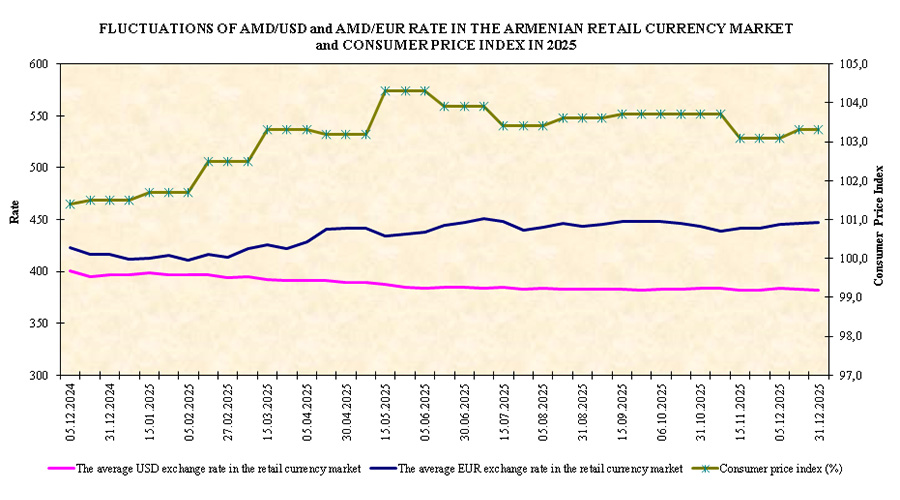
The March deflation of 0.7% was accompanied by a revaluation of the dram against the dollar by 1.3%, while in Q1 2023, the dram appreciated against the dollar by 1.5% in the conditions of 0.8% inflation. As a comparison, we note that a year earlier, in Q1 2022, inflation in the consumer market of 3.5% was accompanied by a devaluation of the dram against the dollar by 2.4%. In March 2023, the dram appreciated against the dollar by 21.8% per annum (against revaluation by 5.8% a year earlier) - up to 388.4 AMD/$1 from 497 AMD/$1 in March 2022.