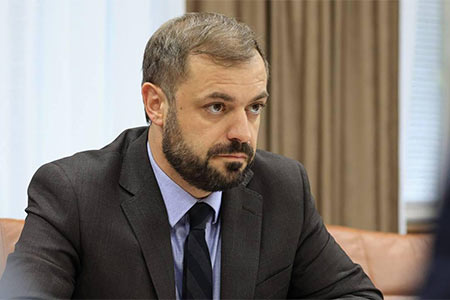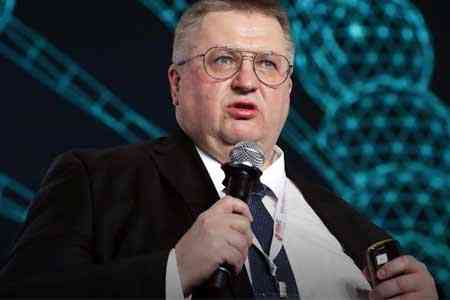
ArmInfo.Russia is Armenia's major trade partner and major cause of the economic boom in Armenia, Russian Vice-Premier Alexey Overchuk told TASS.
"He noted that membership in the EAEU, namely the absence of customs, barrier-free environment, free movement of capital, labor, access to the large market of the EAEU - all this gives Armenia a tremendous advantage and is the reason for the economic leap that this close to the Russian Federation is experiencing today. "We are pleased with the economic successes of our ally, which are a living example and proof of the loyalty of the integration course proposed by the Russian leadership to our neighbors. I do not even want to think about the possible consequences of the breakup between Armenia and Russia, they are too obvious," Mr Overchuk said.
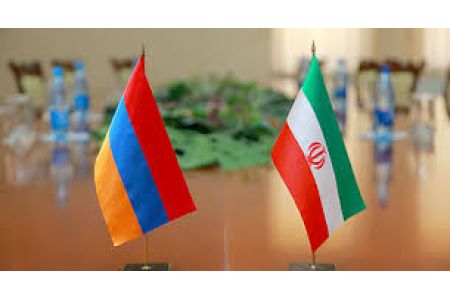
He continued that the existence of common markets, a single customs space, negotiations on free trade zones with any countries are conducted not by the Russian Federation, but by the Eurasian Economic Commission. "There is a special minister of the collegium who conducts these negotiations. And in the course of these negotiations, he tries to balance the points of view of all five countries. So he has a very hard job, but he succeeds. And, of course, as is customary in the EAEU, everything is decided on the basis of a consensus of the five countries: with whom to negotiate, which commodity groups to include, how deep this free trade zone should penetrate the markets of the respective countries. All this is a subject of negotiations, very complex negotiations. And, as a rule, such negotiations take several years. With Indonesia, the commission is just starting negotiations, and it is difficult to say how long they will last. This is an issue that is in their area of attention and competence. Of course, I would like it to happen sooner. What is important: now, indeed, the EAEU has come very close to concluding such an agreement with Iran. And this issue was reported, including at the Eurasian Intergovernmental Council, and received the support of the heads of government. So here we are moving forward. We very much hope that such an agreement can be signed by the end of the year. And the EAEU, as they say, has a number of agreements in the pipeline, which are also being negotiated. And with Egypt, and with India, and with Indonesia, and with the UAE. All these countries are friendly to us, growing markets, in their direction, in fact, the economic center of the new multipolar world is moving. Therefore, the process is underway. Even in a bilateral format, negotiations on free trade zones are very difficult and take years to complete. Negotiators need to take into account a lot of different interests. In our case, the interests of all five EAEU member states, their businesses and consumers are involved here. All this should be taken into account by our negotiators. This is a complex process," Overchuk said.
Answering a question about the possibility of introducing a single currency of the EAEU, the Russian vice- premier said that it is for almost three years and a half that he has been a member of the Council of the Eurasian Economic Commission, such an issue has never been on the agenda. "In reality, the following is happening: in the Eurasian space there is an increase in the use of national currencies. Indeed, cross-border settlements in national currencies for goods reached 90% in March. More than three quarters of these mutual settlements are carried out in the Russian ruble. This is also understandable, because Russia in Northern Eurasia is the largest economy, and, naturally, the currency of the strongest economy is used. So this is the situation today. Negotiations are also ongoing on the formation of a common gas market in the EAEU.
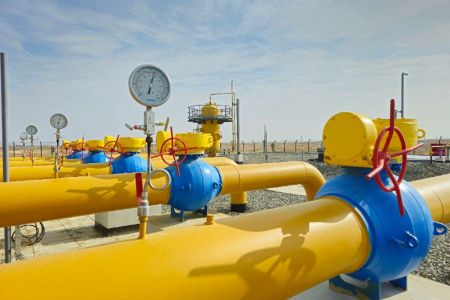
Decisions to form a common gas market were made in completely different economic conditions. It was 2011. Obviously, at that time there could still be bright hopes that the invisible hand of the market itself could balance supply and demand. However, the structure of the gas market has its own characteristics, and the rules of the classical market do not always work here. Last year, we all saw on the example of the spot markets in Europe how the price jumped above $3,000 per 1,000 cubic meters. Imagine what situation the economies of our friends in the EAEU could find themselves in if we took the same path. Even though Russia is a gas seller, ultra-high prices cut the ground from under the feet of consumers, and we don't need it either. We are for stable, predictable, long-term relationships that take into account the interests of sellers and buyers. And of course, this led us to certain thoughts. It is clear that the long-term gas contracts that underpin our gas market offer much greater predictability and benefit both consumers and suppliers. Negotiations are underway, there are nuances, but the partners also have, perhaps, an understanding that the Russian position has a serious basis," Mr Overchuk said.