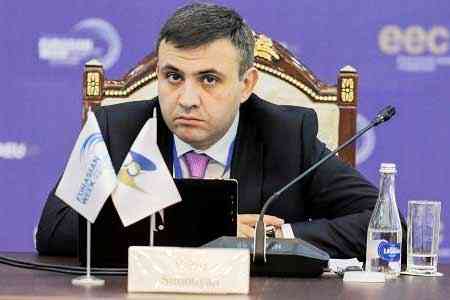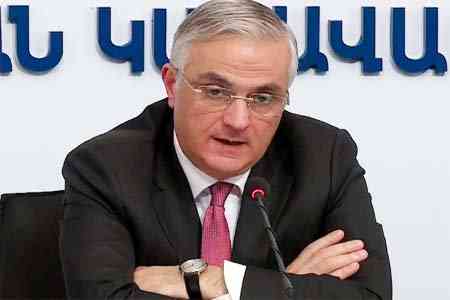
ArmInfo. The deflationary impact from the external sector on the Armenian economy will continue. This was stated on September 12 by head of the Central Bank of the Republic of Armenia Martin Galstyan at a press conference regarding the third reduction in the refinancing rate this year from 10.25% to 9.75%.
He noted that against the backdrop of tough financial conditions and a slowdown in global economic activity, prices on international commodity markets will continue to form at low levels. "The risks of a decline in global economic activity have increased significantly. YOY inflation continues to decline in Armenia's main partner countries, however, the cost of goods and services with rigid prices remains high. Consequently, the central banks of partner countries will continue to implement relatively contractionary monetary policy in the near future politics," the head of the Central Bank added.
M. Galstyan also noted that in Q3 2023, the high growth rates of economic activity in Armenia slowed down (in January-July to 10.4% per annum from 13.1% in the same period of 2022 - ed. note), remaining at a high level. Economic growth continues to be supported by high growth rates in the construction and service sectors (in January-July 2023, respectively, 17.2% and 14.9% per annum, against 13.6% and 27.5% a year earlier, ed. note). The latter are influenced by the continuing high domestic and external demand in the economy.
In the context of deflationary pressure from the external sector, a contractionary monetary policy and the revaluation of the dram, inflation-conducing high demand and inflation expectations have decreased to a certain extent. Nevertheless, high prices for services and some goods are adjusted at a relatively slow pace. According to statistics, in August 2023 compared to August 2022, deflation was recorded at 0.2%(against inflation of 9.1% a year earlier), and core y-o-y inflation, according to the Central Bank, decreased to 0.4% (from 10 .2% a year earlier).
In this situation, the Central Bank Board considered it appropriate to reduce the discount rate by 0.5 percentage points this time. To ensure adjustment of demand and stabilization of inflation expectations, the Central Bank Board will continue to consistently take steps. According to the intended monetary policy scenario, y-o-y inflation will remain below the target threshold in the near future, but then gradually increase in the medium term and stabilize near the targeted 4%. According to the Central Bank Board, the risks of inflation deviating from the planned trajectory are largely balanced, but in the event of risks of any direction, the Central Bank will respond appropriately in order to ensure price stability.
In 2023, the refinancing rate remained at a record 10.75% level almost until mid-June, after which reductions followed one after another - twice by 0.25 percentage points and once by 0.5 percentage points: June 13 - up to 10.5%, August 1 - up to 10.25% and September 12 - up to 9.75%. Before this, the Central Bank regularly raised the key rate for two years - in 2021-2022 (twelve times), first time to a historical maximum of 10.5%, and then to a new record level of 10.75%. And even earlier in 2020, the Central Bank, after reducing the refinancing rate four times (March, April, June, September 2020) from 5.5% to 4.25%, in December of the same year raised it to 5.25% and then continued to increase over the next two years. Let us recall that in previous years, the historical maximum of refinancing rate was recorded in 2015 - 10.5%, in particular on February 10, being increased by 1 percentage point - from 9.5% to 10.5%.