

ArmInfo. Emirati investments and collaboration with ANIF serve to spotlight the potential and investment prospects within Armenia. This is stated in the extensive analysis of Armenia's economic opportunities of the Specialeurasia platform (Italy), a significant part of which is dedicated to ANIF's projects and especially to the strategic cooperation with the companies of the UAE.
According to the source, "Armenia possesses several noteworthy strengths that contribute to its economic landscape. The country is endowed with significant mineral resources, including gold, copper, molybdenum, and zinc. Additionally, Armenia benefits from comfortable foreign exchange reserves and a relatively flexible exchange rate for the dram.
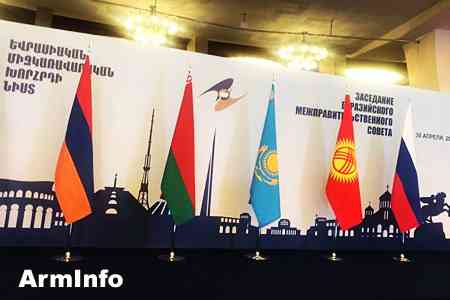
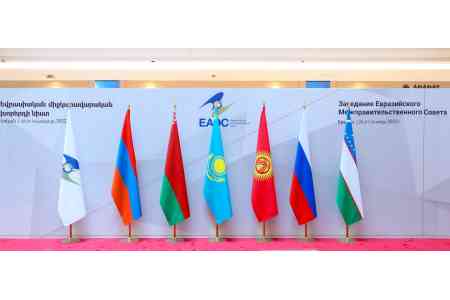
It is a member of the Eurasian Economic Union (EAEU) and maintains a partnership agreement with the European Union (EU), positioning it strategically in both regional and international trade networks.
Furthermore, Armenia demonstrates a willingness to reform, particularly in areas concerning corruption, justice, and competition, reflecting a commitment to strengthening its economic and legal frameworks. However, Armenia grapples with certain challenges that warrant consideration. The nation exhibits a significant dependence on mineral exports, which constitute 40% of its total exports and account for 8% of its GDP, despite ongoing efforts to diversify its economic base.
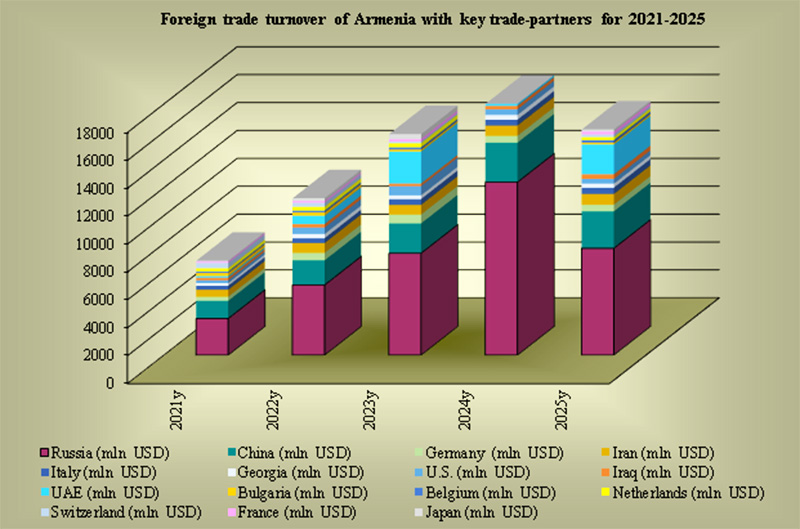
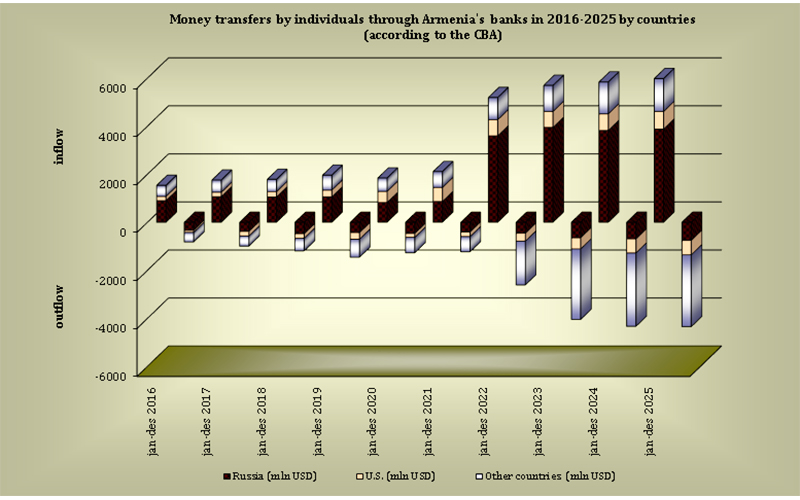
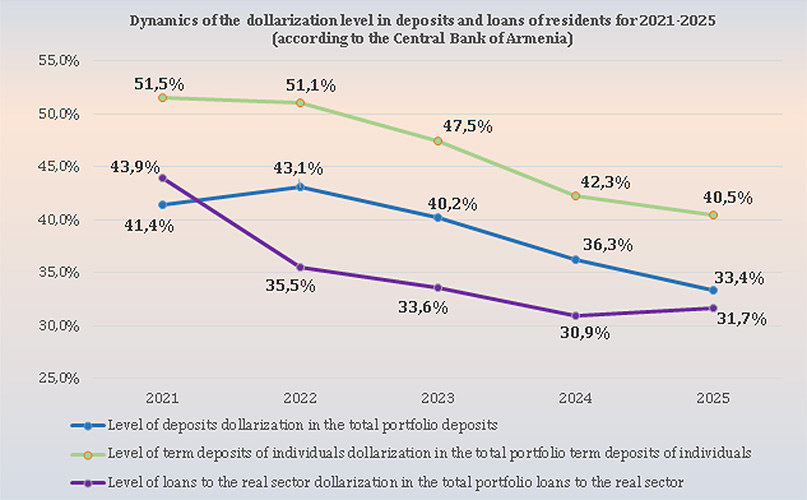
Additionally, Armenia's reliance on Russia is pronounced, spanning aspects of security, trade, expatriate remittances, and foreign direct investment. The banking system remains heavily dollarised, and a substantial portion of the public debt is denominated in foreign currencies, amounting to 75%.
Moreover, Armenia contends with high and persistent levels of poverty, affecting approximately 30% of its population, along with an unemployment rate of 17%. These factors underscore the need for concerted efforts to address these economic challenges in pursuiting sustained growth and development in Armenia.
Below, we summarised some of the main positive aspects of the Armenian economy and business market:
Armenia's geographical position and fiscal system have transformed the country into an interesting market where foreign investors might direct their interests. Indeed, the Armenian government welcomes FIDs and strives to realise and implement economic and fiscal reforms that support local and foreign business activities and enhance the investment climate;
The country boasts robust human capital, with a highly educated population, positioning itself as an attractive technology market with a competitive labour force;
Armenia is a member of the Eurasian Economic Union (EAEU), a Moscow-led economic organisation that promotes trade and business and allows the Caucasian republic to get access to a market of over 182 million customers. Armenia has also signed bilateral treaties on reciprocal promotion and protection of investments with 43 countries and has free-trade agreements with Georgia and most of the CIS countries. Following the Ukrainian conflict, many Russian citizens emigrated to the country, which resulted in Armenia's economic growth;
Relations between Yerevan and Brussels are based on the EU-Armenia Comprehensive and Enhanced Partnership Agreement. EU interests in Armenia, because of its strategic position and sociocultural and historical connection with several European countries, confirms the Caucasian republic's potential to become a Eurasian `bridge' capable of linking Europe and Asia. Indeed, the European Union is the second largest Armenian trade partner.
Investor might benefit from Yerevan's establishment of four Free Economic Zones:
1.The Alliance Free Economic Zone, established in 2012, operates at two strategic locations - RAO Mars and the Yerevan Computer R&D Institute. This zone is dedicated to the production and export of cutting-edge technologies, encompassing electronics, precision engineering, pharmaceuticals, biotechnology, information technology, alternative energy, industrial design, and telecommunications.
2.The Meridian Free Economic Zone, founded in 2014 at the heart of Yerevan, specialises in the fields of jewellery, diamond cutting, and watchmaking. It serves as a highly effective platform for businesses in these sectors, particularly for non-residents, be they individuals or legal entities. Furthermore, the FEZ offers a distinct advantage with duty-free importation of raw materials, as well as the import of goods into Eurasian Economic Union (EAEU) countries bearing a "Made in Armenia" certificate.
3.The Meghri Free Economic Zone, established in 2017, is strategically situated on the border with Iran in the Meghri region. Yerevan tailored this area to attract both non-resident and resident companies engaged in agricultural, trade, transport, processing, and tourism endeavours. With the broadest industry coverage among Armenia's free economic zones, Meghri serves as a pivotal trade bridge connecting Armenia with Iran, EU countries, and the Eurasian Economic Union.
4.The ECOS Free Economic Zone in Hrazdan, located 50 kilometres from Yerevan in the Kotayk region, is is geared towards innovation and the development of high technology, with the requisite infrastructure in place to support ICT companies, including those engaged in blockchain technology. This zone embodies Armenia's commitment to technological advancement and innovation in the global business landscape.
Conclusion
Armenia presents an interesting opportunity for companies and investors seeking to tap into a market with significant potential in a strategic region as the Caucasus.
The Armenian National Interests Fund (ANIF) emerges as a crucial interlocutor for those interested in this Caucasian republic, given its mandate to consolidate and effectively manage state-owned enterprises, promote export growth, and facilitate co-financing in large- scale projects.
Despite ongoing geopolitical tensions that have affected the region, Armenia's strengths are evident. The country's significant mineral resources, comfortable foreign exchange reserves, and membership in the Eurasian Economic Union (EAEU) and partnership with the European Union (EU) all contribute to a resilient economic foundation. In this context, the increasing involvement of Emirati companies in Armenia presents an intriguing development. Unlike in Central Asia, where Islam played a significant role in interactions, Abu Dhabi's engagement in Armenia stems from a different context. Emirati investments and collaboration with ANIF serve to spotlight the potential and investment prospects within Armenia. European companies, cognisant of Armenia's strategic geographical location, would be wise to carefully consider and assess these opportunities.
While concerns about tensions with neighbouring Azerbaijan and Turkey may give pause to potential investors, it is noteworthy that recent events in Nagorno-Karabakh have spurred heightened attention and interest in Armenia from European countries, particularly France.
This dynamic underscores a shifting perception of Armenia's strategic significance and the potential rewards for those willing to navigate the developing landscape."