


ArmInfo. In Armenia, the specific debt burden per capita by October 1, 2023 increased to $3.8 thousand from $3.4 thousand a year earlier. Moreover, the per capita debt burden increased both in terms of external debt from $2.1 thousand to $2.2 thousand, and in terms of internal debt from $1.3 thousand to $1.6 thousand, amid an increase in the population of Armenia over the year by 23.2 thousand people - up to 2.994 million people by October 1, 2023.
The degree of coverage of external debt by gold and foreign exchange reserves by October 1, 2023 increased to 64% from 60.8% a year earlier, against the background of a y-o-y growth of external debt by 6% with an increase in reserves by 11.4%. And this despite the fact that reserves in August of this year reached a historical maximum, retreating only slightly from this level in September. As a comparison, we note that a year earlier on this date, external debt was in decline by 8%, and reserves showed a higher growth of 17.2%.
According to preliminary data from the Ministry of Finance of the Republic of Armenia, published by the Statistical Committee, the public debt of Armenia by October 1, 2023 amounted to $11.322 billion (4.454 trillion drams), accelerating in y-o-y growth from 9.9% to 14%, which conditioned by the growth of the external debt, and the continuous double-digit growth of the domestic debt. In particular, external debt turned its dynamics from a 7.8% decline towards a 6% growth, and domestic debt slowed down in growth from 59.5% to 27%, resulting in their absolute value respectively amounting to $6.516 billion (2.6 trillion drams) and $4.807 billion (1.9 trillion drams).
Over the first 9 months of 2023, Armenia's public debt increased by 6.4% due to an increase in internal debt by 14.7%, with an increase in external debt of 1.1% alone, while a year earlier for the same period, public debt grew by 7.7% was accompanied by a sharp increase in domestic debt by 46.9% and a decline in external debt by 7.5%.
In Q3 2023 alone, public debt maintained its growth rate at 2%, as a result of an imperceptible slowdown in the growth of domestic debt from 3.7% to 3%, with a very slight acceleration in the growth of external debt from 0.6% to 1.2%. As a comparison, we note that a year earlier, the quarterly dynamics of government debt showed a deterioration from 6.1% growth to a 0.002% decline, against the background of a deepening decline in external debt from 2.2% to 5.4% with domestic growth slowing from 26.7% to 10.2%.
Within external debt at the end of 9 months of 2023, the share of the Government increased to 91.8% from 91.3% a year earlier, while the share of the Central Bank decreased to 8.2% from last year's 8.7%, amounting in absolute terms to $5.984 billion and $531.9 million respectively. Moreover, the multidirectional y-o-y dynamics of the external debt of the Government and the Central Bank has remained, but now decreasing rates are recorded for the debt of the Central Bank. In particular, the external debt of the government increased from a 9.4% decrease to a 6.6% increase, while the Central Bank, on the contrary, changed the dynamics from a 12.7% increase to a 0.3% decrease.
Within domestic public debt, government bonds traditionally dominate, the share of which decreased over the year from 89% to 87.4%, amounting to $4.2 billion or 1.7 trillion drams, with a slowdown in y-o-y growth in absolute value from 49.2% to 24.8%. The share of Armenian Eurobonds in domestic debt increased on y-o-y terms from 10.7% to 12.3% - $589.1 million or 231.7 billion drams, with a slowdown in y-o-y growth in absolute value from 3.5-fold to 45.6%. The remaining 0.3% or $14.4 million (5.7 billion drams) were from internal guarantees, with a y-o-y increase in absolute value of 26.3%. Last year's dynamics of internal guarantees are not given, as they were nullified in August 2019 and recorded in October 2021.
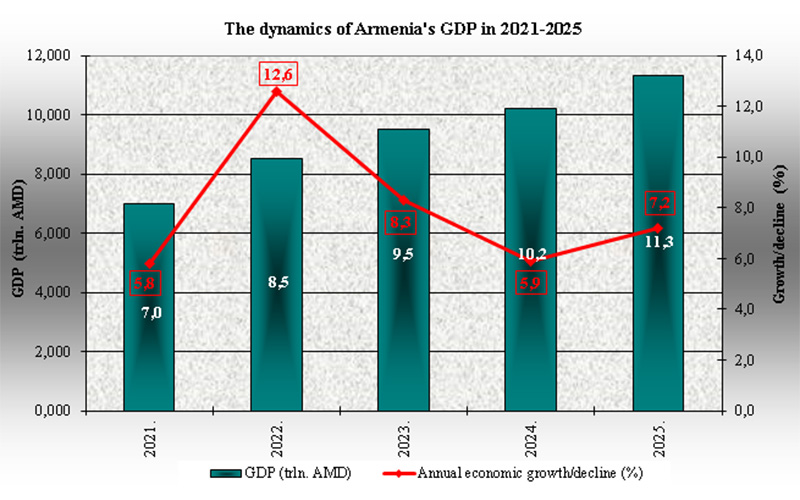
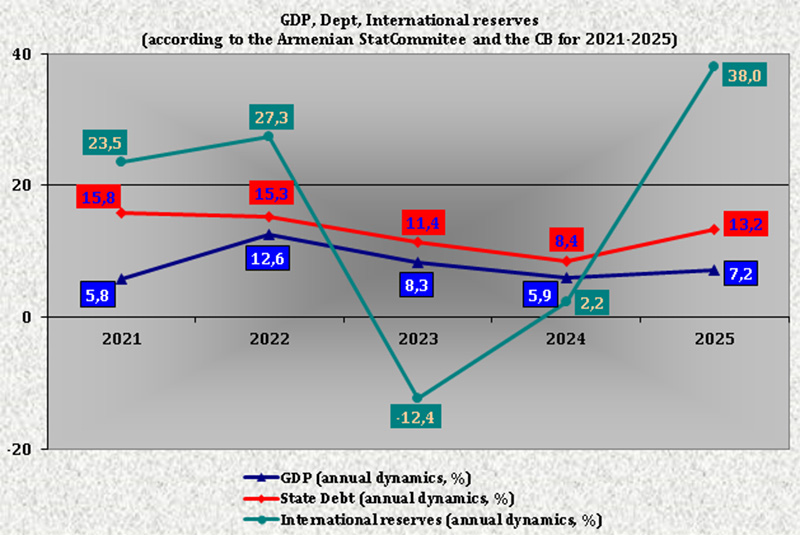
The ratio of public debt to GDP in 2022 decreased from 63.4% to 49.2%, with double-digit growth in both public debt (by 15.3%) and GDP (by 12.6%). In 2022, the ratio of external debt to GDP also decreased - from 45.7% to 29.9%, with a decline in external debt of 3%. The degree of coverage of external debt by gold and foreign exchange reserves increased in 2022 from 48.6% to 63.7%, against the backdrop of a decline in external debt with an acceleration of double-digit growth in reserves from 23.5% to 27.3%. At the end of 2022, both the GDP of Armenia and the GIR (gross international reserves) of Armenia reached a historical maximum - 8.5 trillion drams and $4.1 billion, respectively, and the public debt exceeded $10.6 billion. The persistence of a negative migration balance and weak population growth, with a double-digit increase in public debt, increased the specific debt the per capita debt burden for 2022 from $3.1 thousand to $3.6 thousand. Moreover, for 2022, the per capita debt burden from external debt remained at the level of $2.2 thousand, and from internal debt increased from $870 to $1.4 thousand.