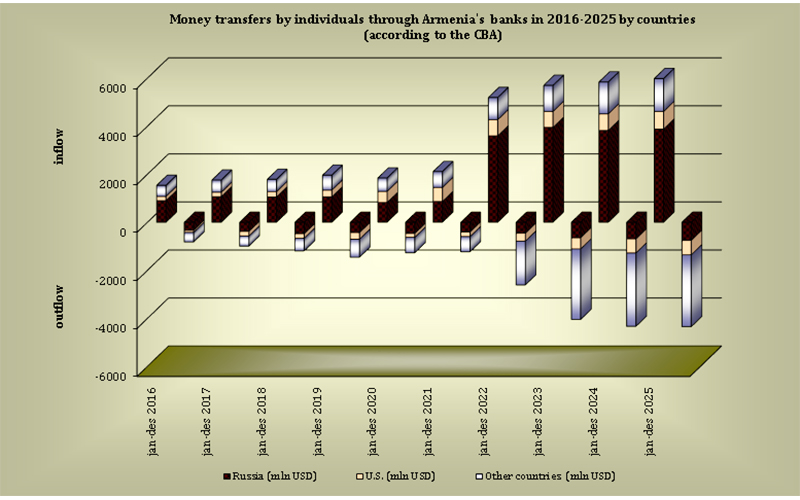


ArmInfo. The outflow of private transfers from Armenia continues to grow significantly, while the growth of inflows has sharply stopped.
According to the data of the Central Bank of the Republic of Armenia, y-o-y growth of outflows slowed down from 76% to 50% alone, while the growth of inflows slowed down greatly: 2-fold to 7%. As a result, the volume of inflows of transfers to Armenia increased to $1.3 billion in January-October 2023, while outflows barely reached $1.9 billion, which reduced the gap in favor of inflows from last year's 2-fold to the current 1.4-fold.
This, in turn, worsened the y-o-y dynamics of the net inflow of private transfers to Armenia, which changed from a 2.4-fold increase to a 35.5% decrease, which resulted in a decline in volume during the 10 months of 2023 to $568.4 million
In particular, growth in inflows from the Russian Federation has slowed sharply (from 3.3-fold to 11%) and the growth from the USA decreased (by 13%, against 2.5% growth a year ago). At the same time, the outflow of remittances from Armenia to Russia increased from a decrease of 8.8% to a high growth of 44.3%, in parallel with which a significant increase in transfers flowing to the United States continued, accelerating from 35.4% to 36.7% . However, it is noteworthy that the outflow of transfers from Armenia has grown much more impressively to: the UAE (2.3-fold), Monaco (9.1-fold), Singapore (32-fold), Spain (2.2-fold), Greece (2.2-fold), Iran (15.2-fold) and to France and Italy (by 61-63%) in a slightly more modest amount.
Russia is the leader in terms of inflow and outflow: $1.3 billion and $215.9 million, respectively. The United States is in second place in terms of inflow: $211.8 million, Switzerland ranks 3rd: $42.5 million (an increase of 32.5%), Germany ranks 4th: $33.1 million (an increase of 22.8%), the UAE ranks 5th: $24.9 million (an increase of 86.4%), the UK ranks 6th: $24.6 million and Ireland ranks 7th: $20.3 million (with an increase of 13.5% and 30 .1% respectively). In terms of outflows, the UAE rose to second place: $191.2 million, from where the USA dropped to the 3rd place: $145.8 million, followed by the UK, 4th place: $109 million (a decline of 3.5%), Monaco ranks 5th: $101.7 million, Switzerland ranks 6th: $80.7 million (29.5% decline) , Singapore ranks 7th: $46.1 million (manifold increase).
As a result, Russia's share in inflows increased from 67.8% to 70.4% over the year (versus 41.3% in 2021), while slightly decreasing in outflows - from 17.1% to 16.5% (versus 33 % in 2021). The US share fell in both inflows and outflows by almost the same amount, 11.3% and 11.1%., from last year's 13.9% and 12.2%, respectively (versus 27.2% and 15.9% in 2021).
At the same time, the share of those occupying the third, fourth and fifth places in terms of inflow: Switzerland, Germany and the UAE, increased from 0.8-1.8% to 1.3-2.3%. The UAE, which ranks second in terms of outflow, increased its share from 9.4% to 14.6%, there is also growth in Monaco's share, which ranks 5th, from 1.3% to 7.8%, and the UK, which ranks 4th, on the contrary , reduced its share from 12.9% to 8.3%.
As a comparison, we note that in 2022, the influx of private transfers accelerated in y-o-y growth from 14.5% to 2.5-fold (4.2-fold from Russia), reaching a record $5.2 billion. The same change in y-o-y dynamics was observed in outflow of transfers - from a 3.3% decline toa 2.1-fold increase (to the USA - by 74%), and also to a record $2.6 billion. As a result, the net inflow of remittances from individuals sharply accelerated in growth from 53.8% up to 3-fold, reaching a historical high of $2.6 billion.
The incraese in transfers from Russia in 2022 was due to the influx of a huge number of immigrants from the Russian Federation to Armenia, who moved here along with their businesses and capital. Moreover, this move to Armenia of over 100 thousand immigrants took place in two impressive flows - from the end of February 2022 (with the outbreak of Russia's war in Ukraine) and in September of the same year (with the announcement of mobilization in the Russian Federation). They left Russia because in their homeland they encountered difficulties with work, financial and card transactions due to unprecedented large-scale anti- Russian sanctions (including disconnection from the S.W.I.F.T. system, withdrawal from the Visa and MasterCard market, blocking of Western social networks).