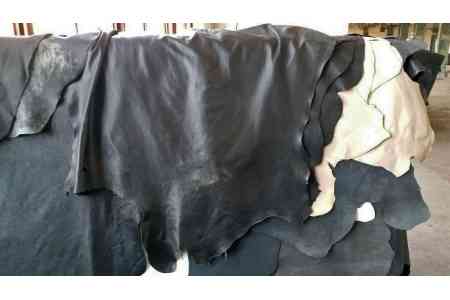
ArmInfo. Armenia's Cabinet has extended the ban on the export of raw leather once again. As noted in the explanation to the document, currently local industrial companies engaged in leather processing in Armenia have a demand for leather raw materials, and the capabilities of the raw material base are still not fully used.
Armenian leather processing enterprises (about 50%) currently mainly carry out the first stage of leather processing and export it in the form of a semi-finished product (wet blue). "Ultimately, this decision will allow Armenia to transform from a country exporting raw materials into a country exporting processed products," note the authors of the initiative.
Most of the products of the Yerevan and Gyumri tanneries are sold in Armenia, and a significant part of the products of the Masis factory (65% of all products according to the manufacturer) is exported abroad.
The Gyumri fur and leather workshop has been operating since April 2022 and specializes in processing sheepskin. Raw materials are entirely purchased in Armenia, and 5 employees are involved in the production process. The company plans to expand production from 2023. As a result, the company will be able to double its production capacity and process about 350 thousand square meters of sheepskin monthly. The company is currently negotiating to export its products to Pakistan and Israel. The expansion of production capacity, according to the company's estimates, will make it possible to process more than 30% of all sheep skins slaughtered in Armenia (starting from 2024, the company plans to process about 6,000- 7,000 pieces of sheep skins monthly). Along with expanding operations, it is also planned to double the number of employees.
In the local value chain, footwear manufacturers have increased the use of locally processed leather. Providing local raw materials allowed companies to expand production volumes and almost completely sell local raw materials.
The decision comes into force on January 22, 2024 and is valid until July 22, 2024.