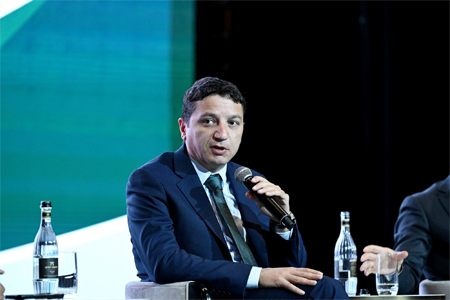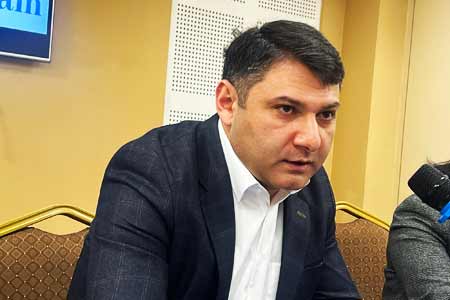
ArmInfo. Haykaz Fanyan, Director of the Armenian Center for Socio-Economic Studies (ACSES), said in response to ArmInfo at a press conference organized by the Economic Journalists Club.
According to Statistics Committee data published yesterday, Armenia's GDP growth slowed down in 2023 to 8.7% (from 12.6% in 2022), amounting to AMD 9,503bln ($24.2bln) at current prices. The GDP deflator index also decreased - to 102.8% from 108% in 2022.
According to the economist, 2023 presented a pleasant surprise to the Armenian economy. The actual figure turned out to be higher than the expectations of both international organizations and the country's financial authorities. Fanyan recalled that the current Cabinet of Ministers in its 5-year program of activities has set a goal of ensuring GDP growth of 7% annually, and in the presence of favorable external conditions - all 9%. Thus, the recorded growth of 8.7% turned out to be closer to the "ceiling" of 9% growth planned by the Cabinet for 2021-2026.
According to the head of ACSES, economic growth of 8.7% in 2023 was driven mainly by trade (2.9 percentage points), information and communications (1.7 percentage points) and construction (1.7 percentage points). 1 p.p.). The contribution of the trade sector to recorded GDP, according to the economist, was mainly due to re-export transactions. Especially in the first 8 months of 2023, car re-exports reached impressive volumes. However, tightening on the part of international structures, Russia and Georgia, by the end of the year led to a significant decline in car re-exports. Meanwhile, for other items, the pace of re-export remains unchanged. Moreover, a reverse trend has emerged - certain goods are imported from the Russian Federation to the Republic of Armenia, sometimes undergo processing, and then are exported to other countries. The latter circumstance also has a positive impact on the Armenian economy, Fanyan noted.
The expert refrains from making specific assessments of the contribution of relocants to GDP in 2023."However, with the naked eye one can observe a reduction in their numbers over the past year. The downward trend will continue. At the same time, we see the growing role of labor migrants from India, who over time will become a decisive factor for the growth of the areas in which they are involved," the expert noted.
In general, those external positive impulses that were present in 2022 also remained in 2023. As a result, the real cumulative growth of the Armenian economy over the 3 post-Covid years amounted to 29.5%, and the average annual growth was more than 9.8%. (5.8% in 2021, 12.6% - in 2022 and 8.7% in 2023). Thus, the potential for generating GDP has increased - the Armenian economy has managed to develop its capacity in a certain way, which will ensure growth in subsequent years.
"GDP growth of 8.7% for a country like ours is considerable, considering that neighboring Georgia, with almost comparable conditions - relocated employees from Russia, re-exports, etc., - according to the latest data, recorded 7.5% economic growth," he noted.
At the same time, the economist sees certain risks for 2024 in terms of maintaining the rates recorded over the past two years. In this regard, he considers the financial authorities' forecasts, in particular those included in the state budget, for GDP growth in 2024 at 7%, to be overestimated. The World Bank's estimates (4.7%) look more realistic, he noted.
"There will be no decline, there will be some growth, especially if the promised investment projects are implemented, for example, the investment program to launch the Amulsar mine. However, in the coming years, economic growth in Armenia will continue, it will be ensured by the presence of aggregate demand," Mr Fanyan said.