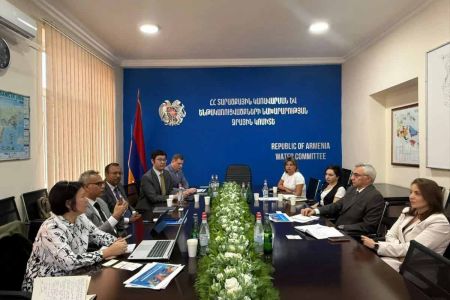
ArmInfo. Armenia faces a number of challenges that relate to the threat of conflicts, climate change, private sector development, logistics and public administration. This is stated in the World Bank Beyond Boundaries - Unlocking Potential for a Sustainable Tomorrow report which was presented by World Bank Senior Specialist Lea Hakim.
In particular, she noted that since 2020, the Armenian public has become more focused on security issues, and prolonged political uncertainty is affecting economic results. "In addition, we see that public trust in government agencies is declining," said the WB representative.
Speaking about climate change, she noted that the average air temperature in Armenia is higher than the world average. "This suggests that Armenia is vulnerable," she said. In this regard, the WB representative noted that this area involves large expenses, both in the social sector and in the agricultural sector.
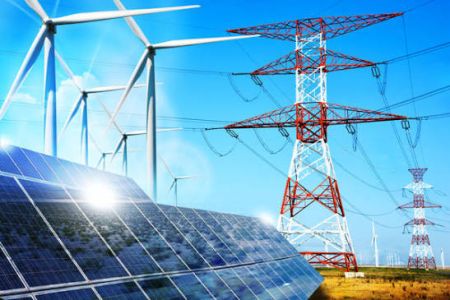
In particular, the expert also attached importance to carrying out mitigation measures in the field of waste management, mining, energy, and agriculture. Speaking about the energy sector, she noted that more efforts could be made to manage disaster risks and strengthen the resilience of infrastructures. Hakim noted that Armenia should switch from natural gas to solar energy, invest more in networks, and also "green" the mining industry, taking into account the global decarbonization process.
Regarding the development of the private sector, the WB senior specialist noted that the country has low productivity, which is associated with human capital, low availability of financial resources, especially in the case of small businesses, since large businesses are more concerned about the unstable political situation.
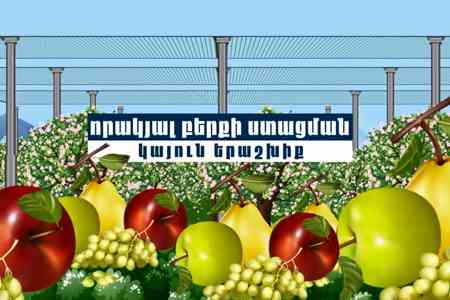
She noted that productivity in the industrial and service sectors is many times higher than agricultural productivity. According to the expert, the share of agriculture in GDP decreased to 8% at the end of 2023 against 18% in 2012. "And yet, the sector continues to be an important employer. About 22% of citizens are employed in agriculture, and 44% of those employed are among the poor," she added. To improve the business environment, she said, it is necessary to stimulate investment, both domestic and foreign. "It would be good to have a strategy to understand which areas are priority so that the investor knows where to invest. And it is necessary to revise the law on foreign investment, which was adopted back in 1994," the expert said.
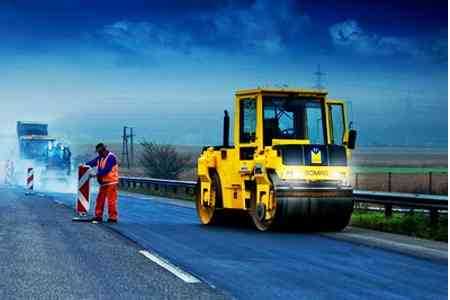
She also pointed out problems related to logistics, noting that compared to comparable countries, Armenia's infrastructure is in a more imperfect state. According to the specialist, one of the reasons for this is the transport sector. She noted that 45% of roads in Armenia are in poor condition. Because of this, residents of rural areas, who are already in poor condition, are unable to access a number of services in secondary cities, including those related to education.
According to World Bank assessments, Armenia needs to do a lot more in the field of competition policy, create a level playing field, and also direct more efforts to develop institutional capabilities. "We need to conduct monitoring, evaluation, and for all this we need data. We need to invest in the data sector, because data is the most important factor when making decisions," the expert said.