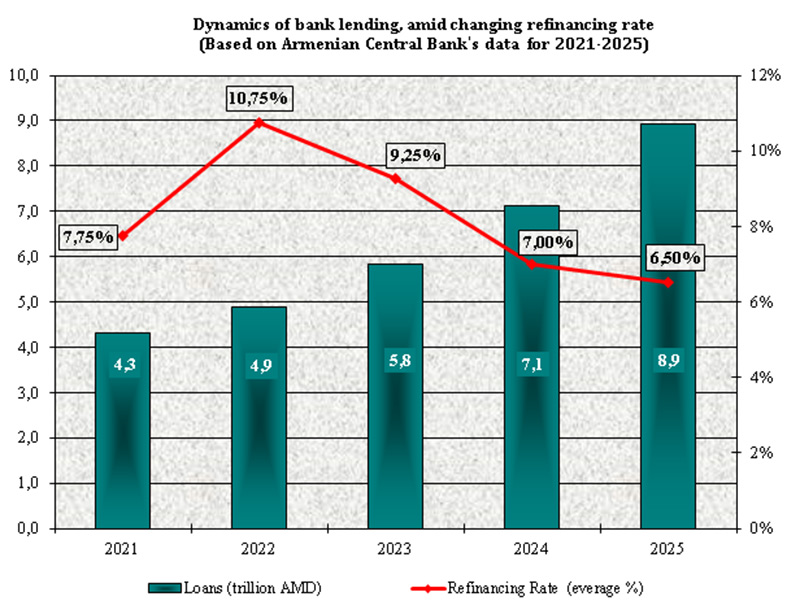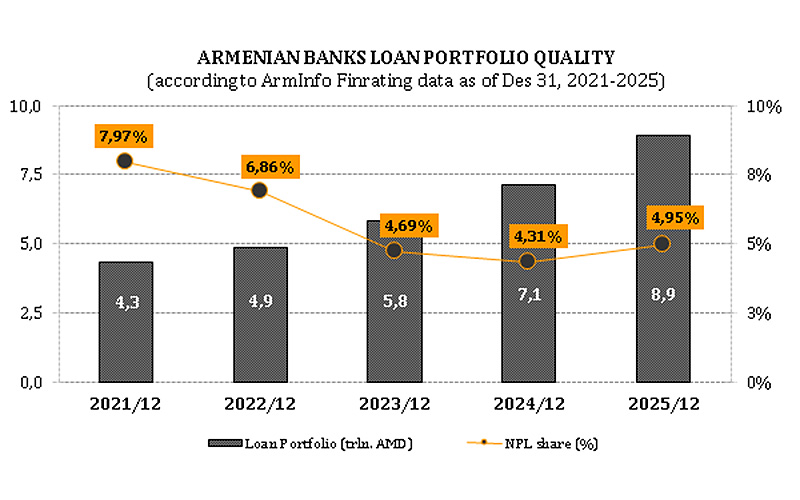


ArmInfo. According to the 2024 results, the loan portfolio of Armenian banks grew by 24%, reaching almost 6.4 trillion drams, an increase of 1.2 trillion drams, as stated by Daniel Azatyan, the Chairman of the Union of Banks of Armenia, during a press conference on February 25.
He also noted that the majority of loans, almost 50%, are to individuals (consumer loans and mortgages), 44% are to legal entities, and about 6-7% are interbank loans. In particular, Azatyan reported that the share of consumer loans at the end of 2024 was 22.8%, totaling 1.447 trillion drams, which is 33% higher than the previous year. Mortgage loans follow closely behind - with a share of 22.4% or 1.423 trillion AMD. With a year-on-year growth of 32.9%, lending to the construction sector covered 10.4% or 660.5 billion AMD. Lending to the trade sector increase by 10.2%, totaling 9,9% or 631,2 billion AMD, industry - 9.4% or 595.6 billion AMD with a growth of 17%, the financial sector - 7.5% or 475.6 billion AMD with a growth of 16.9%, the service sector - 5.8% or 368.5 billion AMD with a growth of 12.6%, the agricultural sector - 5.3% or 335.2 billion AMD with a growth of 23.1%. Lastly, lending to the transport and communications sector increased by 32.9%, covering 2.1% or 134.4 billion AMD.
Azatyan primarily attributed the growth of the consumer portfolio to the rise in the income of individuals and the implementation of a scoring lending system in banks. He also highlighted a significant increase in mortgages in November and December 2024, which was a result of the termination of the income tax return mechanism on mortgage loans in Yerevan.
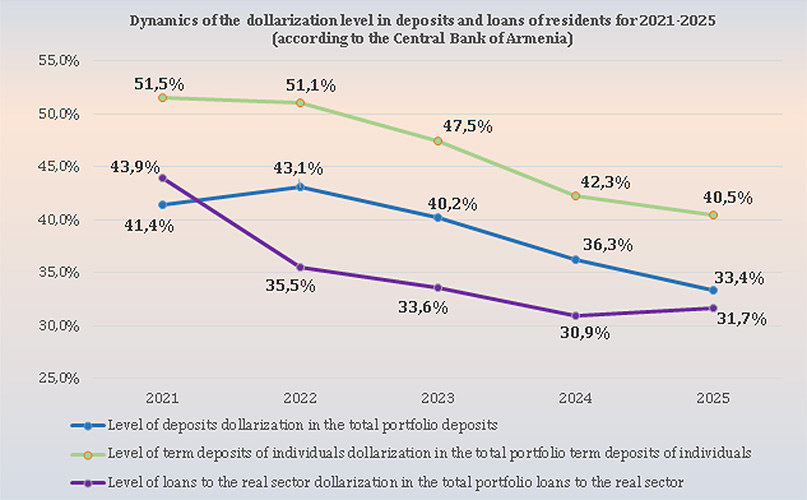
Answering a question from an ArmInfo correspondent about the higher growth rates of consumer loans compared to loans provided to legal entities, the head of the Union of Banks of Armenia emphasized the importance of focusing not on growth indicators, but on areas that are of interest to our banks from an investment perspective. In this regard, he noted that Armenia has a high potential for lending to the real sector of the economy, particularly in construction, agriculture, industry and services. "Compared to Georgia, their credit investments exceed ours by 40-50%. Moreover, the majority of loans in Georgian banks are provided to legal entities," Azatyan said, noting that in Armenia, the demand for loans comes to a greater extent from individuals than from legal entities. At the same time, he said that today, 67% of loans are in AMD, and 33% are in foreign currency. This is a reversal from 2014, which the head of the SBA attributed to legislative restrictions on foreign currency loans and increased public trust in dram loans.
According to the Financial Rating of Armenian Banks as of 31.12.2024, prepared by ArmInfo Investment Company, the volume of non-performing loans (NPL) accelerated in annual growth from 2.3% to 10.2%, exceeding 5.4% in the loan portfolio and 3.5% in assets. Over 42% of toxic loans, as before, accumulate in consumer loans, the majority of which are represented by the hopeless group growing at a double-digit rate. The quality of loans in the construction sector also significantly deteriorated in 2024, with a 3.4-fold jump in the volume of overdue loans, and in the agricultural sector - by 39%. At the same time, healthy loans (classified by risk group as standard) in the agricultural sector and construction grew by 29-28%, and in consumer loans by 23%.