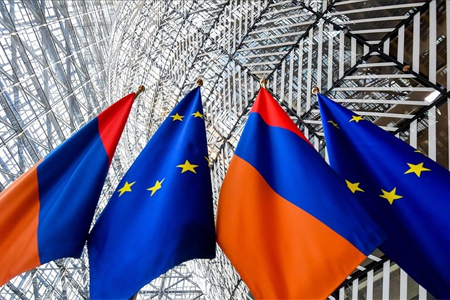
ArmInfo. Armenia's foreign trade with the EAEU has started to decrease, while it is aiming to increase trade with the EU. The foreign trade turnover between Armenia and the EAEU has shifted from an impressive 2.1-fold growth to a noticeable decline of 61.5% in annual dynamics. On the other hand, trade between Armenia and the EU, although still declining, has shown a slowdown in rates from 19% to 7.5%. As a result, the volume of Armenia's foreign trade with the EAEU was $1.01 billion in January-February 2025, and $298.6 million with the EU. This is evidenced by statistical data for January-February 2025.
Moreover, among the EAEU countries, all without exception (but to a significant extent the Russian Federation) reduced volumes, while half of the EU countries preferred to increase volumes. These countries include the Netherlands, France, Romania, Slovakia, Poland, Greece, Hungary, Austria, and Bulgaria. This change in annual dynamics has reduced the share of the EAEU in the structure of Armenia's foreign trade from 45.2% to 36.2% (with the Russian Federation decreasing from 44.4% to 35.1%), while the EU's share increased from 5.6% to 10.7%. The top five trading partners of Armenia are Russia, China, the UAE, Iran and Germany. In January-February 2025, the volume of foreign trade with these countries amounted to $978.2 million, $383.8 million, $240.9 million, $98.9 million and $60.7 million, respectively. Among these, only Iran managed to bring the dynamics from a double-digit decline to 12% growth, while the rest experienced a decline.
Russia and the UAE both experienced a significant decline in growth rates, with Russia dropping from 62.1-80% and the UAE from several times. China also saw a decrease from 84.5% growth to a 22% decline, and Germany, on the contrary, managed to visibly slow down its decline from 35.4% to 9%. In particular, in the direction of Russia, the dynamics of imports worsened from a growth of several times to a significant 74.8% decline (to $519.8 million), while exports also declined by 12.1% to $458.5 million. In the direction of China, export dynamics decreased by 75.9% , while imports increased by 41.6% to $64.3 million and $319.5 million, respectively. In the direction of the UAE, export dynamics declined by 81.1% , while imports increase by 82.1% to $226.1 million and $14.7 million, respectively.
In the direction of Iran, there was a noticeable improvement import dynamics, shifting from a double-digit decline to 16.5% growth. Additionally, there was a slowdown in the decline of exports from 18.7% to 8.8%, the values of totaled $84.6 million and $14.3 million, respectively. In the direction of Germany, there was a significant change in export and import trends: exports moved from a decline to 45.8% growth, while imports saw a slowdown from 35.4% to 18.3%. The values of exports and imports amounted to $14.1 million and $46.6 million, respectively.
In terms of exports, the top-5 include Russia, the UAE, China, Iraq ($54.8 million, with a 3.6-fold increase) and Switzerland ($20.8 million, with a 42.4% increase), and in terms of imports, the leading five are Russia, China, Iran, the USA ($51.6 million, with a 26.7% decline) and Germany.
It should be noted that Russia and the UAE have distinguished themselves in the past two years with significant volumes of exports and imports through Armenia via transit operations with precious metals and stones. However, the current industry breakdown of Armenia's foreign trade (for January-February 2025) already indicates a significant decrease in the share of precious metals and stones to 13.5% of imports and 31.1% of exports (from 55% and 70% a year ago). Let us recall that according to customs data for the first half of 2024, the lion's share of the total volume of diamond and gold imports came from Russia - 77% and 99.7%, respectively, and the dominant export of these precious metals and stones came from the UAE (77% diamonds and 64% gold) and Hong Kong (17% diamonds and 25% gold).
By the end of 2023, a similar picture had emerged, with 46.7% of diamonds and 99.2% of gold coming from Russia, and afterwards exported to the UAE (84.6% diamonds and 71.4% gold) and Hong Kong (2.7% diamonds and 25.4% gold). Armenia's foreign trade turnover for January-February 2025 was $2.8 billion, decreasing by 52% year-on-year (versus a 2-fold increase a year ago). Both exports and imports saw a decline, with a 59.7-45.8% decrease compared to the previous year. Export volumes fell to $1.04 billion and imports volume fell to $1.7 billion, respectively. Armenia's negative foreign trade balance for January-February 2025 increased by 11% per annum - to $703.7 million, with negative balances of $46 million and $150.2 million with the EAEU and EU countries.
It should be noted that the forecasts of the Central Bank of Armenia (CBA), the IMF and the WB regarding exports and imports for 2025 differ greatly. According to the CBA's expectations, after almost equal growth of exports and imports in 2024 by 35.6-31.4%, in 2025 the foreign trade turnover will be in decline: accordingly, the volume of exports is expected to decrease by 19.8-24% and imports by 19.7-22.8%. The IMF also forecasts a decline in both exports and imports for Armenia in 2025, but by a more modest 10.4% and 5.4%, respectively. The WB, unlike the CBA and the IMF, forecasts only a slowdown in the growth rates of both exports and imports for Armenia in 2025 to 5.6% and 7%, respectively.