

ArmInfo. The net flow of total foreign investment in the real sector of the Armenian economy decreased in January-March 2025 by 14.3% year-on-year, to positive $98.1 million (38.4 billion drams) from positive $114 million (44.8 billion drams). At the same time, the net flow of foreign direct investment (FDI) went from negative $73.3 million (28.8 billion drams) to positive $14.6 million (5.7 billion drams), increasing 2.2 times year-on-year. This is evidenced by the data of the RA Statistical Committee, indicated as a net flow, meaning the difference between attracted and repaid foreign investments.
The reduction in the net investment flow was caused by the negative background from the Russian Federation, which was the leader with a positive indicator a year earlier. Thus, the net flow of general investments from Russia, significantly decreasing for the second year in a row, sank to negative $13.2 million (5.2 billion drams, with the annual decline accelerating from 2.3 times to 2.7 times). Moreover, the net flow of direct investments from Russia was also in the red - $3.9 million (1.5 billion drams), having sagged 2.2 times year-on-year (after a decline of 5.2 times a year ago).
But the most significant negative net investment flow was demonstrated by Cyprus and the UAE - $32.4 million (12.7 billion drams) and $27.1 million (10.7 billion drams), respectively, with an annual reduction in the negative level of 9.3% and 32.1%, respectively. Cyprus modestly invests in the production of basic metals, wholesale trade, began to invest too restrainedly in the production of machinery and equipment, increased investments in energy projects, while significantly reducing investments in metal ore mining, the IT sector, housing construction, hotel business, financial intermediation, the real estate market, and completely zeroing out investments in retail trade.
The UAE modestly invests in the production of electrical equipment, the purchase and sale of cars and motorcycles, while significantly reducing investments in metal ore mining, cigarette production, in the transport sector, financial intermediation, and completely zeroing out investments in retail trade and aviation. Meanwhile, in terms of positive net flow of total investments, the TOP-5 countries by the results of Q1 2025 include Luxembourg, Switzerland, Canada, Singapore and the USA, with Germany and France in sixth and seventh positions. As for the leaders in terms of positive net flow of FDI, the TOP-5 countries include Luxembourg, Canada, the USA, France and Switzerland, with the Netherlands and India in sixth and seventh positions.
In particular, the net flow of total investments (entirely in the form of FDI) from Luxembourg amounted to $23.8 million (9.3 billion drams, a 66% increase over the year), and was directed to air transport, energy projects, beverage production, warehousing and auxiliary transport activities, and scientific and technical professional activities.
The net flow of total investments from Switzerland amounted to $16.8 million (6.6 billion drams, a 43.5% increase over the year), of which FDI was $2.1 million (804 million drams, a 83% decrease over the year). The lion's share of investments was directed to the extraction of metal ore, and the rest was in wholesale and retail trade, hotel business, software development and related activities in the field of IT, scientific research, while investments in housing construction decreased.
The net flow of total investments (entirely in the form of FDI) from Canada amounted to $13.6 million (5.3 billion drams, a 10.4% increase over the year), and the entire volume was directed to the metallurgical industry, while investments in the chemical industry decreased.
The net flow of total investments from Singapore amounted to $8.3 million (3.2 billion drams, a significant increase over the year by several times), and the entire volume was directed to the extraction of metal ore. The net flow of total investments from the USA amounted to $6.7 million (2.6 billion drams), with an annual increase of 13 times (with an increase in the positive level), and this is entirely FDI. The majority of American investments, as before, were directed to the IT sector, and the rest fell on the production of basic metals, housing construction, and consulting activities. However, American investments in energy projects, wholesale trade, and in the hotel business, scientific research activities have significantly decreased.
The net flow of total investments from Germany and France amounted to $3.7 million and $3 million, respectively (1.4 billion and 1.2 billion drams). Moreover, investments from Germany increased 3.3 times year-on-year (moving from negative to positive), while those from France, on the contrary, decreased significantly (staying at a positive level). At the same time, Germany continues to significantly reduce FDI (deepening into negative), while investments from France are almost entirely represented by FDI. Investments from France were mainly directed to energy projects and water management, while the rest came from wholesale trade and the tourism industry. At the same time, investments from France in beverage production and the IT sector decreased. Investments from Germany were almost entirely directed to the production of machinery and equipment, while the rest came from energy projects and wholesale trade. At the same time, investments from Germany in the production of basic metals and the IT sector decreased, while investments in the production of electrical equipment were completely zeroed out.
In 2024, the net flow of total foreign investment in the real sector of the Armenian economy decreased by 2.6 times - to negative $285.6 million from positive $479.3 million. The net flow of foreign direct investment (FDI) also ended up in the red, having dropped by 2.2 times over the year - from positive $624.1 million to negative $112.9 million. Such a pronounced deterioration in the annual dynamics with the net investment flow entering the red came from the Russian Federation and the UAE, which had previously been leading with a positive level. In particular, the negative net flow of total investment from Russia increased by 5 times in 2024 - to $156.3 million, and FDI also ended up in the red - $215.1 million (a drop of 4.8 times). The net flow of total investment from the UAE has dropped more significantly - from positive $257.6 million to negative $23.5 thousand, which was also observed for FDI - from positive $248.9 million to negative $23.4 million. The UAE has significantly reduced investments related to financial intermediation, where almost the entire volume was previously directed, and the Russian Federation has significantly reduced investments in the mining industry.
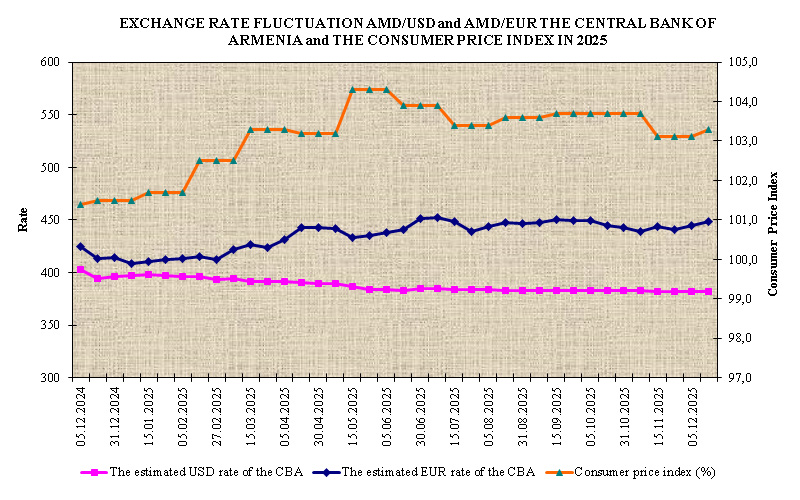
Meanwhile, in terms of positive net flow of total investment and FDI, the TOP-5 countries by the end of 2024 included Canada - $45.1 million (all FDI), the offshore island of Jersey - $40.5 million (all FDI), the USA - $36.5 million (90% - FDI), Switzerland - $28.7 million (97% - FDI), and France - $28.5 million (65% - FDI). Canada invested in the metallurgical and chemical industries, from the USA the majority of investments went to the IT sphere and the production of basic metals, Switzerland directed the bulk of investments to housing construction and the IT sphere, France directed investments to the water management and the IT sphere. As for the offshore island of Jersey, investments in this area ceased in 2018 and resumed, in fact, six years later, which, according to independent observers, could be associated with the preparation of the restart of the Amulsar gold mining project, as well as, possibly, with the construction of a number of small metal processing plants. (The estimated exchange rate of the dram against the US dollar on 31.03.2025 was 391.57 drams / $ 1, against 393.28 drams / $ 1 on 31.03.2024 and 396.56 drams / $ 1 on 31.12.2024).