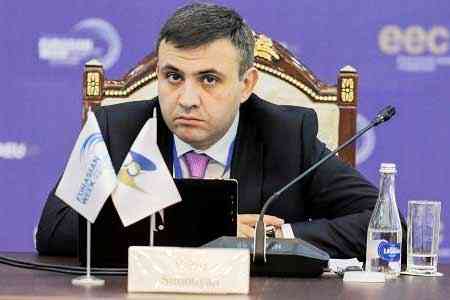
ArmInfo. The poor development of the economic component of the Crossroads of Peacce project promoted by the Armenian authorities increases the risk that the initiative will be perceived as one-sided and may not meet the expectations associated with it, according to economist and former head of the State Revenue Committee of the Republic of Armenia David Ananyan.
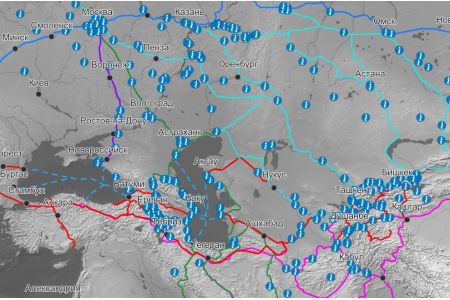
"At the beginning of September, during the summit of the Shanghai Cooperation Organization (SCO), Armenian Prime Minister Nikol Pashinyan once again took the opportunity to present the Crossroads of Peace initiative. It was interpreted as a new communication platform designed to connect the infrastructure highways of the Black, Caspian, Mediterranean and Persian Gulfs, forming the basis for economic integration and mutually beneficial cooperation. The possibility of combining and harmoniously integrating the initiative with the Chinese project "One Belt, One Road" (BRI) was particularly emphasized.
Despite strong political support, including clear statements from the PRC Chairman regarding Armenia's sovereignty, the initiative is mostly viewed as a political and diplomatic symbol, rather than a real economic opportunity," Ananyan wrote on his Facebook page.
According to the economist, from the point of view of economic feasibility, the initiative faces a number of serious limitations:
1. Limited transit potential. Armenia's transit position, although strategically important, is primarily symbolic in nature. It is unlikely that transit cargo turnover through Armenia will exceed 2-3 million tons per year, while more than 20 million tons already pass through Georgia, and about 2 million tons through Iran.
2. Low profitability. Transit, customs and service fees at the specified volumes may generate an annual income of about 10-14 million US dollars. However, taking into account the costs of infrastructure maintenance, security and labor costs, the net economic effect is unlikely to exceed 3-5 million US dollars.
3. High capital costs. Preliminary technical calculations suggest that a minimum investment of 350-400 million US dollars is necessary. This includes the restoration of lines, the construction of customs checkpoints, bridges and interchanges. However, these costs do not yet take into account political risks, security risks and other factors.
4. Lack of access to ports. Armenia will still lack direct access to sea routes. Although providing access in Turkey (Mersin, Derzey) or Azerbaijan (Aliyat) is theoretically possible, in the current regional situation this remains impractical and hypothetical. In reality, Armenia will continue to depend on the ports of Georgia (Poti, Batumi) and Iran (Bandar Abbas).
5. Uncertainty of the return on investment. Economic modeling shows that the period for a return on investment will exceed 50 years at best. Such a lengthy timeframe contradicts international standards for infrastructure financing.
"It is obvious that at this stage the initiative is more about shaping Armenia's foreign policy image. It is presented as a peacekeeping idea that can capture the attention of some international centers. However, the weak elaboration of the economic component increases the risk that the initiative will be perceived as one- sided, failing to meet the expectations associated with it.
At the same time, there is a real risk of Armenia losing sovereign control over some infrastructure facilities, especially if communication links are primarily directed towards Azerbaijan and Turkey," David Ananyan concluded.