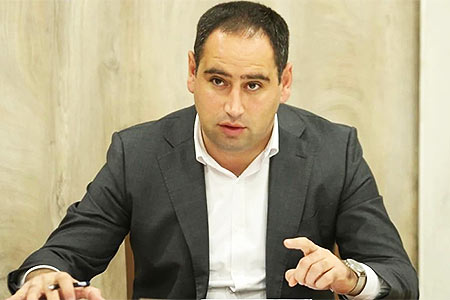



ArmInfo.Prime Minister Nikol Pashinyan attended the opening ceremony of the Business Accelerator building in Engineering City.
The Prime Minister toured the building, got acquainted with the work carried out, the created conditions. It was reported that 810.4 million drams were spent in 2024 for the construction of the building and parking lots, improvement of the territory, as well as the acquisition of equipment and furniture, and as of October 2, 2025, about 1.2 billion drams had been spent. The funds were allocated from the state budget of the Republic of Armenia.
Nikol Pashinyan also visited the Charles Aznavour National Supercomputer Center of Armenia, where the existing capabilities and the expected results of the center's activities were presented.
The Prime Minister also got acquainted with the works presented at the "Armenia- Engineering Week" exhibition, as well as the activities of PMI Science engineering laboratories.
Next, Prime Minister Nikol Pashinyan met with representatives of high-tech companies. During the meeting, the Prime Minister answered questions of interest to those present. They related to the further development of the sector, the balanced and balancing foreign policy of the Armenian Government, the ideology of Real Armenia, and other topics.
Engineering City is a public-private partnership program implemented by the Enterprise Incubator Foundation with the active and key support of the Ministry of High-Tech Industry of Armenia, in cooperation with the World Bank, the Engineering Association, and a number of private sector companies. The main goal of the program is to contribute to the development of high technologies in Armenia by forming an innovation ecosystem, where engineering and high-tech companies will have the opportunity to develop and implement innovative ideas for local and international markets using modern infrastructure.
A 3-hectare site on Bagrevand Street was selected for the creation of the Engineering City. The planned investment volume was reportedly $21.2 million, of which $10.5 million was co-financed by the government under the World Bank's "Trade Promotion and Quality Infrastructure" loan program, and the remainder was investment from National Instruments AM and a consortium of 14 joint-stock companies. The program was expected to become cost-effective in its fourth year of operation. The project planned to train and retrain 1,500 specialists in engineering and high technology, create 2,000 new jobs, and establish 20 new enterprises in the sector.