ArmInfo. As of October 1, 2025, the Armenian plastic market contained over 4.7 million cards, with an annual growth rate of 15%. Moreover, the number of microprocessing cards with NFC chips has almost doubled in three years, including a 26% year-on-year increase, reaching 3.9 million, or 83% of the total number of cards, according to data from the Central Bank of Armenia.
Visa holds the largest share of NFC-enabled microprocessor cards, accounting for 55.3% or 2.153 million units. Mastercard make up 26% or 1.013 million units. Local ArCa cards account for 9.7% or 377,200 units. Other international cards account for 9% or 354,100 units. It's worth noting that ArCa microprocessor cards have experienced significant quarterly growth since 2024, doubling their annual sales, driven by the increased use of local chips. Against this backdrop, despite the relatively modest annual growth rate, double-digit growth for leading microprocessor cards, Visa, continued at 21%, outpacing Mastercard, whose growth accelerated from 12.3% to 14.6%. However, growth slightly lagged other international cards (including AmEx, Diners Club, MIR, and UPI) at 24% (versus 38% a year ago, including HSBC cards, which withdrew from the Armenian market in November 2024).
Virtual cards also showed strong growth, despite a slowdown from 2.3 times to 52%. Their number reached 413,135 units, with their share of the total number of cards increasing from 6.7% to 8.7%. While until mid- 2022, these were exclusively Visa cards, Mastercard cards were added in Q3. This annual growth of virtual cards is supported by a more significant increase for Mastercard - three times greater than for Visa - at 44.4%. However, Visa dominates in terms of quantity, with 373,260 units.
Additionally, the number of magnetic stripe cards is declining - by half year-on-year, to 380,593 units, bringing their share of the total number of cards down to 8%, while the share of microprocessor cards with NFC chips has already reached 83%. Almost all magnetic stripe cards are local ArCa cards, which, given their affordability, were primarily issued to pensioners for pension receipts and cashless payments.
The share of hybrid cards has already fallen to 0.4% of the total number, amounting to 19,368 units. With a year-on-year decrease of 1.6 times, which was due to a similar decline in the dominant Visa and Mastercard, and the ongoing decline of local ArCa cards.
Co-badged ArCa-MIR cards were reset in Q3 2025. It's worth noting that in February 2024, NSPK MIR was placed on the sanctions list, and as of March 30, the linking of the national card systems of Armenia and Russia-ArCa and MIR-was suspended, leading banks to refuse to service MIR cards. Only VTB Bank (Armenia), which began issuing MIR cards in mid-2022 and has its own processing facility, continued to service them.
Visa cards continue to drive the annual growth in the total number of cards, increasing by 25% year-on- year to 2.531 million, increasing their share from 50.2% to 53.6%. Mastercard cards increased by 16% year-on-year to 1.066 million units, their share of the total increasing from 22.5% to 22.6%. Meanwhile, local ArCa cards, after a 5% decline, totaled 770,302 units, significantly lagging behind Mastercard in both quantity and share penetration at 16.3% (compared to 19.8% in 2024).
Other foreign cards (including AmEx, Diners Club, MIR, and UPI) totaled 354,258, representing a 16% year-over-year increase and maintaining their share of the total at 7.5%. Debit cards continue to dominate the overall card mix, accounting for 66.4% or 3.135 million cards, followed by debit cards at 33% or 1.559 million cards. The share of credit cards increased slightly to 0.6% or 27,420,000 cards. Moreover, the number of debit and debit cards continues to grow, by 16.3% and 13.6% annually, respectively. As for credit cards, they saw a significant decrease by half in 2022, followed by a modest 1.5% growth in 2023. In 2024, there was a significant decline- 3.4 times. However, starting in 2025, quarterly growth was observed, which amounted to 44% over 9 months. Previously, Visa only held the lead only in debit and charge cards, and Mastercard was the leader in credit cards. However, starting in the fourth quarter of 2022, Visa began to displace Mastercard from the leading position in credit cards as well. As a result, by October 1, 2025, there were already approximately 1.5 million Visa debit cards, over 1 million Visa charge cards, and over 17,700 Visa credit cards.
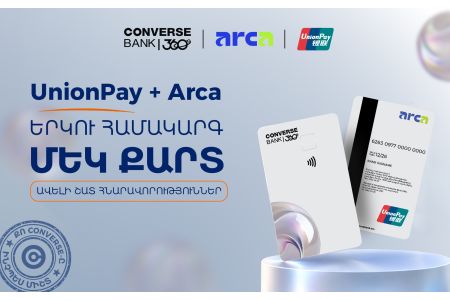
It should be noted that the UnionPay International (UPI) payment system cards have recently been issued and serviced by three Armenian banks: Acba Bank and Converse Bank (since May 2024) and Evocabank (since September 2024). Moreover, Acba Bank has been servicing cards of this system since October 2019. Regarding HSBC cards, with the completion of the merger of HSBC Bank Armenia with Ardshinbank on November 29, 2024, these "nominal" cards of the foreign bank "departed" from the Armenian market, and cardholders were offered Visa or Mastercard instead.
Recall, an important technological solution was introduced in 2024: the ability to accept ArCa card payments online through the EMV 3DS 2.0 EPS Armenian Card domain, ensuring the security of online ArCa card payments for all Armenian banks, regardless of the platform they are processed. In November 2024, Armenian Card launched the ArCa Pay instant express payment system, which was immediately joined by Ameriabank, Evocabank, Converse Bank, and AMIO Bank. There are plans to connect all banks and payment and settlement organizations in Armenia to this system virtually. According to the Central Bank's decision, a requirement to ensure interoperability for payments or transfers using QR codes (a single QR code image installed by banks and payment and settlement organizations at points of sale and/or services) came into effect in October 2025. In October 2025, Armenian Card launched the ArcaQR system-everyday payments using a QR code directly from a bank account. Ardshinbank, Ameriabank, Converse Bank, Araratbank, Evocabank, and Armeconombank immediately announced their participation.