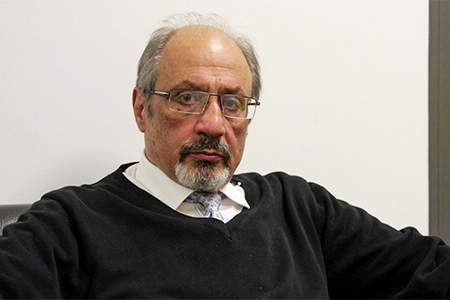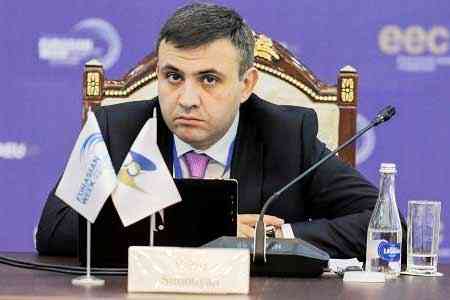
ArmInfo. The import of Azerbaijani fuel to Armenia is not just a transaction. It is a symptom. It is a symptom of the fact that Armenian economy operates without a political goal (or, even more frightening, with targeted political leadership), without a national strategy for capital development, and without responsibility for the broader context in which the Armenian state exists, as stated by David Ananyan, former head of the State Revenue Committee, former Deputy Minister of Finance of Armenia, economist, and member of the "Wings of Unity" political initiative.
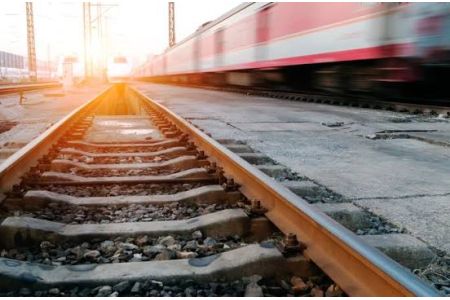
The day before, Azerbaijani media reported that the first shipment of SOCAR petroleum products (22 railcars of AI-95 gasoline produced by SOCAR) would depart fromAzerbaijan for Armenia that same day. It was noted that the export was purely commercial in nature and the gasoline would be sold at prices in line with international market prices. Prime Minister Nikol Pashinyan confirmed this at a briefing later that day, noting that the peace established between Armenia and Azerbaijan had created the political conditions necessary for such commercial exchanges. Speaking about the possibility of continuing cooperation with Azerbaijan in that particular area, the prime minister highlighted certain issues related to transit tariffs through Georgia, expressing hope that those issues would be resolved. According to David Ananyan, the public outcry over the import of the first shipment of gasoline from Azerbaijan to Armenia naturally has an emotional and political component. However, if we approach this issue from the perspective of an impartial political-economic analysis, the picture turns out to be much deeper and more troubling than it might initially appear, he noted. "Let's start with the simple and obvious. Countries that don't produce essential goods for their economies, such as energy, are objectively compelled to import them. In this sense, diversifying import sources should not be seen as a negative phenomenon. Moreover, from a narrow economic standpoint, it can be viewed as a risk-mitigation tool. However, this is where simple economic interpretation ends and a true political-economic analysis begins," the economist wrote on social media.
Thus, any import, regardless of the type of product, means one thing in macroeconomic terms: the exporting country's gross domestic product (GDP) is financed by that country's gross domestic consumption. In other words, when Armenia imports Azerbaijani gasoline, the money paid by Armenian consumers, converted into foreign currency, directly contribute to Azerbaijan's GDP. This is not a moral judgment or a rhetorical ploy. It is a classic macroeconomic fact. "Opponents may object that this is merely an economic decision made by private businesses to maximize profits. And this argument would be acceptable if the state did not have a constitutional obligation to conduct economic policy. This is where the true depth of the problem becomes apparent," he emphasized.
In modern states, private business does not operate in a political vacuum, the expert reminds. It operates within a value-based, institutional, and incentive environment shaped by public policy. And one of the key components of this environment is public policy that encourages corporate responsibility. "In our understanding, a corporately responsible enterprise is one that: - pursues the strategic goal of building national capital, - carries out export-oriented or import-substituting activities, - and, in principle, does not finance the economies of countries with which Armenia does not have diplomatic relations, or which are hostile or openly hostile states. This is not idealism. It is economic rationality based on state interests. The fact that there is currently no discussion at state level about which countries should encourage imports and which should restrict or hinder them is evidence not of 'market freedom', but of opportunistic economic behavior. Or, more precisely, it is indicative of the absence of economic policy.
When the state fails to define the framework of its national economic interests, the market itself begins to act, driven by short-term profit. And short-term profit never builds security, sovereignty, or long-term development," the expert is convinced. "The economy cannot be 'apolitical.'" And when it is presented as such, in reality the country simply becomes a state with an economy that has forsaken politics," David Ananyan concluded.