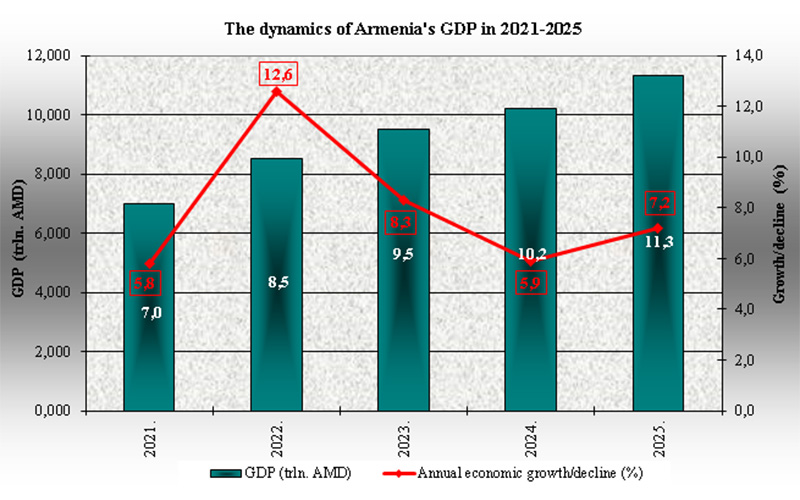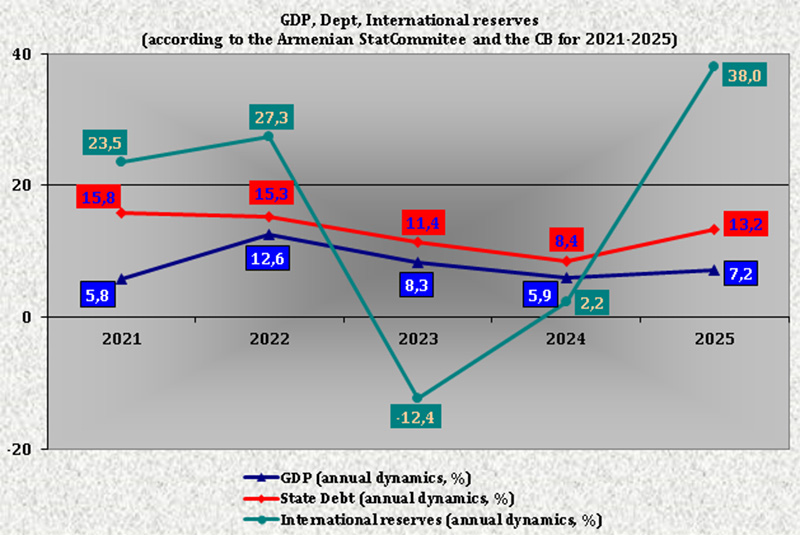


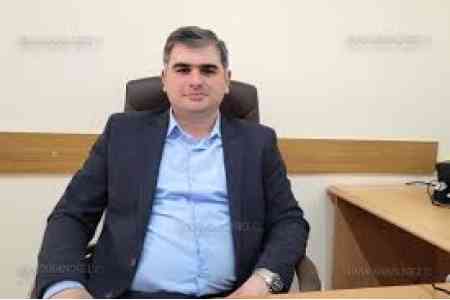
ArmInfo. Presenting his study "Armenia's Mining Sector in Figures," economist Suren Parsyan noted that the mining industry's share of Armenia's GDP fell from 5.5% to 2.6% between 2021 and 2024.
The decline in this indicator, he said, was due to the war in Ukraine, which led to accelerated economic growth, as well as the war in Artsakh, which caused certain issues with the exploitation of the Sotk gold mine. According to the study, the Sotk mine, operated by GeoPromining Gold and one of Armenia's largest mining assets, was forced to suspend operations at its high-productivity open pit mine in April 2023 due to persistent shelling from Azerbaijani military positions. This forced the company to focus exclusively on the much smaller underground mining operation, severely limiting production capacity and economic output. "Overall, this downward trend in the sector's output-to-GDP ratio reflects both the impact of cyclical commodity price fluctuations and existing structural challenges within the sector. However, despite its relatively modest direct contribution to GDP, the mining sector has broader economic significance in terms of exports, employment, and its impact on regional development," he noted.
Specidially, the economist noted that mining is a primary driver of high wages in Armenia. In the Syunik region, the average salary in the sector ranges from 800,000 to 830,000 drams, in the Kotayk region - 450,000 to 500,000 drams, and in other regions - from 200,000 to 300,000 drams.
The sector also has a significant impact on the country's poverty rate. Specifically, as Parsyan noted, while the poverty rate in Armenia was 23.7% in 2023, in Syunik, where the largest mining enterprise, the Zangezur Copper and Molybdenum Combine (ZCMC), is located, the figure was 7% (6.2% in 2024), and in the Lori region, where the Teghut mine is located, it was 14.2%. "That is, we can say that in every region, the mining industry has a significant social impact, addressing the important issue of poverty," he noted. In Yerevan, which accounts for over 60% of the gross domestic product, 43.5% of jobs, and 78% of the wage bill, the poverty rate for the reporting period was 17.9%. Citing data provided by the State Revenue Committee, he reported that as of 2024, there were 403 industrial enterprises in Armenia, with 41 being inactive, as well as 99 metallurgical enterprises, with 12 being inactive.
The sector's turnover amounted to 520 billion drams in 2024 (compared to 540 billion drams in 2022). According to the economist, there will be a slight improvement in 2025, due to changes in metal prices and increased ore volumes. As of July 2025, 13,000 people are employed in the sector, 4,500 of whom are ZMMC employees with an average salary exceeding 800,000 drams. He noted that the reason for such high wages in Syunik is the large-scale operations of the Zangezur Copper and Molybdenum Combine. Specifically, 40-45% of the Syunik region's population is employed in the mining industry, 30% in agriculture, about 15-20% in the service sector, and about 10% in construction, transportation, and trade. "Thus, the ZCMC segment in the Syunik region provides wages approximately 2-2.4 times higher than in other regions. In the Kotayk region, for example, wages are in line with the national average. In other regions, mining is carried out on a small scale and does not provide high incomes, resulting in a low standard of living and relatively low wages," the study states.
The study also examined the mining industry in the context of investment. Parsyan noted that this sector has been the most attractive for investment for years. According to the study, from 2014-2024, investments in the mining sector amounted to 159.3 billion drams (approximately $600-700 million), which corresponds to 17.3% of total national investment flows. Of this amount, approximately $350-370 million was allocated for the launch of the Amulsar gold mine. The economist noted that investment in this sector has declined significantly in 2024, but the restart of the Amulsar mine (suspended in 2019 for environmental reasons - Ed.) could improve the situation. "The successful implementation of the Amulsar project and the further development of existing facilities will be important indicators of Armenia's ability to implement large-scale mining projects," he noted. Over this ten-year period, Germany, the United Kingdom, Russia, Cyprus, Switzerland, and other countries have primarily invested in the sector.
The study notes that Germany has historically been the largest source of investment in Armenia's mining sector, primarily due to the long-term involvement of German industrial groups in the Zangezur Copper and Molybdenum Combine. This partnership has brought advanced technologies, environmental standards, and operational experience to the Armenian mining industry. The volume of accumulated German investments has amounted to 120 billion drams. Switzerland is next in terms of accumulated investment (44 billion drams), followed by the United Kingdom (34.5 billion drams), Russia (34.1 billion drams), and Canada (30.7 billion drams). As the economist noted, by the end of 2024, the industry had paid 130 billion drams in taxes, with 102 billion drams being ZCMC's share. In this regard, he emphasized that the company has a significant impact on the country's economy. At the same time, the expert noted that the tax burden for the industry in 2024 was 25.6% (compared to 36.5% in 2022), which is nevertheless quite high compared to the national average.
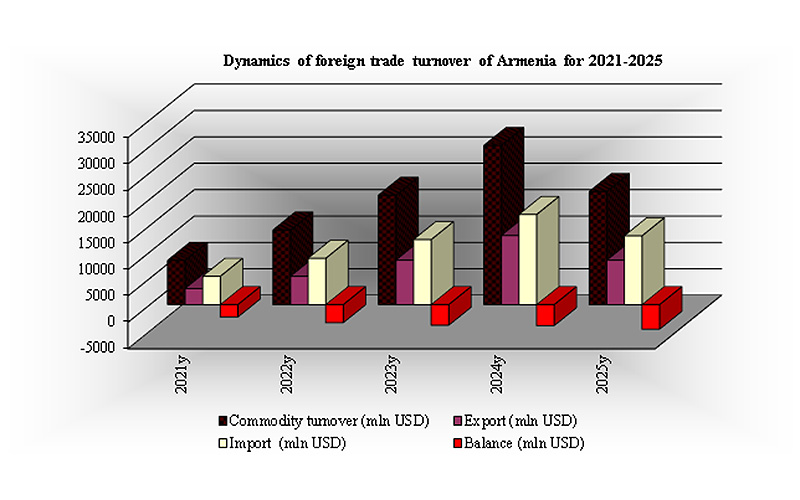
Presenting the study results, Parsyan emphasized that mining is a completely export-oriented industry. In this regard, he pointed out that 100% of the metallurgical industry is exported, while the share of alcohol exports accounts for 50% of total production, cigarettes - 70%, and so on. Parsyan added that in 2021, mining accounted for 30.6%, or 1/3, of Armenia's total exports. This figure dropped to 17% in 2022, 9.4% in 2023, and 7% in 2024. "However, excluding re-exported goods (for example, gold, diamonds, telephones, household appliances, cars, and vehicles), the share of ores and concentrates exports in 2024 will account for 22.6%," the economist said.
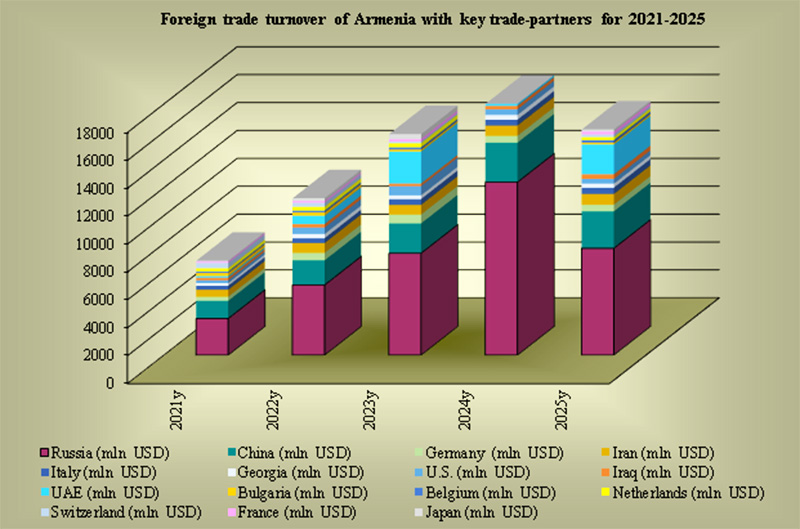
China has become the dominant export market in recent years, increasing its share from 38.5% in 2020 to 52.2% in 2024, followed by Switzerland, Belgium, Bulgaria, Russia, and other countries. "The mining industry has a significant economic impact in several regions, contributing to job creation and budget revenue generation. However, environmental issues and social inequality often lead to certain tensions. To maximize the positive impact of the industry, more transparent management, effective oversight, and responsible social policies are necessary," the study states.
It should be noted that, according to the RA Statistics Committee, in January-October 2025, the mining and open-pit mining industry recovered from an 8.1% decline to a 1.2% growth, reaching 410.7 billion drams. In October alone, a growth of 4.1% was recorded, reaching 50.2 billion drams.