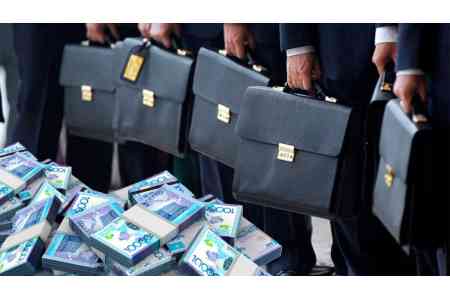
ArmInfo. The net flow of total foreign investment into the real sector of Armenia's economy decreased threefold in January-September 2025 compared to the same period in 2024. It dropped from a positive $246 million (95.2 billion drams) to a negative $221 million (84.5 billion drams).
At the same time, the net flow of Foreign Direct Investment (FDI) remained in positive territory, doubling year-on-year from $42 million (16.1 billion drams) to $88.2 million (33.7 billion drams). According to the RA Statistical Committee, this increase in FDI was achieved thanks to significant direct investments from Luxembourg and new inflows starting to arrive from Moldova.
This decline in total investment would have been even more substantial-especially given the sharp drop in inflows from Russia, Canada, and Germany, and the zeroing out of investments from Jersey-if not for the noticeable increase in funding from the USA, Luxembourg, Switzerland, Kazakhstan, and Singapore, as well as new investments coming from Moldova, Qatar, and Ireland.
Canada recorded the highest negative net investment flow at $232.8 million (89.1 billion drams). This consisted entirely of FDI and represented a more than tenfold annual decline (dropping from the fourth- largest positive level a year earlier). Previously, almost all Canadian investment was directed toward the mining industry, with the remainder going to the chemical industry, law, and accounting. Russia followed with a negative net investment flow of $152 million (58.1 billion drams). Just a year ago, Russia held the top position for positive indicators, but it now ranks second for negative flows (after Canada). Russia's net FDI flow also turned negative, reaching $77.3 million (29.6 billion drams). On a year-over-year basis, total investments from Russia decreased fivefold, while FDI decreased 3.8-fold.
Russia significantly reduced investment in metal ore mining and other mining sectors, clothing manufacturing, construction, real estate transactions, wholesale and retail trade, electricity and gas supply, and financial intermediation. Investments in pharmaceutical production were completely eliminated. At the same time, small amounts of investment were directed to telecommunications, research and development, law and accounting, household services, ground transportation (South Caucasus Railway), computer manufacturing, electronic and optical equipment, food and beverage production, crop production, livestock farming, and fisheries.
Germany follows in terms of its highly negative net investment flow, with $94 million (35.8 billion drams), with only a small portion represented by FDI. Furthermore, net investment from Germany was negative in 2024, but has now increased 30-fold. Investments in energy projects, as well as in the production of basic metals, have been largely curtailed, while investments in electrical equipment manufacturing have been completely eliminated, and only small amounts have been retained in wholesale trade, software development, and related IT activities.
Sweden and the UAE occupy the fourth and fifth positions in terms of negative net investment flow, with $27.7 million (10.6 billion drams, excluding FDI) and $21.7 million (8.3 billion drams), respectively, with only a small portion is represented by FDI. Moreover, net investment from Sweden in 2024 was positive, but has now declined by 3.4 times, entering the negative zone. The UAE's negative level has deepened by 26%. Sweden has primarily reduced its dominant investments in mining and food production, while modestly resuming investment in wholesale trade. The UAE has primarily reduced investments in cigarette production, metal ore mining, electrical equipment manufacturing, transportation, and financial intermediation, while resuming investment in other mining sectors, slightly increasing investments in the wholesale and retail sale of automobiles and motorcycles, but completely zeroing out on investment in retail trade and air transport.
The United States leads in positive net investment flows for the first nine months of 2025, with $222.4 million (85.1 billion drams), with only 7.2% represented by FDI. Year-on-year, net investment from the United States jumped more than ninefold, but FDI as a share of its total investment decreased by 27%. The bulk of this investment went to the mining industry, while the remainder went toward software development and related IT activities, as well as housing construction. Additionally, investment in the production of basic metals, energy projects, wholesale trade, the hotel business, and research and development was reduced. Investments in cigarette production ceased completely. Luxembourg ranked second in terms of positive net investment flow (entirely FDI) at $80.1 million (30.6 billion drams, with an annual growth rate of 5.4 times, turning negative). It directed the bulk of its investment into air transport, with the remainder going into energy projects, beverage production, warehousing, and support services for transport, while simultaneously reducing its already modest investments in scientific and technical professional activities. Kazakhstan ranked third in terms of positive net investment flow at $54.5 million (20.8 billion drams, with an annual growth rate of 2.5 times). While previously this figure was entirely FDI, its share is now negligible. Kazakhstan primarily directed its investments into metal ore mining, a sector it had not previously invested in, while the remainder, as before, went into law and accounting. Singapore ranks fourth in terms of positive net investment flow, with $50.3 million (19.2 billion drams, a 5.6-fold annual increase and a decline in net investment), although no FDI flows from this sector. Singapore's investments, as before, are entirely directed toward metal ore mining.
Switzerland rounds out the top five in terms of positive net investment flow, with $42 million (16.04 billion drams, a 57.3% annual increase), of which FDI accounts for 23% (3.7 billion drams, a 55.4% year-on-year decline). For the first time, the bulk of Swiss investment went toward metal ore mining, with the remainder going toward wholesale and retail trade, software development and related IT activities, the hotel industry, research and development, and some investments in advertising and market research. At the same time, investments in housing construction and energy projects have been reduced. Investments from Moldova were entirely in the air transport sector, amounting to $10.2 million (3.9 billion drams).
It should be noted that the net flow reported in the statistical report is the difference between attracted and repaid foreign investment.
Recall , in 2024, the net flow of total foreign investment into the real sector of the Armenian economy decreased by 2.6 times, from a positive $479.3 million to a negative $285.6 million. The net flow of foreign direct investment (FDI) also fell by a factor of 2.2 over the year, from a positive $624.1 million to a negative $112.9 million. This marked deterioration in annual dynamics. Net investment flow entering the negative, came from Russia and the UAE, which had previously led with positive levels. In particular, the negative net flow of total investment from Russia increased fivefold in 2024, reaching $156.3 million, with FDI also in the red, at $215.1 million (a 4.8-fold decline). The net flow of total investment from the UAE declined even more significantly, from a positive $257.6 million to a negative $23.5 million. The same was true for FDI, which fell from a positive $248.9 million to a negative $23.4 million. The UAE significantly reduced investments related to financial intermediation, where almost all of its investment had previously been directed, while the Russian Federation significantly reduced its investments in the mining sector. Meanwhile, in terms of positive net flow of total investment and FDI, the TOP-5 countries by the end of 2024 included Canada - $45.1 million (all FDI), the offshore island of Jersey - $40.5 million (all FDI), the United States - $36.5 million (90% - FDI), Switzerland - $28.7 million (97% - FDI), and France - $28.5 million (65% - FDI). Canada invested in the metallurgical and chemical industries. The United States mainly invested in the IT sector and the production of basic metals. Switzerland directed the majority of investments to housing construction and the IT sector, and France directed investments to the water management and IT sector. As for the offshore island of Jersey, investments from this direction ceased in 2018 and resumed, in fact, six years later, which, according to independent observers, could be connected with preparations for the restart of the Amulsar gold mining project, as well as, possibly, with the construction of several small metalworking industries. However, in 2025, investments from Jersey ceased again. (The calculated exchange rate of the dram against the US dollar on 30.09.2025 was AMD 382.52 / $ 1, against AMD 387.29 / $ 1 on 30.09.2024 and AMD 396.56/ $ 1 on 31.12.2024).