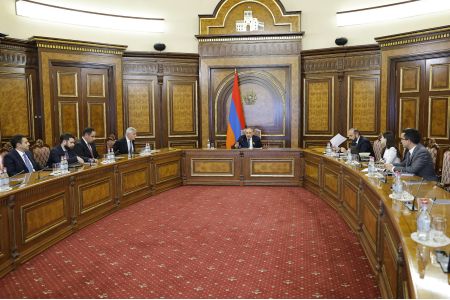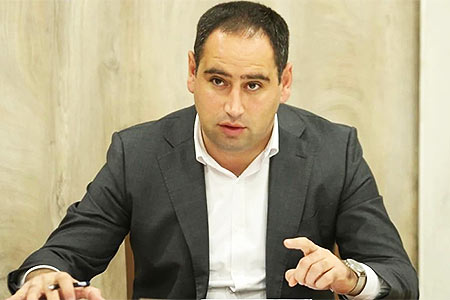
ArmInfo.Armenia's average annual GDP growth in 2021-2025 (calculated for 2025) reached approximately 8.13%, surpassing the government's target of 7.0% for 2021-2026. Economy Minister Gevorg Papoyan presented these figures to Armenian Prime Minister Nikol Pashinyan during a meeting at the Ministry to discuss the ministry's 2025 performance report.
According to the press service of the Armenian government, Papoyan described 2025 as a favorable year for the Armenian economy. According to him, growth of 6.0% was recorded in January-September 2025 compared to the same period in 2024. It was also noted that the economy has grown by more than 50% since 2018, and GDP per capita reached $8,560 in 2024, compared to $3,800 in 2017.
Regarding economic activity, it is reported that the economic activity index was 8.3% in January- November 2025 compared to the same period in 2024. Positive growth was recorded in industry (0.5%), services (10.9%), trade (3.0%), and construction (20.1%). In the agricultural sector, growth of 6.0% was recorded in January-September 2025, and the annual indicator is projected to range from 5.0 to 6.0%. Speaking about productivity, Papoyan noted that, according to 2024 data, productivity in Armenia was $10.3 per person per hour, an increase of more than 1.7 times compared to 2017. He stated that if current trends continue, it is entirely possible to achieve the target of $12 per person per hour set for 2026.
Regarding international business environment assessments, the World Bank's Business Ready for 2025 (B- READY) report was mentioned, where Armenia had received a score of 66.7, which is 6.6 points higher than the average of the countries assessed (60.1). According to analytical calculations conducted by the Ministry, Armenia ranks 37th out of 101 countries.
Regarding the 2025 budget, the Ministry of Economy utilized 97.2% of its allocated 79 billion drams, totaling 76.8 billion drams. Funding was distributed across 10 programs and 93 specific initiatives, with execution rates of 99.3% in industry, 96.3% in agriculture, and 83.0% in tourism.
Papoyan also presented to Pashinyan the work done to digitalize the Ministry's processes and procedures, noting that several electronic platforms are operational within the system: the sale of standardization documents, a measuring instrument calibration system, the ANI PAS information system, accreditation and conformity assessment registries, and electronic systems for accepting applications for intellectual property.
During the reporting period, the foundation of a value chain management system for agricultural (grape) products was developed and implemented to ensure traceability of wine products, regulate the procurement process, and prevent fraud. Interactive vineyard zoning maps were created as well.
The application process for irrigation and hail protection programs has been digitized, and the verification of data received from financial institutions has been automated. He also announced that an automated electronic accreditation system has been implemented since December 2025 to fully digitalize the accreditation process. ArcGIS Enterprise is used for spatial data management to create and update thematic layers for agricultural programs. It was noted that the Ministry has a digitized system, but applications are still accepted in paper form.
In this context, the Armenian Prime Minister noted that the next step should be to completely eliminate paper from the system. He stated that digitalization is also of interest to the authorities from the standpoint of ensuring traceability and control. The Prime Minister stated that the introduction of digital technologies will make life easier for citizens by reducing their expenses. Pashinyan then asked Papoyan whether it would now be possible to see on a map, for example, which sectors have drip irrigation systems installed, and received a positive response. "Nine levels have been digitalized, to which another five will need to be added. After that, we need to add other levels, for example, industrial enterprises and their capabilities," the Minister of Economy clarified.
The head of government was also informed that Armenia currently has 4,630 hectares of intensive orchards. The government's 2021-2026 program envisaged the annual creation of 1,000 hectares of intensive orchards, but over 4.5 years, more than 4,600 hectares have been created.
As part of the Productivity Enhancement Program, it was noted that from its launch until the end of 2025, the loan and leasing portfolio amounted to approximately 439 billion drams, the number of beneficiaries was 4,976, the number of contracts signed was 8,841, and 13,660 units of machinery and equipment were purchased. In 2025 alone, the amount of subsidies amounted to approximately 22.9 billion drams.
Papoyan also stated that the aforementioned machinery and equipment does not include agricultural machinery and equipment, but rather relates to construction, industry, healthcare, and other sectors. He added that 3,969 units of agricultural machinery have been purchased over the past 4.5 years, while the government's 2021-2026 program provides for the annual acquisition of 250 units of agro-processing equipment, but 2,832 units have already been purchased. The agri-food sector's lending portfolio amounted to 23.3 billion drams, while the agricultural machinery leasing program's portfolio also amounted to 23.3 billion drams.
The slaughterhouse organization process and the state support program were then addressed. The Minister of Economy noted that two companies have currently benefited from the government program, and emphasized the importance of policies aimed at tightening and stimulating slaughterhouse regulations. In the area of intellectual property, a draft strategic program for 2026-2030 was developed in 2025, and analytical work was conducted. As for export promotion, the adoption of an export strategy for 2025-2030 and the organization of participation in international exhibitions were mentioned.
In the area of competition and consumer protection, the adoption of relevant legislative amendments in 2025 was noted and in the area of green development, the adoption of a green economy taxonomy and the approval of a framework action plan for the development of a green, sustainable, and circular economy were presented. Papoyan also presented priorities for the first half of 2026. The government, however, did not provide details on this matter.