

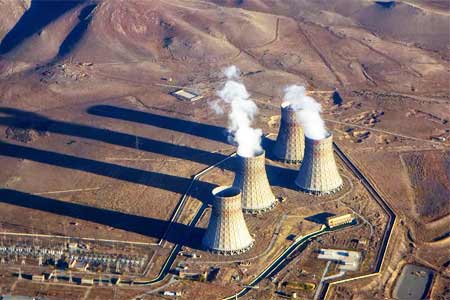
ArmInfo. Back in 2018, the Armenian government decided to build a Backup Crisis Center for the Armenian Nuclear Power Plant. However, the established deadlines "were not met for a number of objective and subjective reasons." This is stated in the draft resolution of the Armenian government dated February 19 "On the Contribution of Assets to the Authorized Capital of Armenian Nuclear Power Plant CJSC."
As stated in the explanatory note to the Cabinet of Ministers' resolution, the development of this draft resolution is necessary to ensure the implementation of the RA Government Resolution of May 3, 2018 (Construction and Armament of the Backup Crisis Center) for the Armenian Nuclear Power Plant in accordance with the requirements of the International Atomic Energy Agency (IAEA), the World Association of Nuclear Operators (WANO - unites all operators), the Nuclear Safety Regulatory Committee of the Republic of Armenia, and the Basic Safety Rules for Nuclear Power Plants.
It is noted that, within the framework of the aforementioned resolution, an industrial zone with a total area of 2.2812 hectares located at 50/12 Ts. Isakov Avenue, Yerevan, Malatia-Sebastia was measured and demarcated. As a result, a 0.1717 hectare area was allocated and assigned the address: 50/22 Ts. Isakov Avenue, Yerevan, Malatia-Sebastia. A procurement procedure for the construction of the Backup Crisis Center was announced, following which a contract was signed with BIDEK LLC on April 13, 2024.
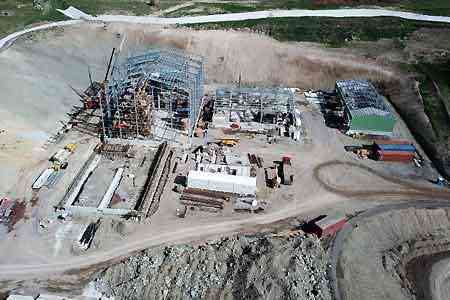
In accordance with the terms of the contract, BIDEK LLC began construction of the Backup Crisis Center. However, according to the state title deed for the property located at the specified address, the property belongs to the Republic of Armenia, which prevents ANPP CJSC from conducting a number of transactions related to this property, such as concluding contracts for the provision of communication services, paying property taxes, etc.
Furthermore, the deadlines set forth in paragraph 6.7.1 of the Appendix to the RA Government Resolution of May 3, 2018, "were not met for a number of objective and subjective reasons."
Initially, the backup crisis center was planned to be built on the premises of ANPP CJSC's boarding house, located in the Aknalich district of Armavir Region. This was not implemented because the requirement to be located outside the ANPP emergency protection zone was not met.
Later, the possibility of constructing the facility on the third floor of the production workshop at 50 T. Isakov Avenue, Malatia-Sebastia, Yerevan, was considered. However, during discussions with the IAEA, WANO, and the RA Nuclear Safety Regulatory Committee, a change in construction location was proposed based on safety requirements. Construction in the basement proved more feasible due to the greater protection basements offer from both potential radiation accidents and civil safety threats. As a result, certain adjustments were necessary to the technical requirements for the Backup Crisis Center, which were also used to develop the technical specifications for the design of the Backup Crisis Center. The technical requirements stipulated that the construction schedule for the Backup Crisis Center be prepared only after final approval of the design documentation.
During the design process, multiple working discussions were held with interested experts, and after the project's completion, an expert review of the design and estimate documentation was conducted.
The aforementioned measures were highly labor-intensive, resulting in the established deadlines not being met.
The draft resolution of the Cabinet of Ministers of Armenia states that the construction of the Reserve Crisis Center will be completed and the property will be invested in the authorized capital of the closed joint-stock company "Armenian Nuclear Power Plant" with an estimated market value of 98,023,000 drams, thereby increasing the authorized capital of the Company.
It's worth noting that the Armenian Nuclear Power Plant (ANPP) accounts for approximately one-third of Armenia's electricity generation. In 2026, the ANPP will enter the active phase of the second lifespan extension program for Unit 2. $165 million saved during the first program will be allocated for this purpose. This explains the length of the ANPP outage (this year, the plant will be shut down for 150 days for scheduled maintenance and refueling, compared to 30-45 days last year). The project will include modernization of the reactor cooling systems, safety systems, main circulation pumps, and other upgrades. Following the project's completion, the unit is expected to operate until 2036, by which time a new nuclear power unit is scheduled to be built in the country.