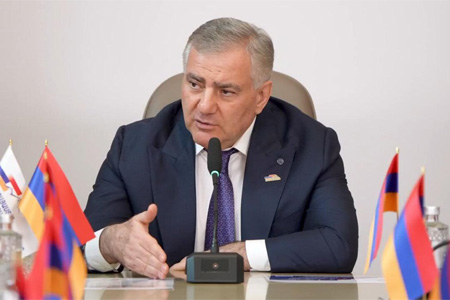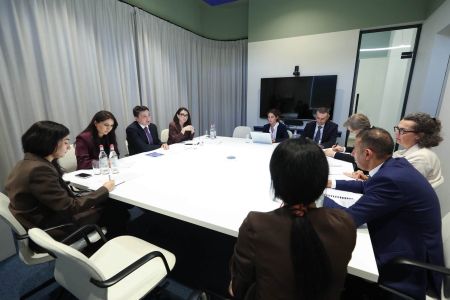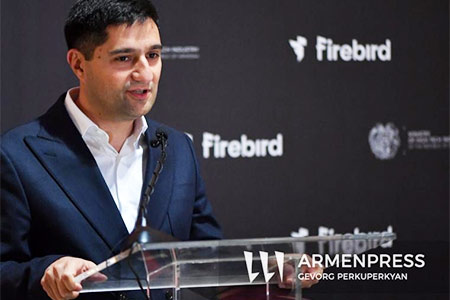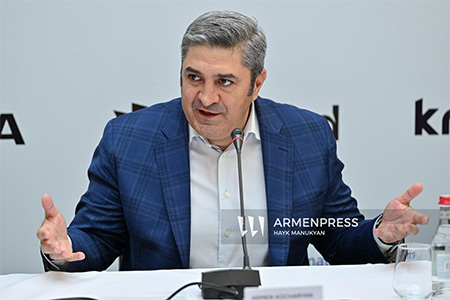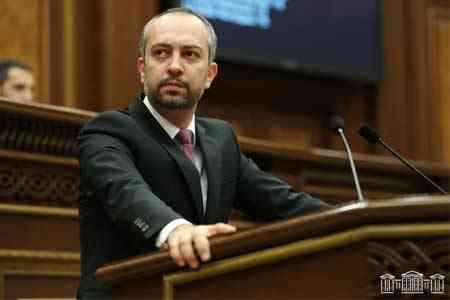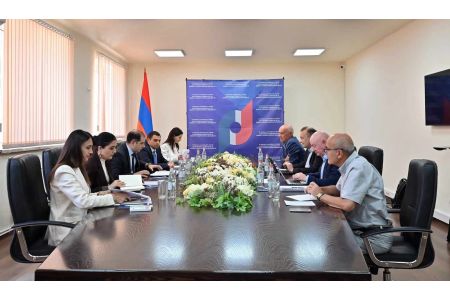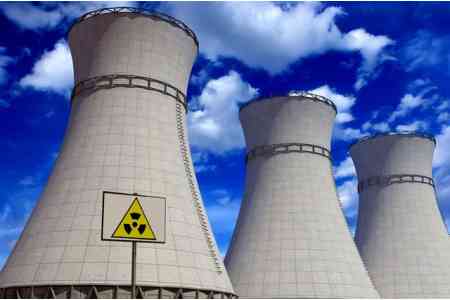
ArmInfo. The State Atomic Energy Corporation Rosatom guarantees the operation of the Armenian Nuclear Power Plant (NPP) in Metsamor in compliance with the highest quality standards, allowing it to act as a stabilizer and a powerful energy support for Armenia's development, as stated by Dmitry Litskaya, Advisor at the Russian Embassy in Armenia, at a press conference in Yerevan "BRICS+ Cooperation in Nuclear Energy."
He emphasized that, in its interactions with BRICS countries, Russia actively supports the development of nuclear energy. Russia views the organization as a platform for a more equitable world order, where each country's choices are respected, its interests are taken into account, and there is a willingness to compromise, which is especially relevant in the context of modern conflicts and global crises.
"Within BRICS, this has all been worked out, and as a result, the organization is attracting new members. Currently, it includes major countries from Eurasia, Africa, the Middle East, and Latin America. BRICS spans a third of the globe, with its countries accounting for 40% of the global economy. These countries are becoming a driving force for economic development and are exploring opportunities to expand dialogue in various areas of cooperation, including economics, culture, science, and education," Litskaya noted.
The Russian Embassy Advisor also mentioned progress in transportation, logistics, and insurance. He also noted that environmental and energy issues are becoming increasingly pressing today amid global events, which in turn leads to fluctuations in oil prices and supply.. In these circumstances, he said, nuclear energy serves as a reliable stabilizer.
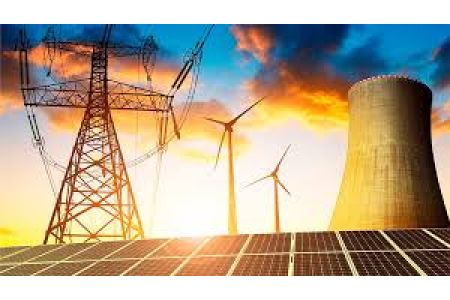
"Countries with nuclear energy are not dependent on external supplies or price fluctuations in the global market, as nuclear energy is environmentally friendly and has long-term development potential. Russia holds a leading position in this field, and the state corporation Rosatom controls half of the global market, combining expansion with high quality and safety. In fact, it is the only corporation in this field," Litskaya emphasized.
He cited the the Armenian Nuclear Power Plant in Metsamor, which cooperates with Rosatom, as a clear example of the state corporation's technological and technical excellence. "Rosatom ensures the station's operation meets all the highest quality standards, allowing it to serve as a stabilizer and powerful energy support for Armenia's development. Relying on its own nuclear power generation, the country will be able to ensure economic development and socio-economic support. Therefore, we look forward to continued Armenian-Russian cooperation in this area," the Russian Embassy Advisor noted.
In this regard, he recalled that Armenia is actively considering the possibility of constructing a new power unit. "Russia is ready to share its developments with all BRICS countries. Several countries in this organization are already constructing nuclear power plants, and new projects are being developed. Russia is acting on a partnership basis and is ready to share its technologies," Litskaya stated.
In turn, Garnik Asatryan, Director of the Institute of Oriental Studies at the Russian-Armenian University, noted that the conference's topic is particularly relevant against the backdrop of the global changes the world is experiencing. He emphasized that, in these circumstances, BRICS is becoming increasingly important, adding that many of the organization's members are leading developers of nuclear technology. Speaking about Armenia, he emphasized that discussing such issues is especially important, as energy security is not just an economic preference: it is a matter of national security.
Recall, Unit 2 of the Armenian Nuclear Power Plant (ANPP) is currently undergoing a second program to extend its operating life by 10 years, until 2036. The Armenian government has allocated $165 million for the entire extension program, with $57.5 million under the responsibility of Rosatom, and the remaining funds being implemented by the ANPP itself. The parties intend to continue measures to enhance the plant's safety. Specifically, they plan to transition to a new range of design-basis accidents-those that must be included in safety systems. Work will also be carried out to improve the ANPP's fire safety and modernize its auxiliary circulation pump systems. Considerable attention will be paid to materials science studies, as the plant will be operated well beyond its intended lifespan, and for this reason, work will be carried out to inspect the reactor vessel metal.