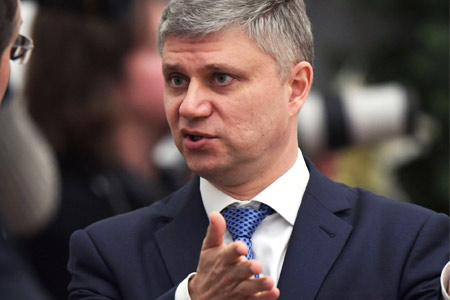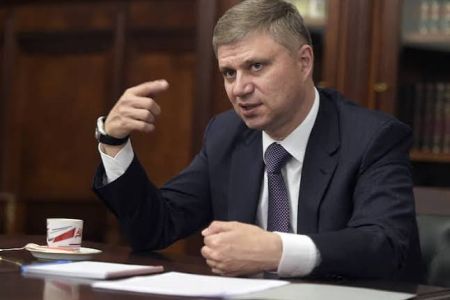


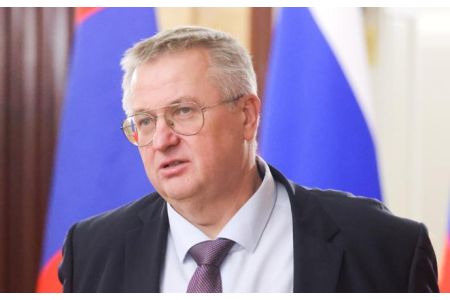
ArmInfo. Moscow and Yerevan share a common interest in unblocking transport links in the South Caucasus, Russian Deputy Prime Minister Alexey Overchuk stated.
"For Moscow, the road through Meghri is an opportunity to improve transport links with another EAEU member state, Armenia, as well as improve access to the Iranian and Turkish markets. For Tehran, it is a competing route and a threat from the United States. For Ankara, it is the most convenient access to Azerbaijan and the Central Asian states. For Yerevan, the Meghri section is an opportunity to unblock the country, realize the advantages of its geographic location, and give additional impetus to its economic development. Our interests and those of Armenia coincide in this," he stated in an interview with TASS.
Overchuk emphasized that the Russian side supports the process of unblocking Armenia, recalling Russia's active mediation in the trilateral working group at the deputy prime minister level. He also expressed his conviction that unblocking Armenia is essential for the development of the entire South Caucasus, and that only Russia's presence in this process can ensure a balance of interests.
"It's important to understand that unblocking Armenia, opening convenient transport links between the two parts of Azerbaijan, and restoring the Meghri section are essential for the peaceful development of the entire South Caucasus. Without this road, there will be no peace there, but it can only be built taking into account the balance of interests of all countries in the region, and only Russia's presence can ensure this," he noted.
"If we set aside the factor of close relations between Azerbaijan and Turkey, which, of course, cannot be done, then the only thing that could direct the flow of goods through Armenia is competition," Overchuk continued. According to him, this requires convenient and low tariffs, service, and fast border crossings, and then there might be a chance that people will travel there. "But competition is a separate issue," the Russian official asserted.
According to the Deputy Prime Minister, in addition to Turkish railways, Armenian railways will be in constant direct competition with the existing Baku-Tbilisi-Kars railway, which is being modernized. "In Iran, construction of a modern highway parallel to the Trump Route is nearing completion. Furthermore, the construction of a railway that would run from Azerbaijan to Nakhchivan through Iranian territory, parallel to the Meghri section, is being considered," he added.
"According to international experts, Chinese and Russian cargo will likely travel through Iran rather than through the US-controlled section of Armenian territory, meaning that the main cargo flow will most likely not enter Armenia at all, even for these 42 kilometers," Overchuk emphasized.
On January 14, the Armenian Foreign Ministry published a framework document signed with the American side in Washington on the implementation of the Trump Route for International Peace and Prosperity (TRIPP). The 12-page document outlines the project's main goals and operating mechanisms. Among other things, the document emphasizes Armenia's intention to authorize and support the creation of the TRIPP Development Company. The company is expected to be responsible for developing the TRIPP project receiving an initial development right for a period of 49 years. Armenia intends to offer the United States a 74% stake in the TRIPP Development Company, retaining 26%. This partnership is expected to be extended for another 50 years, with an additional ownership stake granted to the Armenian government, bringing its stake to 49%.
As a reminder, on August 8, 2025, Armenian Prime Minister Nikol Pashinyan and Azerbaijani President Ilham Aliyev signed a seven-point joint "Declaration of Peace" in Washington. It provides for a joint appeal to the Organization for Security and Cooperation in Europe (OSCE) to terminate the OSCE Minsk Process and related structures, as well as the creation of a transport corridor through Armenian territory that will connect Azerbaijan with its Nakhchivan exclave, surrounded by Armenia, Turkey, and Iran.