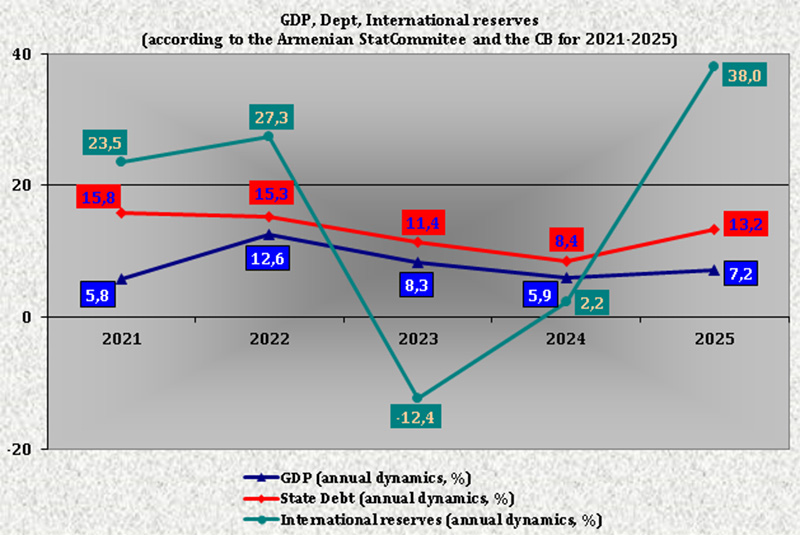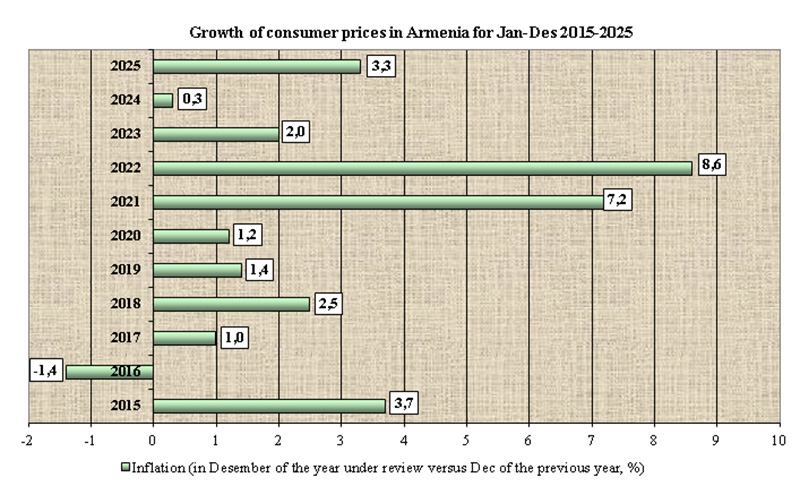


ArmInfo. In Armenia, economic activity growth accelerated to 7.4% per annum in January-February 2026 (from 4.1% in the same period of 2025). Moreover, the industrial sector once again became one of the growth drivers, compared to a double-digit decline the previous year.
According to the final data from the RA Statistics Committee, this was accompanied by an improvement in foreign trade, with a significant decline returning to moderate growth. According to statistics, the acceleration of economic activity in January-February 2026 was largely due to an improvement in the annual growth rate of the industrial sector, from a 19.4% decline to 17.2% growth, and an even faster acceleration in the construction sector, from 12.2% to 20.5%. At the same time, annual growth in the energy sector slowed, from 8.8% to 7.5%, while annual growth in trade continued to slow, from 7.8% to 3.3%, and in services, from 12.4% to 7.2%. The agricultural sector's performance is not included in this statistical report.
According to statistics for January-February 2026, the trade sector retains the lead in absolute terms, with a volume of 892.2 billion drams ($2.4 billion). The service sector ranks second in terms of volume at 630.3 billion drams ($1.7 billion), followed by the industrial sector at 491.5 billion drams ($1.3 billion), and the construction sector at 53.95 billion drams ($142.4 million), due to the lack of data from the agricultural sector. Electricity generation in January-February 2026 amounted to 1,921 million kWh, of which 835.3 million kWh was generated in February alone. Meanwhile, in February 2026, compared to February 2025, economic activity also accelerated, growing by 7.2% (from 1.5% a year earlier), and in February alone, growth accelerated from a 48.3% decline to 4.5% (compared to a 5.3% decline in February 2025). Moreover, the industrial sector's growth improved in February 2026, rising from a 56.7% decline to 12.2% growth, compared to a decline recorded in the same month a year earlier, from 41.3% to 0.6%. In addition to the industrial sector, February also saw growth in trade and construction, while a slowdown in the services sector and a decline in electricity generation were observed.
On an annual basis (February 2026 to February 2025), all sectors demonstrated an upward trend, except for the energy sector, which experienced a decline (3.7%). Specifically, the industrial and construction sectors demonstrated the highest annual growth rates - 23.8% and 21.8%, respectively, followed by the services and trade sectors - 7% and 5.6%, respectively. A year earlier, in February 2025 to February 2024, almost all sectors, except for the industrial sector, which experienced a decline (26.6%), demonstrated growth: construction - by 12.7%, services - by 12.1%, energy - by 7.3%, and trade - by 6%.
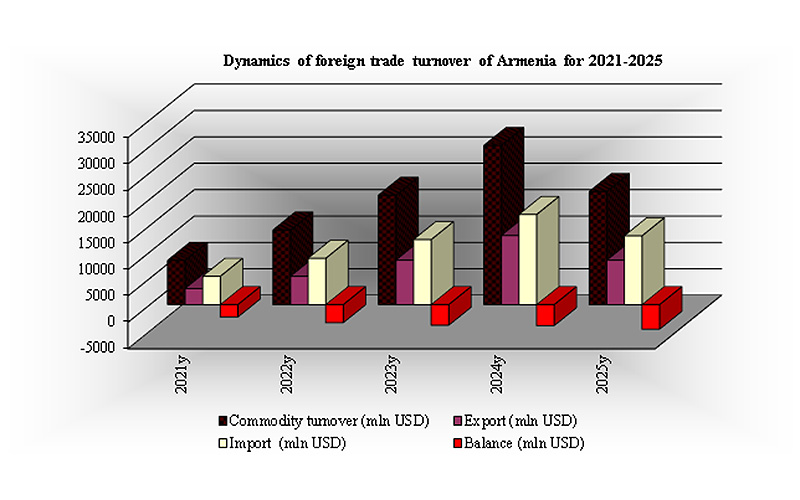
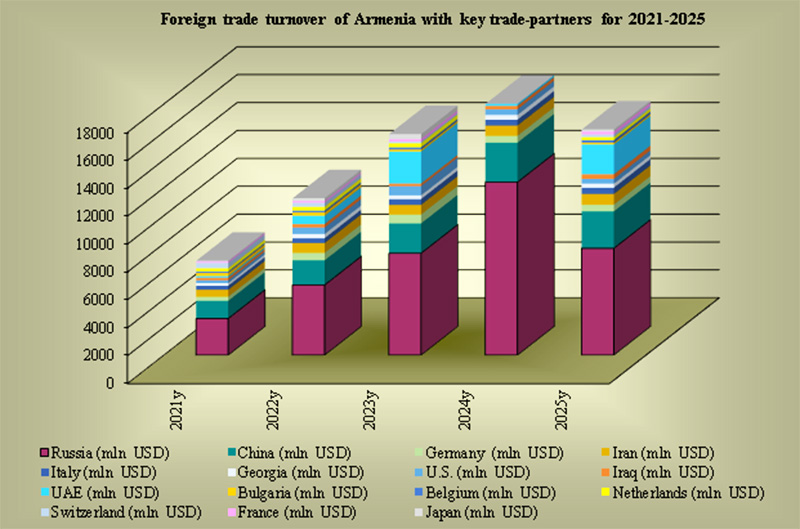
Against this backdrop, Armenia's foreign trade turnover in January-February 2026 amounted to 1.2 trillion. AMD ($3.1 billion), an increase of 9.3% year-on-year (versus a 52% decline a year ago). This is due to the growth of both exports and imports, up 12.6% and 7.3% year-on-year, respectively (compared to declines of 59.7% and 45.8% a year ago). As a result, the absolute value of exports amounted to AMD 442.5 billion ($1.2 billion), and imports to AMD 717.6 billion ($1.9 billion). In February 2026, compared to February 2025, foreign trade turnover increased by 30.8%, driven by a 37.6% increase in exports and a 26.9% increase in imports. A year earlier, in February 2025, compared to February 2024, foreign trade turnover fell by 61% due to a significant decline in exports by 67.7% and imports by 55.2%.
It should be noted that, starting in 2023, the methodology for calculating electricity generation volumes in statistical reports has changed; in particular, the volume of electricity generated by autonomous generators has now been included. For the agricultural sector, data is published only in quarterly and annual statistical reports. (The average dram exchange rate in January-February 2025 was 378.76 drams per US dollar.)