ArmInfo.Armenia's foreign trade turnover in January-February 2026 increased by 9.3% year-on-year, recovering from a 52% decline in the same period last year.
The growth was driven by the dominant export item, mineral products, and one of the leading import items, processed food products. This is evidenced by data from the Statistical Committee of the Republic of Armenia, according to which the annual dynamics of both exports and imports improved, recovering from a 59.7-45.8% decline to a 12.6-7.3% increase.
Specifically, mineral products were exported in January-February of this year for $273.6 million, with the annual dynamics shifting from a 14.9% decline to a significant 2.1-fold increase. Finished food products were imported for $154.7 million, accelerating growth from 28% to 56.4%. The share of mineral products in exports increased from 12% to 23.4% over the year, while the share of finished food products in imports changed less significantly-from 5.6% to 8.2%.
Machinery/mechanism/equipment also retained its leading position in imports, amounting to $482.7 million. Exports of these products reached $215.6 million during the reporting period, with an improvement in annual growth from an 18.6% decline to 6.5% growth. Moreover, machinery/mechanism/equipment ranks third in exports by volume, following mineral products and precious metals/stones. As for precious metals and stones, which dominated foreign trade just two years ago, the neutralization of their impact since 2025 (imports of gold and diamonds from Russia and their re-export to the UAE) has led to a monthly decline in export and import volumes. In January-February 2026, the share of precious metals and stones in both exports and imports declined to 23% and 10%, respectively (from 70% and 48% in the same period of 2024), with a two-year decline in volumes of 7-10 times to 2023 levels. Nevertheless, precious metals and stones rank second in overall exports, with a value of $267.1 million, while they fell to fourth in imports, with a value of $180.4 million.
Overall, exports for January-February 2026 reached $1.2 billion, while imports reached $1.9 billion, bringing foreign trade turnover to $3.1 billion.
IN the country breakdown, a decline in foreign trade turnover was recorded for Russia, the leader (down 17.4%), and the UAE, in third place (down 40.9%). China, on the other hand, reversed a double-digit decline to 18.4% growth. In particular, in the direction of the Russian Federation, both imports (by 25.3%) and exports (by 8%) fell, and in the direction of the UAE, a decline in exports by 41.9% and imports by 25.3% was also noted, while in the direction of China, a 2.4-fold jump in exports was accompanied by a decline in imports by 6.9%.
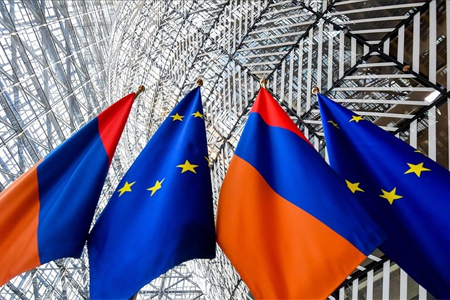
Foreign trade turnover between Armenia and the EU achieved an impressive 61.6% growth (from a 7.5% decline a year ago), amounting to $482.3 million in January-February 2026. This was due to improved annual dynamics and exports, which increased from a 12.7-5.7% decline to an impressive 87.8-53% growth, reaching $139.1 million and $343.3 million, respectively.
At the same time, foreign trade turnover between Armenia and the EAEU remained in decline, with annual rates slowing from 61.5% to 14.7%, amounting to $877.6 million in January-February 2026. This is the result of still sagging imports and exports, with rates slowing from 74.5-12.7% to 22.6-5.7%, the volumes of which amounted to $139.1 million and $343.3 million, respectively. $424.6 million and $453 million.
It should be noted that, according to the Central Bank of Armenia's updated forecast in March, 2026, exports from Armenia will increase by 25.5-28.5%, while imports will increase to 36.7-34.9%. The Central Bank expects this growth trend to continue in 2027, but at a slightly slower pace: exports to 16-19% and imports to 11-14.3%. In its December forecast for 2026, the International Monetary Fund projected more modest growth rates for exports and imports at 2.2% and 2.1%, respectively, with further acceleration in 2027 to 3.4% and 3.7%.