

ArmInfo. In Armenia, economic activity growth accelerated to 7.1% annually in January-March 2026 (from 4.1% in the same period of 2025), driven by the construction and industrial sectors. According to the final data from the RA Statistics Committee, this was accompanied by an improvement in foreign trade dynamics, with a transition from a significant decline to moderate growth.
According to statistics, the acceleration in economic activity in January-March 2026 was largely due to an improvement in the annual dynamics of the industrial sector, from an 18.5% decline to 13.4% growth, and an even faster acceleration in the construction sector, from 13.6% to 22%. Annual growth in the energy sector also accelerated, from 6.5% to 7.3%. Meanwhile, annual growth in trade continued to slow, from 6% to 2.1%, a trend also observed in services, which declined from 11.5% to 7.4%. In the agricultural sector, annual growth worsened, reversing from 10.5% growth to a 5.2% decline.
According to statistics for January-March 2026, the trade sector remains the largest sector in absolute terms, with a volume of 1.4 trillion drams ($3.8 billion). Second place by volume goes to the services sector, with 981.7 billion drams ($2.6 billion), followed by the industrial sector, with 748 billion drams ($1.98 billion), the agricultural sector, with 96.4 billion drams ($254.7 million), and the construction sector, with 95.6 billion drams ($252.8 million). Electricity generation in January-March 2026 amounted to 2,817.6 million kWh, of which 896.6 million kWh occurred in March alone.
At the same time, economic activity also accelerated from March 2026 to March 2025, reaching 6.6% (from 3.7% a year earlier), and in March alone, growth accelerated from 4.6% to 11.6% (as compared to 5.8% to 11.9% a year earlier). Moreover, industrial sector performance worsened in March 2026, reversing from 12.2% growth to a 2% decline, while a year earlier, the same month, the same period, saw a 15.9% growth rate, up from a 0.9% decline. Other sectors demonstrated growth in March, with the highest double- digit growth in construction (34.4%, slowing), followed by trade (14.1%, slowing), services (12.6%, recovering from the downturn), and energy (7.3%, recovering from the downturn).
On a year-over-year basis (March 2026 vs. March 2025), all sectors demonstrated an upward trend. Specifically, the construction sector demonstrated the highest annual growth rate at 24%, followed by services (7.8%), industrial production (7%), energy (6.9%), and trade (0.2%). A year earlier, in March 2025 compared to March 2024, almost all sectors, except for the industrial sector, which experienced a decline (16.9%), showed growth: the construction sector - by 15.5%, the service sector - by 10.1%, the trade sector - by 3.2% and the energy complex - by 2.1%.
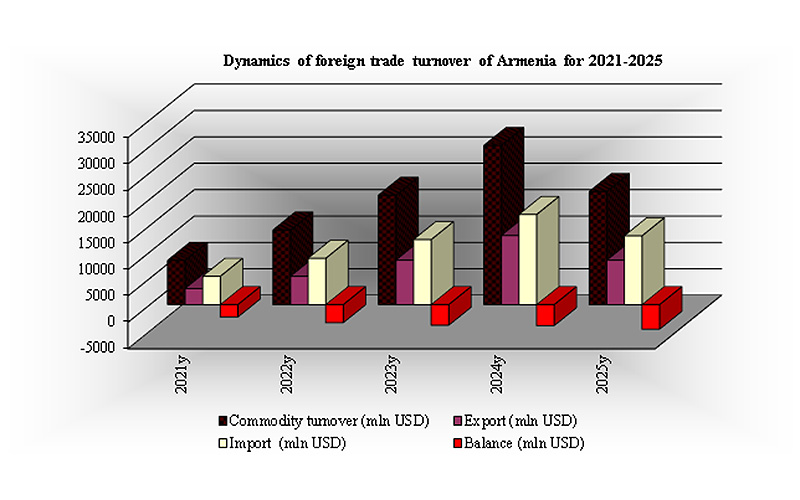
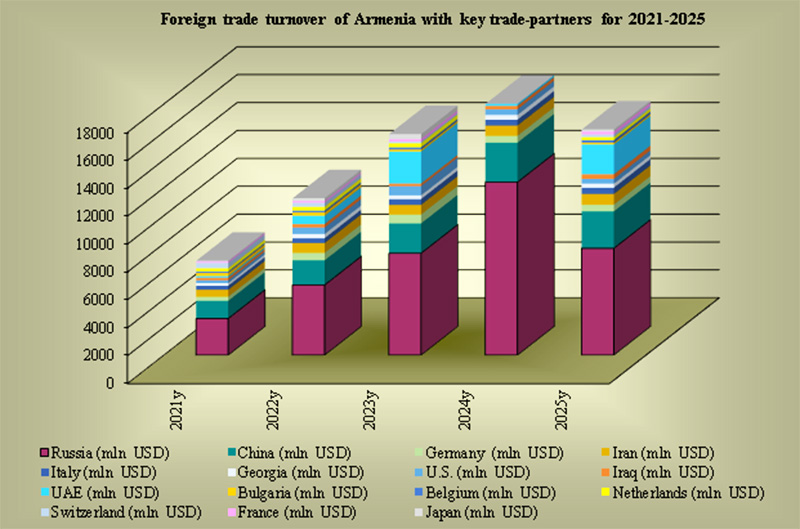
Against this backdrop, Armenia's foreign trade turnover in January-March 2026 amounted to 1.8 trillion drams ($4.7 billion), an increase of 4.6% year-on-year (compared to a 54.2% decline a year ago). This is due to both export and import growth of 4.5% and 4.6% year-on-year, respectively (compared to declines of 61.8% and 47.9% a year ago). As a result, the absolute value of exports amounted to 665.7 billion drams ($1.8 billion), and imports to 1.1 trillion drams ($2.9 billion). In March 2026, compared to March 2025, foreign trade turnover decreased by 6.8% due to a decline in both exports (12.6%) and imports (3.2%). This was a more significant decline compared to March 2024, when foreign trade turnover fell by 31.8% due to a significant decline in exports (65.4%) and imports (51.2%).
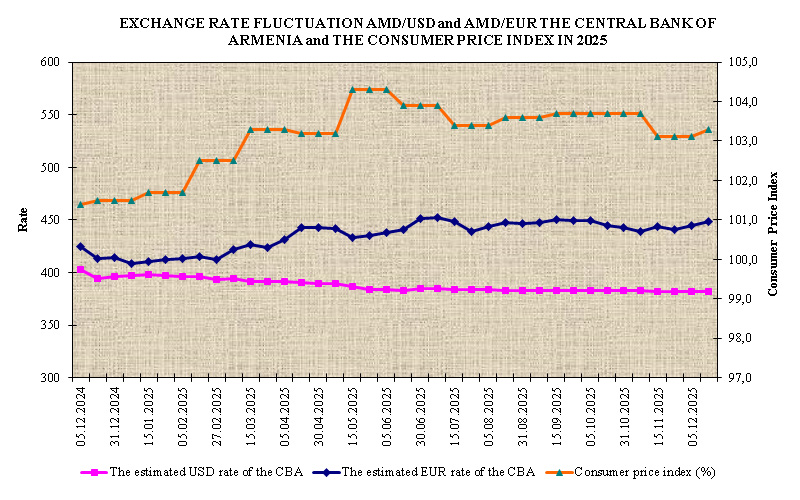
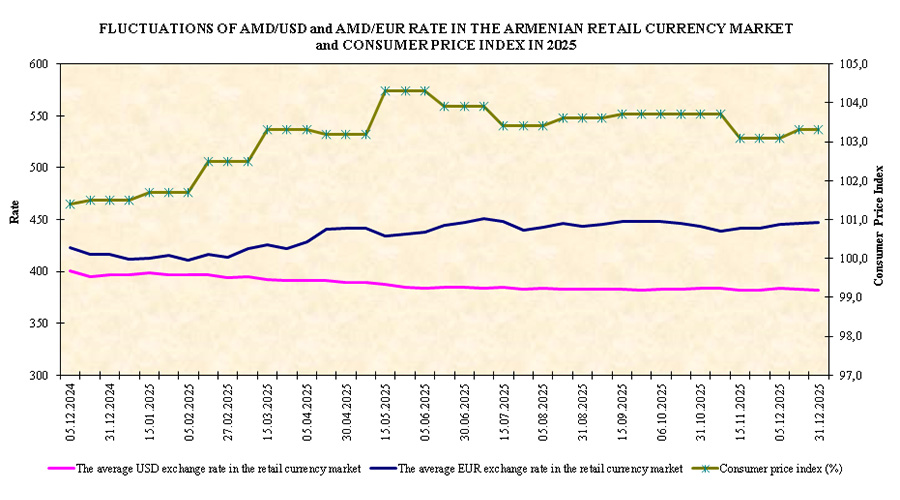
It should be noted that, starting in 2023, the methodology for calculating electricity generation volumes in statistical reports has changed, specifically including electricity generated by independent generators. For the agricultural sector, data is published only in quarterly and annual statistical reports. (The average exchange rate of the dram in the first quarter of 2026 was 378.30 drams/$1, compared to 395.42 drams/$1 in the first quarter of 2025).