

ArmInfo.The Executive Board of the International Monetary Fund (IMF) completed the first review under the Stand-By Arrangement (SBA) with Armenia.
The completion of the review enables access to an amount equivalent to SDR 18.4 million (about US$25.1 million), bringing total access to SDR 36.8 million (about US$50.2 million). The SBA was approved by the IMF's Board on December 1, 2025 (see Press Release No. 25/403). The Armenian authorities continue to treat the arrangement as precautionary. The Executive Board's decision was taken on a lapse-of-time basis.
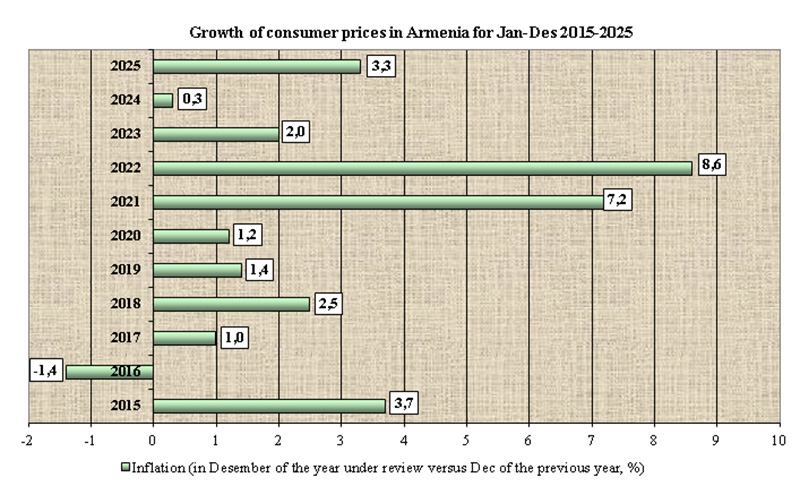
Armenia's economic activity remains strong. Real GDP growth is expected to decelerate to around 5? percent in 2026 as domestic demand softens and some trade disruptions from the war in the Middle East materialize. Inflation is expected to remain elevated in the near term on the back of commodity price increases and increased logistics costs from trade re-routing, but return to Central Bank of Armenia's (CBA) target over the projection horizon. Short-term risks to the outlook stem from the unprecedented uncertainty related to the war in the Middle East. Over the medium term, a potential slowdown in the growth of trading partners and tighter global financial conditions could affect Armenia. However, external and financial sector buffers remain strong.
Strong fiscal performance is anticipated to continue in 2026. A sizable revenue overperformance is expected compared to the 2026 budget, supported by strong economic activity, tax policy measures, and ongoing revenue administration improvements. The authorities plan to save revenue overperformance to contain demand and strengthen buffers, aiming for a budget deficit of 4.0 percent (down from 4.5 percent of GDP in the 2026 budget), which is appropriate.
The program is broadly on track. All end-December quantitative performance criteria (QPCs) were met. Inflation was within the MPCC inner band for the December 2025 test date, but slightly exceeded the indicative inner upper band for March 2026 test date. Progress continues on structural benchmarks, although with some delays.
The ongoing economic uncertainty underscores the need for continuing efforts to build resilience and improve prospects for future growth:
Fiscal policy should continue to balance spending priorities and fiscal sustainability. Careful expenditure prioritization and improvement in spending efficiency alongside tax policy reforms and strengthened revenue administration are required to create fiscal space to meet spending pressures while maintaining debt at a moderate level.
The central bank should continue to monitor economic developments, inflation dynamics, and inflation expectations closely and stand ready to adjust policy rates as needed to bring inflation back to target. The flexible exchange rate should continue to serve as a key shock absorber, with foreign exchange interventions limited to addressing disorderly market conditions.
To sustain long-term growth, planned structural reforms to encourage diversification in the country's export basket and markets, improve the business environment and corporate transparency, and enhance access to finance are welcome.
The Central Bank of Armenia, in its March forecast, predicted GDP growth of 7.1-4.7% for 2026 and then 5.7-5.3% in 2027. The World Bank (WB), updating its forecast in April, expects Armenia's GDP growth in 2026 to be 5.3%, slowing to 5.1% in 2027. The European Bank for Reconstruction and Development (EBRD), updating its forecast in early June, expects the same 5.5% GDP growth for Armenia in 2026 and 2027. Fitch Ratings, in its forecast updated in January of this year, expects sustainable economic growth prospects for Armenia - above 5% in 2026-2027. S&P Global Ratings, in its February update, The forecast predicted a slowdown in Armenia's GDP growth in 2026 to 5.3% and then to 4.8% in 2027, after which the rate would accelerate slightly to 5% in 2028. In its April forecast, the Asian Development Bank (ADB) predicted GDP growth of 5.5% for Armenia in 2026, accelerating to 5.7% in 2027. Armenia's draft state budget for 2026 projects GDP growth of 5.4%, reaching 11.9 trillion drams (over $32.2 billion).
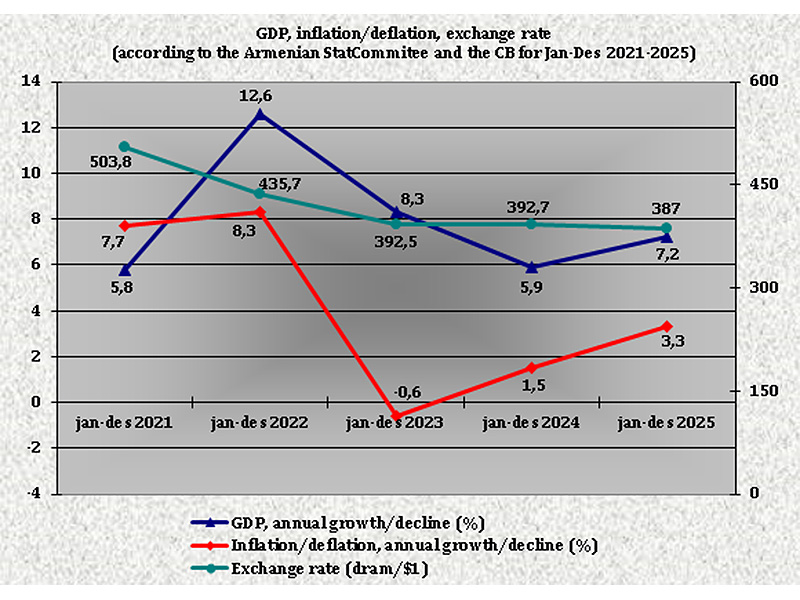
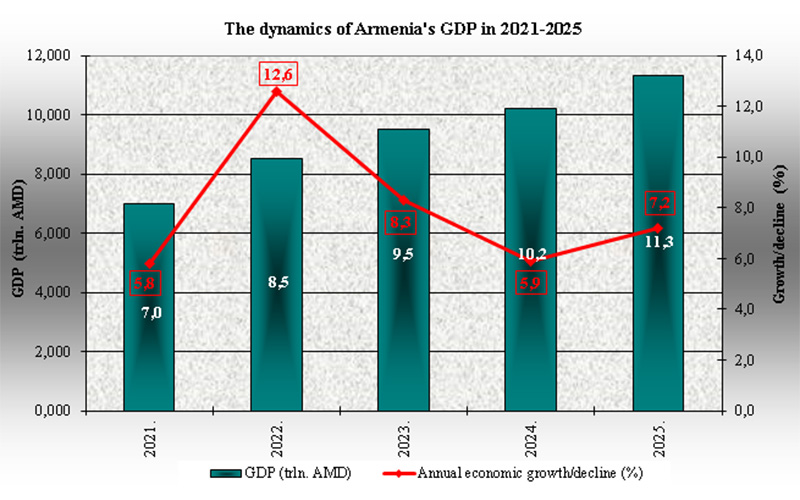
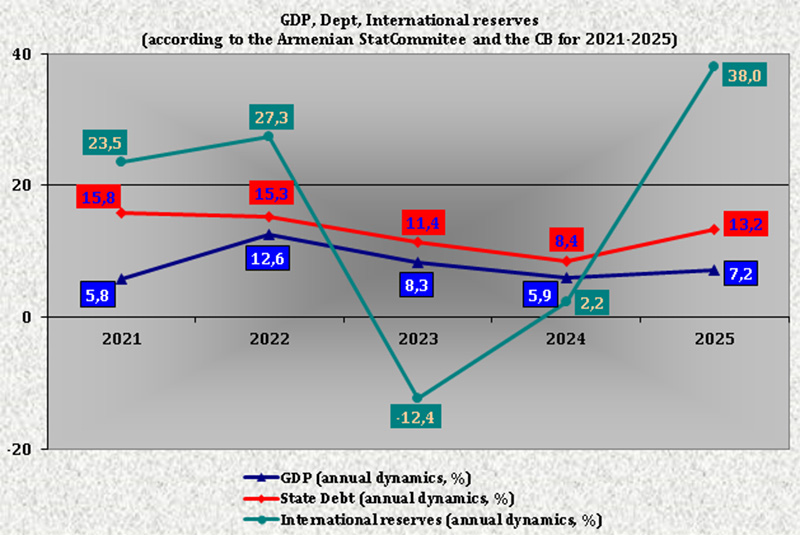
According to the Statistical Committee of the Republic of Armenia, Armenia's GDP growth, after accelerating from 5.8% to 12.6% in 2022, began to slow down in 2023 to 8.3% and then to 5.9% in 2024. However, in 2025, the growth rate again accelerated to 7.1%. In absolute terms, Armenia's GDP in 2025 exceeded 11.3 trillion drams (over $29.2 billion). The GDP deflator index also, after growing from 106.9% to 108% in 2022, began to decline in 2023 - to 103.1% and further to 101.4% in 2024, but in 2025 it again increased to 103.4%.