


ArmInfo.The International Monetary Fund (IMF) has maintained its GDP growth forecast for Armenia for 2026 and 2027, initially projecting a slowdown to 5.3% (from 7.1% in 2025), but then an acceleration to 5.5%. This is noted in the IMF report, which also provides a forecast for the GDP deflator index, which will decline to 103.2% in 2026 (from 103.6% in 2025) and then continue to move downward to 103% in 2027.
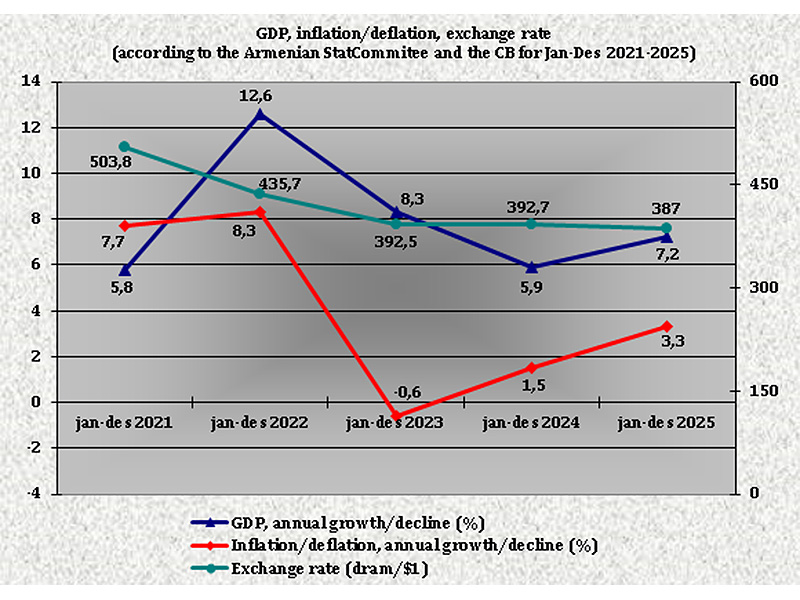
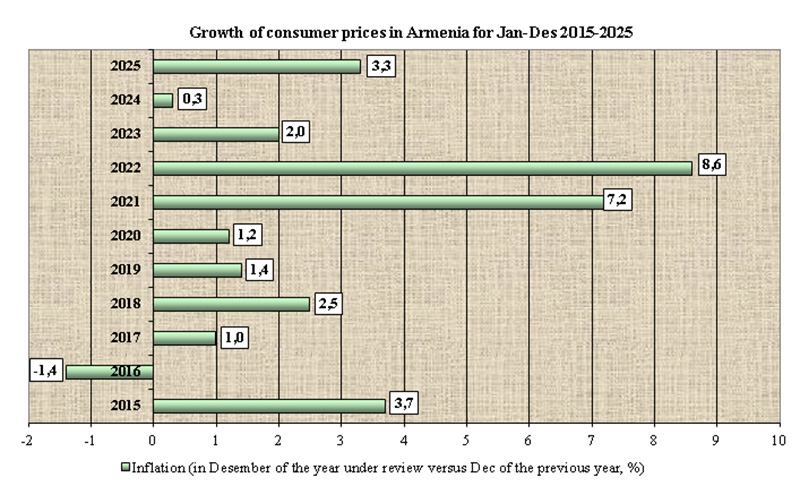
According to IMF's new forecast, inflation in Armenia will accelerate more noticeably in 2026 – to 4.2% (from 3.3% in 2025), but then retreat to 3.6% in 2027 (against the target of 3%, +/- 1 percentage point). The IMF also maintained its forecast for the unemployment rate in Armenia, expecting a decline in 2026 to 12.8% (from 13% in 2025) and then to 12.7% in 2027. In its updated forecast, the IMF indicated a much more modest improvement in Armenia's export and import dynamics in 2026, expecting a recovery from the double-digit recession to a very weak and almost flat growth of 0.9-0.7% (versus the previously projected 2.2-2.1%). However, the IMF significantly improved its forecast for export and import growth for 2027, to 5.5-6.3% (versus the previously projected 3.4-3.7%). The IMF expects the current account deficit to GDP ratio, after growing from 4.6% in 2024 to 7.2% in 2025, to decline to 6.3% and 5.6% in 2026 and 2027, respectively. The IMF forecasts that the share of investment in GDP will continue to grow: to 24.6% in 2026 (from 24.2% in 2025) and then to 25.8% in 2027.
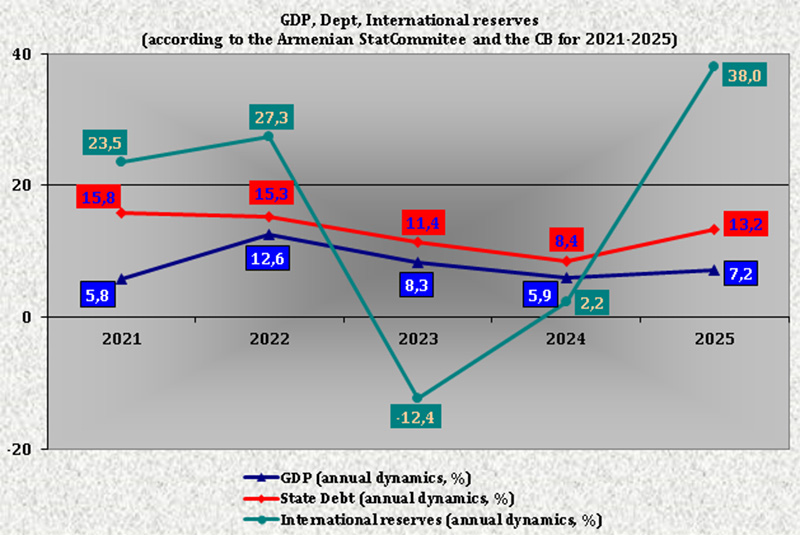
According to the IMF forecast, the government revenue/GDP ratio will increase slightly in 2026-2027, to 25.6-25.7% (from 25.5% in 2025). Meanwhile, the government expenditure/GDP ratio will increase more significantly, initially in 2026, to 29.6% of GDP (from 29.2% of GDP in 2025), before declining to 29% in 2027. As a result, the state budget deficit will increase to 4% of GDP in 2026 (from 3.7% of GDP in 2025), but will then decline to 3.3% of GDP in 2027. The government's public debt, after declining from 48% to 47.3% of GDP in 2025, will increase to 48.7% of GDP in 2026 and then to 49.3% of GDP in 2027.
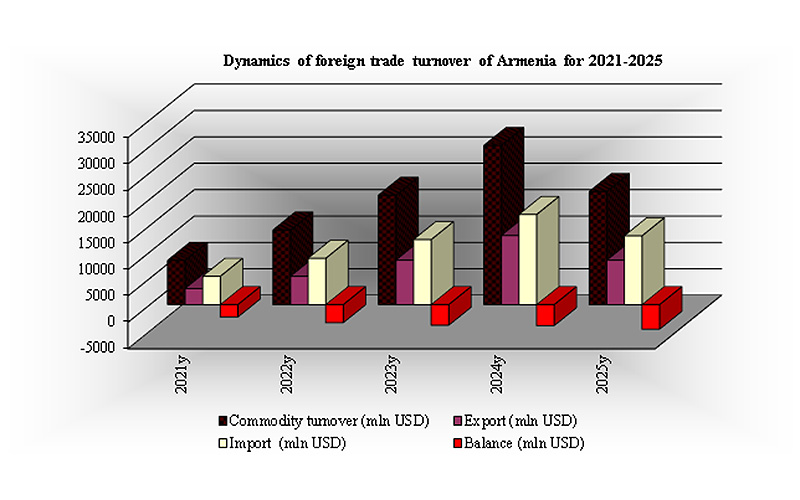
It should be noted that, according to the Central Bank of Armenia's forecast updated in March, 2026, the GDP growth in 2026 will be in the range of 7.1-4.7% and then 5.7-5.3% in 2027. Regarding foreign trade, the Central Bank forecasts an improvement in dynamics in 2026, with both exports growing to 25.5-28.5% and imports to 36.7-34.9% (following a decline of 30.5% for exports and 23.7% for imports). The Central Bank expects this growth trend to continue in 2027, but the rate will slow to 16-19% for exports and 11- 14.3% for imports.
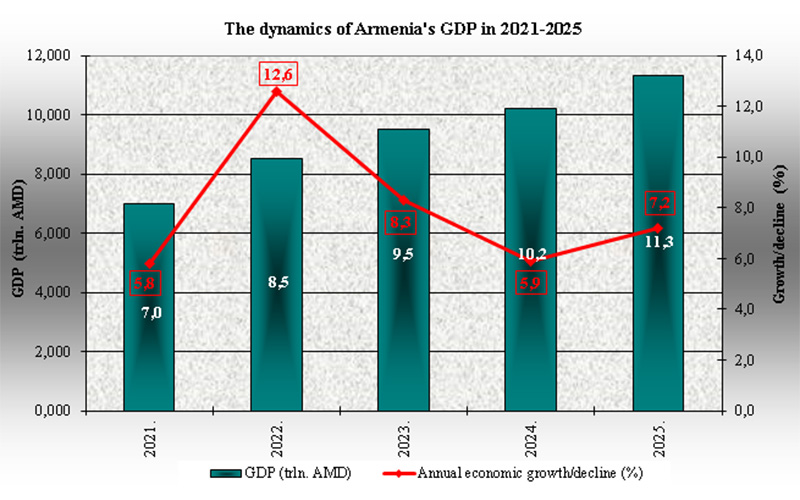
The World Bank (WB), updating its forecast in April, expects Armenia's GDP growth in 2026 to be 5.3%, slowing to 5.1% in 2027. The European Bank for Reconstruction and Development (EBRD), updating its forecast in early June, expects Armenia's GDP growth to be the same at 5.5% in 2026 and 2027. In its January forecast, Fitch Ratings expects sustainable economic growth prospects for Armenia – above 5% in 2026-2027. In its February forecast, S&P Global Ratings predicted a slowdown in Armenia's GDP growth in 2026 to 5.3% and then to 4.8% in 2027, after which the rate will accelerate slightly to 5% in 2028. In its April forecast, the Asian Development Bank (ADB) predicted GDP growth of 5.5% for Armenia in 2026, accelerating to 5.7% in 2027. Armenia's draft state budget for 2026 projects GDP growth of 5.4% – to 11.9 trillion drams (over $32.2 billion).
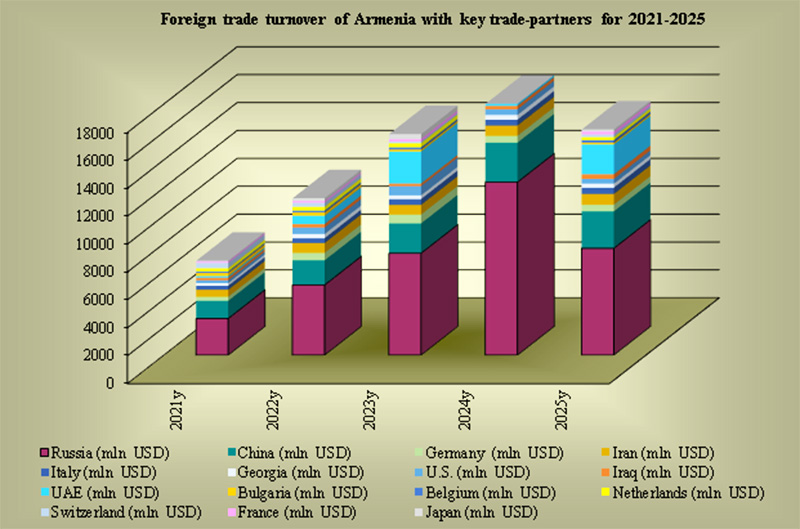
According to the Statistical Committee of the Republic of Armenia, Armenia's GDP growth, after accelerating from 5.8% to 12.6% in 2022, began to slow down in 2023 to 8.3% and then to 5.9% in 2024. However, in 2025, the growth rate again accelerated to 7.1%. In absolute terms, Armenia's GDP in 2025 exceeded 11.3 trillion drams (over $29.2 billion). The GDP deflator index also, after growing from 106.9% to 108% in 2022, began to decline in 2023 - to 103.1% and further to 101.4% in 2024, but in 2025 it again increased to 103.4%. Exports fell by 30.5% to 5.2 trillion drams ($13.5 billion) in 2025, while imports fell by 23.7% to 5.9 trillion drams ($15.4 billion), compared to double-digit growth of 35.6% to 31.4% in 2024. The total public debt to GDP ratio changed slightly in 2025, from 50% to 49%, as public debt growth accelerated more significantly from 8.4% to 13.2% than GDP growth, from 5.9% to 7.1%.