

ArmInfo. The World Bank (WB) has maintained its GDP growth forecast for Armenia for the 2026–2027 period at 5.3% and 5.1% respectively (compared to the actual growth rate of 7.1% recorded in 2025). This is outlined in the World Bank's flagship Global Economic Prospects report published on June 12, which highlights that Armenia's projected economic growth for 2026 is the highest in the South Caucasus.
According to the new World Bank forecast, GDP growth for Armenia's neighboring countries over the 2026–2027 period will be comparatively modest: Azerbaijan: 2.0% and 1.8% (compared to actual growth of 1.4% in 2025); Georgia: 5.0% and 5.5% (compared to actual growth of 7.5% in 2025) and Turkey: 2.8% and 3.7% (compared to actual growth of 3.6% in 2025).
Overall, economic growth in the Europe and Central Asia (ECA) region is projected to slow down to 2.1%– 2.3% in 2026–2027 (down from 2.5% in 2025). Excluding Russia and Turkey, growth in the ECA region is expected to remain relatively stable, decelerating to 2.8% in 2026 before accelerating to 3.1% by 2028. In Russia, the World Bank projects that economic growth will slow to a stagnant 0.8% and 0.7% in 2026– 2027 (following a sharp deceleration in 2025 from 4.9% to 1.0%). Similarly, in Belarus, the World Bank expects economic growth to decelerate to 1.1% and 0.8% in 2026–2027 (after a 2025 slowdown from 4.3% to 1.3%). Meanwhile, in Ukraine, GDP growth is projected at 1.2% in 2026 (following a 2025 slowdown from 3.2% to 1.8%), with a subsequent notable acceleration to 4.0% in 2027.
The report also notes that global economic growth will slow to 2.5% in 2026 (down from 2.9% in 2025) before picking up pace to 2.8% in 2027. United States: Growth will slightly accelerate to 2.2% in 2026 (up from 2.1% in 2025) before returning to 2.1% in 2027. Eurozone: Growth will slow to 0.8% in 2026 (down from 1.4% in 2025) before nearly recovering to 1.3% in 2027. China: Growth will decelerate to 4.2% in 2026 (down from 5.0% in 2025) before slightly accelerating to 4.3% in 2027.
The World Bank report notes that economic growth in the Europe and Central Asia (ECA) region slowed in 2025 amid weakening domestic demand, particularly in Russia, driven by reduced fiscal stimulus and tight monetary policy. Excluding Russia and Turkey, growth in the region accelerated slightly, reaching 3.4%, with Central Asia remaining the subregion with the highest growth rates. Data for early 2026 indicate a slowdown in growth in the ECA region amid a slight tightening of financial conditions following the outbreak of conflict in the Middle East, which put pressure on equity markets, sovereign spreads, and currencies. Disinflation has stalled, as inflation has accelerated again following conflict-induced energy price increases. In recent months, median headline inflation has exceeded 5%, remaining above pre- pandemic levels and central bank targets in most countries. Under these conditions, the scope for further monetary easing has narrowed. These changes point to a more challenging macroeconomic outlook.
Regarding the economic outlook for the ECA region, the World Bank forecasts a continued slowdown in 2026, with the weakening trend affecting around 70% of economies, before recovering to 2.4% by 2028. The World Bank expects the slowdown to have a negative impact on labor markets, constraining job creation in the short term amid persistent demographic pressures.
The baseline scenario assumes the most acute phase of commodity trade disruptions will end in July, with shipping volumes through the Strait of Hormuz recovering in the second half of the year, allowing energy supplies to gradually return to levels close to pre-conflict levels. Higher oil prices, coupled with increased trade and geopolitical uncertainty, have led to downward revisions to 2026 growth forecasts for most commodity-importing countries, offsetting the slight upward revisions for exporting countries. Most economies in the ECA region are net energy importers, and the World Bank expects them to face headwinds in 2026 from higher commodity prices. The World Bank expects economic growth in commodity exporters to slow in 2026 and remain subdued in 2027-2028, although higher commodity prices are projected to support export revenues for energy exporters (including Azerbaijan, Kazakhstan, and Turkmenistan) and metal exporters. The impact of the conflict in the Middle East on economic activity in Russia is expected to be limited.
Domestic demand, according to the World Bank, will remain the main driver of growth in the ECA region, although it will likely be constrained in 2026 by elevated energy prices, which are increasing inflation and reducing real incomes, as well as tighter financial conditions. As price pressures in commodity markets ease, a gradual recovery is projected. Net exports are expected to continue to weigh on economic growth amid a slowdown in the eurozone, before gradually strengthening in 2027-2028 as activity recovers. According to the World Bank's forecast, inflation will rise in 2026, driven by higher energy and food prices, before moderating in 2027-2028 as price pressures in commodity markets ease. The energy price pass-through to inflation is projected to be more pronounced in energy-importing countries with a high share of energy components in their consumer price indexes, such as Armenia, Georgia, and Serbia. Against this backdrop, monetary policy is expected to remain tight amid persistent inflationary pressures.
The World Bank expects fiscal policy in most ECA economies to be broadly supportive of economic growth in 2026-2028. According to World Bank forecasts, fiscal deficits will remain elevated amid ongoing spending pressures, including defense spending and temporary economic measures such as domestic subsidies and price controls designed to soften the blow of higher energy prices. Limited fiscal space will likely limit authorities' ability to absorb this shock. Upcoming elections in many countries add uncertainty to the fiscal outlook. Energy exporters stand out: higher hydrocarbon revenues are helping their fiscal consolidation efforts. Median government debt in the ECA region is projected to rise to approximately 40% of GDP by 2027.
According to the World Bank's forecast, the external balances of energy-importing countries will deteriorate in 2026, reflecting higher energy costs and weaker external demand, driven primarily by the slowdown in the eurozone. Higher energy prices are likely to have the greatest negative impact on Armenia, Georgia, Moldova, and Turkey, where net energy imports exceed 70% of domestic energy consumption. Economies with existing large current account deficits (Moldova, Montenegro, and Ukraine) remain particularly vulnerable to deteriorating terms of trade. Slower growth in the eurozone will likely dampen manufacturing exports, particularly in Central Europe and the Western Balkans. At the same time, the World Bank expects energy-exporting countries to record stronger current account positions. These external pressures, according to the World Bank, will ease in 2027-2028 amid lower commodity prices and a gradual recovery in the eurozone economy. External balances will also be impacted by tourism, remittances, and ongoing structural shifts in trade. Tourism growth is expected to slow compared to the post-pandemic recovery, while remittance inflows, which surged following the Russian invasion and supported consumption (especially in Central Asia), will stabilize amid weaker economic growth in Russia. The World Bank also expects the Border Carbon Adjustment Mechanism to gradually change the structure of trade in the Western Balkans, affecting the composition and competitiveness of carbon-intensive exports to the EU.
It is worth noting that, according to the Central Bank of Armenia's updated March forecast, GDP growth in 2026 is projected to range between 4.7% and 7.1%, before settling between 5.3% and 5.7% in 2027. International financial institutions mirror this optimistic outlook. Following a June update, the IMF expects Armenia's GDP to grow by 5.3% in 2026 and accelerate to 5.5% in 2027. The European Bank for Reconstruction and Development (EBRD) also updated its outlook in June, predicting a flat 5.5% expansion for both years.
Rating agencies remain similarly confident. Fitch Ratings forecasted in January that Armenia will maintain sustainable growth above 5% through 2026–2027. Conversely, S&P Global Ratings predicted a minor deceleration in February, forecasting 5.3% growth in 2026 and 4.8% in 2027, followed by a slight rebound to 5% in 2028. Meanwhile, the Asian Development Bank (ADB) projected 5.5% growth in 2026, rising to 5.7% in 2027. Domestically, Armenia's 2026 draft state budget targets a growth rate of 5.4%, aiming for a nominal GDP of 11.9 trillion drams (approximately $32.2 billion).
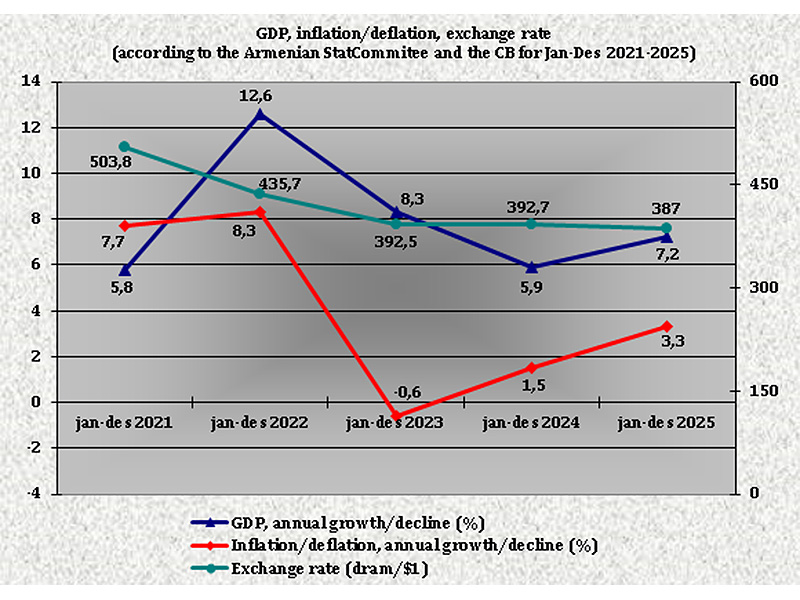
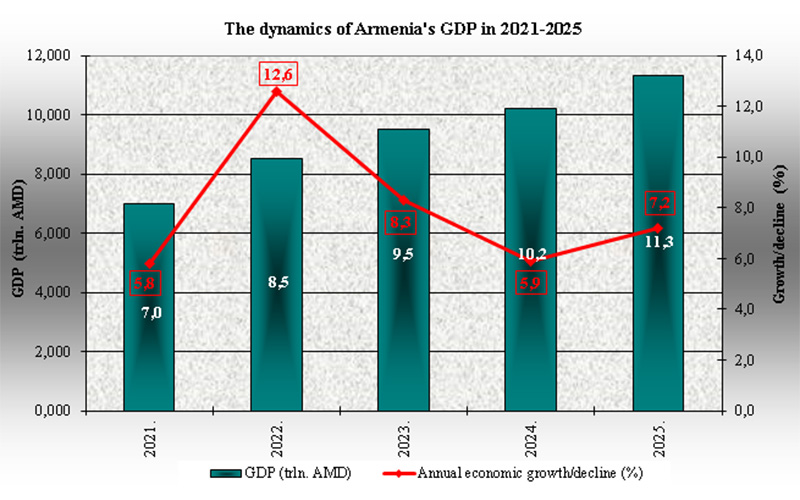
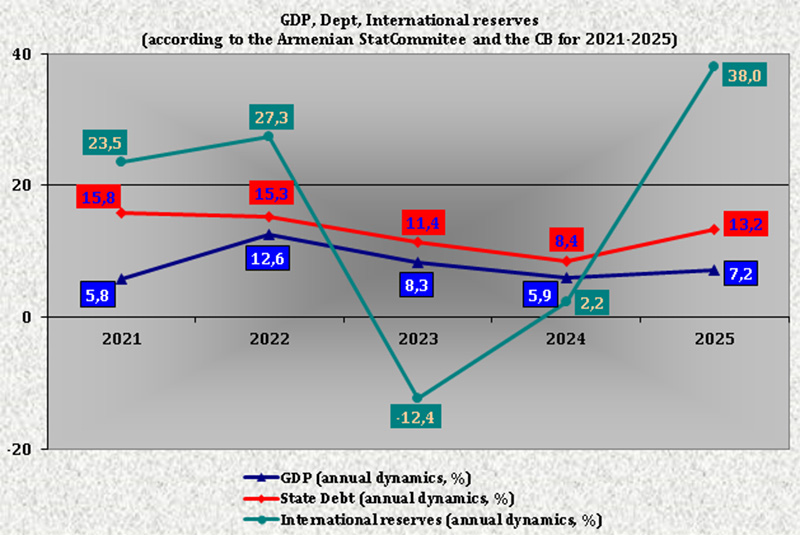
According to the RA Statistics Committee, Armenia's GDP growth, after accelerating from 5.8% to 12.6% in 2022, began to slow in 2023 to 8.3% and then to 5.9% in 2024. However, in 2025, the rate accelerated again to 7.1%. In absolute terms, Armenia's GDP in 2025 exceeded 11.3 trillion drams (over $29.2 billion).