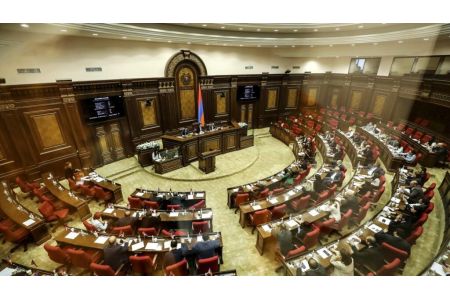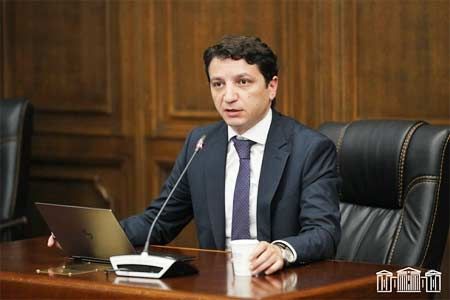
ArmInfo. In recent years, there has been a steady growth trend in financial services exports from Armenia. This was stated by RA Minister of Finance Vahe Hovhannisyan on June 16, while presenting the country's 2025 state budget implementation in the National Assembly.
According to the minister, financial services primarily refer to services provided to non-residents, primarily by the banking sector and investment companies. This, as the head of the Ministry of Finance noted, is the first sign of the emergence of a developed financial system, which could become a reality in terms of the provision of financial services in the region. This sector has seen rapid growth - from 0.3% in 2021 to 2.1% currently, a significant increase.
Vahe Hovhannisyan also touched on the price index, noting that compared to countries in the region and even many European countries, this indicator is in a better position in Armenia. In particular, the distribution of financial resources among various social strata is very good. While the minister noted that the price index results will be published in November, this indicator has remained virtually unchanged in 2024 compared to 2023, which is reflected in tax collection and the more efficient implementation of state treasury expenditure allocation functions.
Responding to a question from members of the National Assembly about whether artificial intelligence will impact the country's economic development, the minister responded positively, despite concerns about job security. At the same time, Vahe Hovhannisyan pointed to the potential of AI to create new jobs. The impact of AI on economic growth could range from 0.8% to 1%.
As a reminder, Armenia's 2025 state budget execution resulted in revenues of 2 trillion 886.5 billion drams (a 101.3% execution rate) and expenditures of approximately 3.3 trillion drams. The budget deficit was recorded at 3.7% of GDP. Economic growth was 7.2%, and tax revenues exceeded 2.7 trillion drams. Revenues totaled 2 trillion 886.5 billion drams (an increase of approximately 12% compared to 2024), while tax revenues and state duties totaled 2 trillion 725 billion drams. Expenditures under the main economic law amounted to 3.3 trillion drams. Significant funds were allocated to infrastructure development and the social sphere. For example, the Ministry of Labor and Social Affairs' actual expenditures amounted to 874.1 billion drams. Capital expenditures reached 6.2% of GDP, exceeding the budget deficit by 283.8 billion drams.